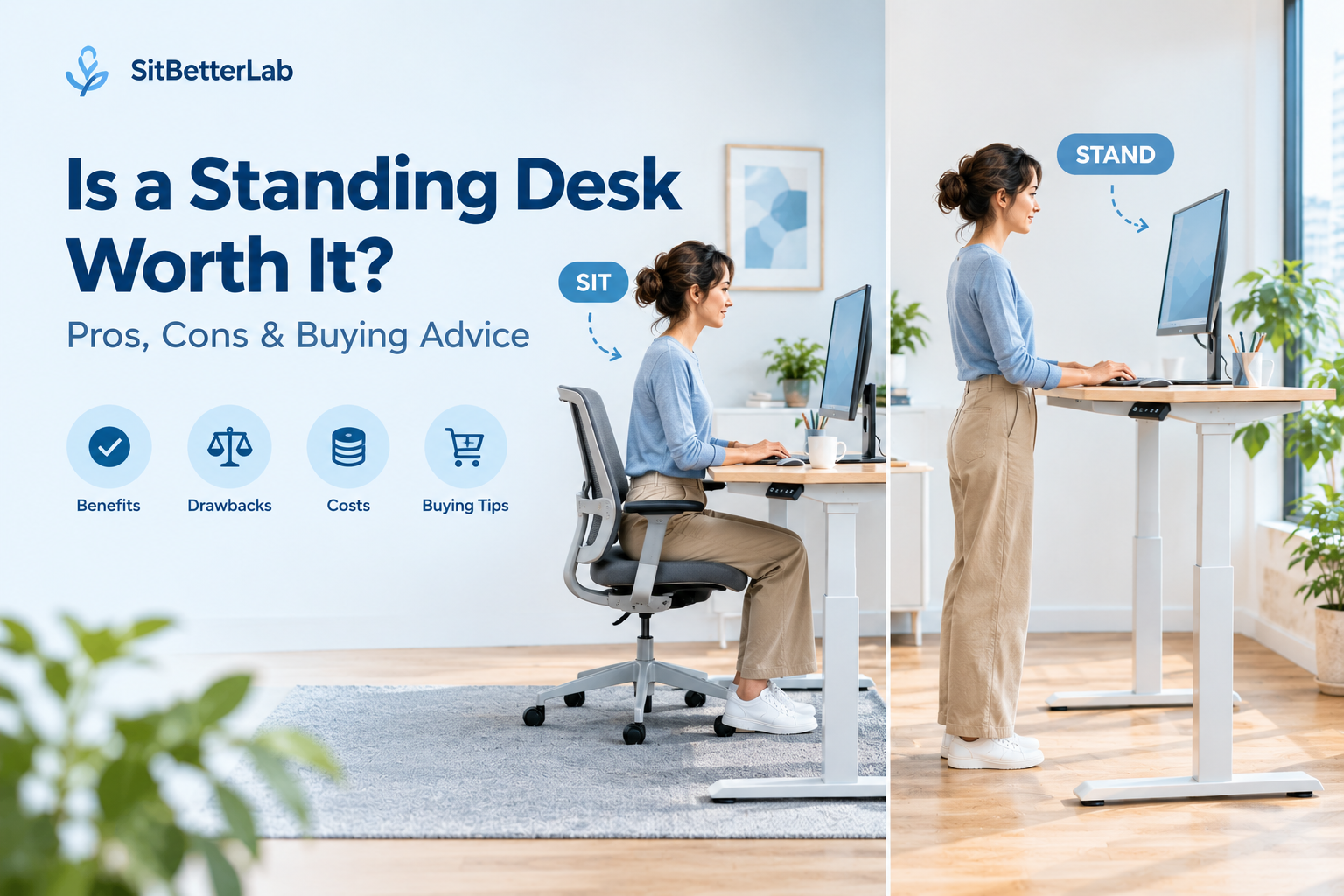
Standing Desk Buying Guide
Is a standing desk worth the investment? For many people who work at a computer for hours, an adjustable desk can make it easier to alternate between sitting and standing. However, it is not a magic solution for back pain, inactivity, or poor posture.
The real value depends on your work habits, budget, desk setup, and willingness to change positions throughout the day. This guide explains the main benefits, drawbacks, costs, and alternatives so you can decide whether a standing desk makes sense for your workspace.
Quick Answer: Is a Standing Desk Worth It?
A standing desk is generally worth considering if you spend much of your day at a computer and want more flexibility to change positions without interrupting your work.
- Worth it for: people who sit for long periods, want a more flexible workstation, or need a desk that adjusts to different working positions.
- Less worthwhile for: people who rarely work at a desk, already move frequently, or would not use the standing function.
- Important limitation: standing all day is not the goal. Alternating between sitting, standing, and moving is a more practical approach.
- Best value: a stable adjustable desk that fits your height, equipment, room, and budget.
Related guide: New to adjustable desks? Start with What Is a Standing Desk? Benefits, Types & How It Works, or browse our Standing Desk Buying Guide for more buying advice.
What Makes a Standing Desk Worth Buying?
A standing desk is an adjustable workstation that lets you work while seated or standing. Electric models use a motor to raise and lower the desktop, while manual crank and pneumatic models use different adjustment mechanisms.
The biggest advantage is flexibility. Instead of being locked into one desk height for the entire workday, you can change your working position as needed. Whether that flexibility justifies the price depends on how often you use it and whether it helps you build better movement habits.
Before spending money, consider three questions:
- Do you spend several hours each day working at a computer?
- Would changing positions throughout the day be practical in your current workspace?
- Will you actually use the adjustment feature regularly?
If you answer yes to these questions, an adjustable desk may offer meaningful everyday value. If not, a conventional desk paired with regular movement breaks may be sufficient.
Benefits of a Standing Desk
1. More Opportunities to Change Positions
One of the clearest advantages is the ability to alternate between sitting and standing without moving to another workstation. This can be useful during long stretches of computer work, virtual meetings, writing, or administrative tasks.
Changing positions also gives you a practical reminder to break up long periods of sitting. The key is to use the desk as part of a broader routine that includes walking and other movement, rather than treating standing as a replacement for all physical activity.
2. A More Adjustable Workspace
A fixed-height desk may not suit every user’s body dimensions. An adjustable desk can make it easier to set the desktop at a comfortable height for both seated and standing work.
This is especially useful for people who are unusually tall or short, share a workstation with another person, or use different types of equipment throughout the day. The desk still needs an appropriate adjustment range, and your chair, monitor, keyboard, and mouse must be set up correctly.
If height is your main concern, see our guide to the best standing desks for tall people and our article on standing desk height and ergonomic setup.
3. Easier Transitions Between Work Tasks
Some people find standing useful for short calls, reading documents, reviewing plans, or completing tasks that do not require prolonged keyboard work. An electric desk with programmable height presets can make transitions quicker when you regularly switch positions.
These conveniences are practical rather than guaranteed productivity benefits. A standing desk does not automatically make everyone more focused or efficient, and individual preferences vary.
4. A Workspace That Can Adapt Over Time
An adjustable desk may remain useful when your working habits change. For example, you might rearrange your monitor setup, change chairs, or share the desk with a family member. A suitable height range can make these changes easier to accommodate.
For smaller rooms, compare compact options in our guide to the best narrow standing desks.
Drawbacks: When a Standing Desk May Not Be Worth It
1. Higher Upfront Cost
Adjustable desks often cost more than basic fixed-height desks because they may include lifting columns, motors, controls, and additional structural components. Larger desktops, higher load ratings, programmable controls, and premium finishes can increase the price further.
Think about the features you will actually use. If you only need a basic height-adjustable workstation, you may not need an expensive premium model or a large number of extras.
2. Standing Too Long Can Be Uncomfortable
Standing for extended periods can cause discomfort or fatigue in the feet, legs, or lower back, particularly when the workstation is poorly adjusted or the user is not accustomed to standing.
The goal is not to replace sitting with uninterrupted standing. Instead, alternate positions, take movement breaks, and adjust your routine according to comfort. Supportive footwear and a suitable floor surface may help, but they do not eliminate the need to move.
3. Ergonomics Still Matter
A height-adjustable desk cannot correct every workstation problem by itself. A monitor positioned too low, a keyboard placed too high, or a mouse that forces an awkward reach can remain uncomfortable whether you sit or stand.
When standing, keep your shoulders relaxed, elbows near your sides, and wrists in a comfortable position. Position the monitor so you can view it without continually bending your neck. Recheck these relationships when you lower the desk for seated work.
4. Motor, Stability, and Space Considerations
Electric desks have moving components that may eventually require troubleshooting or maintenance. Desk stability can also vary depending on frame design, height, desktop size, and the load placed on the surface.
Measure your room before buying, account for the desk’s full range of motion, and check the manufacturer’s stated weight capacity. If you use multiple monitors or heavy equipment, choose a frame designed for that load rather than relying on appearance alone.
Standing Desk vs. Regular Desk: Which Is Better Value?
| Factor | Standing Desk | Fixed-Height Desk |
|---|---|---|
| Adjustability | Supports seated and standing positions | Usually stays at one height |
| Initial cost | Usually higher | Often lower |
| Movement flexibility | Makes position changes easier | Requires another strategy to change working height |
| Maintenance | Electric models have additional moving components | Generally simpler construction |
| Best for | People who want frequent height changes | People who prefer a consistent setup and lower cost |
A regular desk may be the better value if you are comfortable with its height and already take frequent movement breaks. A standing desk is more compelling when changing working positions is an important part of your daily routine.
Are Standing Desks Worth It for Back Pain?
Not necessarily as a stand-alone solution. Some people find that changing positions helps them manage discomfort during long workdays, but responses vary. A standing desk does not diagnose or treat the underlying cause of back pain, and prolonged standing can also be uncomfortable.
If you experience recurring discomfort, review your overall workstation setup, movement habits, and chair support. Adjust your sitting and standing positions rather than forcing yourself to remain in one posture. Persistent, severe, or worsening pain deserves advice from an appropriate healthcare professional.
Depending on your needs, other equipment may also be worth considering. Explore our massage chair buying guide for relaxation-focused options, but remember that massage products are not substitutes for appropriate assessment or treatment of persistent pain.
How Much Should You Spend on a Standing Desk?
There is no single price that makes a standing desk worthwhile for everyone. Instead of buying based on price alone, compare the features that affect daily use.
Budget Priority
Look for a suitable height range, reliable construction, and a clear weight rating. Skip features you are unlikely to use.
Everyday Convenience
Consider an electric frame and programmable presets if you expect to change heights several times each day.
Special Requirements
Prioritize the right height range, desktop dimensions, stability, and load capacity for your body and equipment.
Before paying extra for premium finishes or accessories, make sure the basic desk dimensions and adjustment range fit your needs. For a custom setup, a frame-only model may be worth comparing with a complete desk.
See our guide to standing desk frames for DIY desk builds if you want to choose your own desktop.
What to Look for Before Buying
Use this checklist to focus on features that influence comfort and long-term usefulness.
- Height range: Confirm that the desk can reach a comfortable seated height and standing height for your body.
- Stability: Look for a frame that remains stable at the heights you plan to use, especially if you have multiple monitors.
- Weight capacity: Add up your desktop and equipment loads, then compare them with the manufacturer’s rating.
- Desktop size: Ensure there is enough room for your monitor, keyboard, mouse, and everyday work items.
- Adjustment mechanism: Electric desks offer convenient powered adjustment; manual models may cost less but require more effort.
- Controls: Preset buttons can be useful if you frequently switch between saved seated and standing heights.
- Warranty and support: Check the warranty terms for the frame, motor, and control system before buying.
- Room layout: Leave enough clearance for the desktop to move and for cables to remain safely routed.
If you need a compact workstation, compare narrow standing desks. If stability is your top concern, review four-leg standing desks.
How to Get More Value From a Standing Desk
Buying an adjustable desk is only the first step. Its value depends partly on how you use it after installation.
- Set up both positions properly. Check your chair, monitor, keyboard, and mouse at seated and standing heights.
- Start with manageable changes. Alternate positions for comfortable periods instead of trying to stand for hours on your first day.
- Move regularly. Walk briefly, stretch comfortably, or change tasks instead of remaining stationary all day.
- Pay attention to discomfort. Adjust your setup or change positions when you notice fatigue or strain.
- Use the adjustment feature consistently. Presets and reminders may make it easier to build a routine that works for you.
Frequently Asked Questions
Is a standing desk worth it if I already exercise?
It can still be useful if you spend many hours at a computer and want to change positions during the workday. Exercise and workstation movement serve different purposes, so a standing desk should complement rather than replace regular physical activity.
Should I stand all day at my standing desk?
No. Standing continuously can lead to fatigue and discomfort. Alternate between sitting and standing, take movement breaks, and adjust the routine to your comfort and needs.
Is an electric standing desk worth the extra cost?
It may be if you adjust the desk frequently and value quick, low-effort height changes. If you rarely change positions or are working with a tighter budget, a manual model may be sufficient.
Can a standing desk help me lose weight?
Standing generally uses more energy than sitting, but the difference is limited and varies by person. A standing desk alone should not be expected to produce meaningful weight loss. Overall activity, diet, and other habits matter much more.
Is a standing desk converter a good alternative?
A converter can be a practical way to try standing without replacing your existing desk. However, check its adjustment range, work surface, stability, and available space for your keyboard and monitor. A full adjustable desk may provide a cleaner setup for some workstations.
How long does it take for a standing desk to feel worthwhile?
There is no universal timeline. You may appreciate the flexibility quickly, but whether it remains useful depends on comfort, your daily routine, and how consistently you use the adjustment feature. Give yourself time to find a comfortable pattern without forcing prolonged standing.
Final Verdict: Should You Buy a Standing Desk?
A standing desk is worth considering if you work at a computer for much of the day and want an easier way to alternate between sitting and standing. Its strongest advantage is flexibility—not a guarantee of better health, reduced pain, or higher productivity.
If you will use the adjustment feature regularly, choose a model with the right height range, adequate stability, and enough room for your equipment. If your budget is limited or you rarely work at a desk, a regular desk combined with frequent movement breaks may be a better choice.
Find the Right Standing Desk for Your Workspace
Compare desk types, frame options, size considerations, and ergonomic setup tips before choosing your next workstation.
Editorial note: This article is for general informational purposes. Product specifications, weight ratings, warranties, and prices can change. Verify current details with the manufacturer before purchasing.