
Ergonomic Seating Guide
Best Seat Cushions for Short People
If your office chair feels too tall, too deep, or uncomfortable for your proportions, the right seat cushion may improve support—but adding height is not always the answer. The best choice depends on your feet, thighs, seat depth, and how well you can reach your desk.
Finding a good seat cushion for a short person involves more than choosing a soft pad. A cushion can add padding and change how your body sits on the chair, but it also raises your hips. If your feet already struggle to reach the floor, adding a thick cushion may make the problem worse.
The key is to identify what actually feels wrong. Is the chair too deep, leaving the back of your knees unsupported? Is the seat too firm? Does the chair sit too high even at its lowest setting? Or do you need more support beneath your sitting bones? Each problem calls for a different solution.
Quick Comparison: Seat Cushions for Short People
| Option | Style | Best for Comparing | Important Check |
|---|---|---|---|
| ComfiLife Gel Enhanced Seat Cushion | Foam with gel layer and coccyx cutout | People who want to compare a contoured cushion | Added height and whether the cutout suits your body |
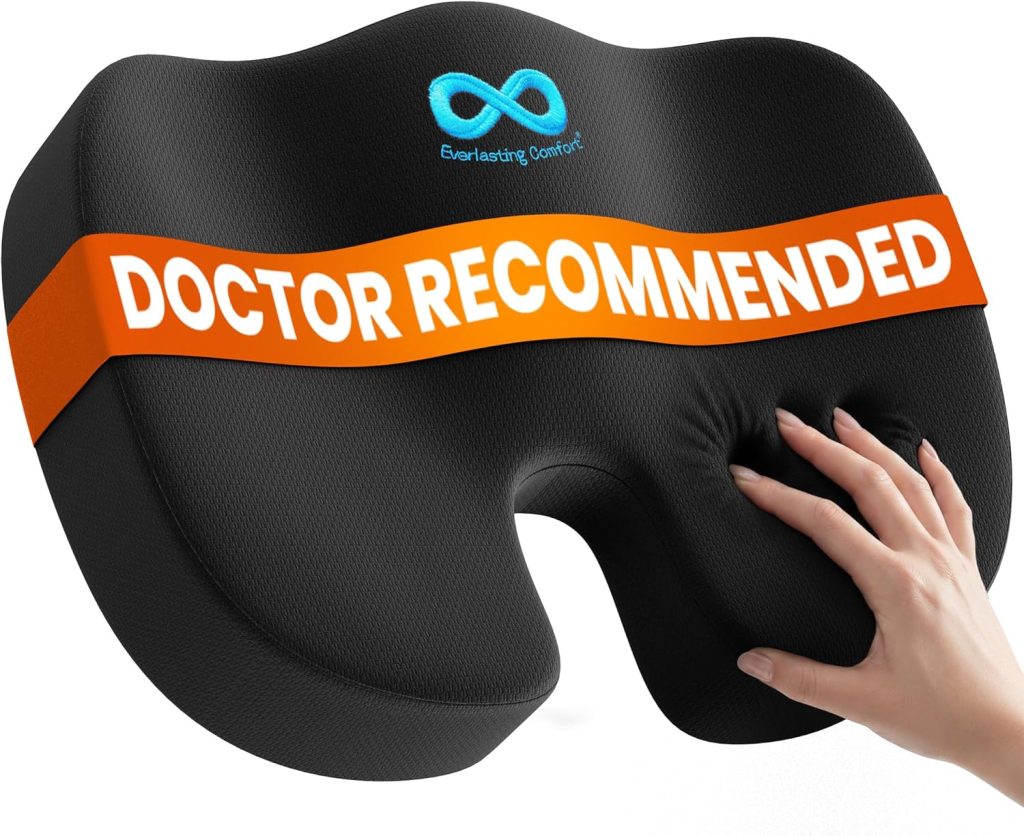
| Everlasting Comfort Seat Cushion | Memory foam seat cushion | People comparing general-purpose cushioning | Thickness, width, and compression |
| Cushion Lab Pressure Relief Seat Cushion | Contoured pressure-relief design | People who want to compare a shaped seat surface | Overall dimensions and fit on a smaller chair |
| Purple Double Seat Cushion | Grid-style cushioning | People comparing a different surface feel | Height, weight, dimensions, and seat stability |
These are products to compare, not a ranking based on personal testing. Product versions and dimensions can change. Check the current listing before purchasing. None is specifically guaranteed to solve a chair-height or seat-depth problem.
1. ComfiLife Gel Enhanced Seat Cushion — Compare the Contoured Shape
The ComfiLife Gel Enhanced Seat Cushion combines foam with a gel layer and a rear cutout. It may be worth comparing if you want a shaped cushion rather than a flat pad, but its suitability for a shorter person depends on the actual dimensions and how much height it adds.
Before choosing it, sit in your chair and check whether your feet are supported at the chair’s current height. If they are not, a cushion that raises your hips may increase the problem. Also check whether the rear cutout aligns with your body and whether the cushion reduces the usable seat depth.
- Consider it if: You want to compare a contoured foam-and-gel cushion.
- Check before buying: Cushion height, width, depth, and current model specifications.
- Potential drawback: The added height may be unsuitable if your chair is already too tall.
2. Everlasting Comfort Seat Cushion — General-Purpose Padding
A general-purpose memory foam cushion is worth considering if the chair feels hard but its height and depth are otherwise appropriate. Everlasting Comfort seat cushions are one option to compare, provided the current model’s size and shape match your chair.
For shorter users, the most important detail is not simply how soft the cushion feels. Check how much it compresses under your weight and whether the remaining height still allows a stable sitting position. A thick cushion can change the relationship between your hips, desk, and armrests.
- Consider it if: You need additional cushioning rather than a solution to an excessively high chair.
- Check before buying: Thickness, foam construction, dimensions, and cover care.
- Potential drawback: A cushion may not solve a seat that is too deep or a desk that is too high.
Check Everlasting Comfort on Amazon
3. Cushion Lab Pressure Relief Seat Cushion — Compare a Shaped Surface
Cushion Lab offers contoured seat cushions designed around the shape of the seated body. If you prefer a shaped surface to a flat cushion, it is an option to compare. However, contouring is not automatically better for every body type or chair.
Pay attention to the usable seating area. A cushion that is too wide for your chair may overhang the sides, while a pronounced contour may not line up with your sitting bones. For shorter users, seat depth matters as much as overall width because the front edge should not press uncomfortably into the backs of the knees.
- Consider it if: You want to compare a contoured design with a more conventional foam pad.
- Check before buying: The current model’s dimensions, profile, and return policy.
- Potential drawback: A shaped cushion cannot compensate for every mismatch between a chair and a shorter user’s body.
4. Purple Double Seat Cushion — A Different Cushioning Feel
Purple’s Double Seat Cushion is an alternative to compare if you want a grid-style surface rather than conventional memory foam. Material and surface design affect how a cushion feels, but the overall fit is still the deciding factor for a shorter user.
Check the current product dimensions and weight, then compare them with your chair. If the cushion adds substantial height, make sure your feet remain supported and that you can sit back comfortably against the chair. Do not choose it solely because the material is different from foam.
- Consider it if: You want to compare a grid-style cushion with foam options.
- Check before buying: Height, width, depth, weight, and compatibility with your chair.
- Potential drawback: Its profile may not suit a chair that is already too high or too deep.
Check Purple Seat Cushions on Amazon
Is a Seat Cushion the Right Fix for a Chair That Is Too Tall?
Not always. A cushion raises your sitting surface. If you already have to point your toes, sit on the edge of the seat, or let your feet hang, adding more height can make your posture less comfortable.
First, lower the chair as far as its adjustment range allows. Then assess whether your feet can rest flat on the floor while your thighs are supported. If the chair cannot go low enough, a stable footrest may help support your feet. If the desk is too high once the chair is adjusted for your body, you may also need to consider desk height or a different workstation setup.
Choose the Solution That Matches the Problem
- Chair feels hard: Compare a supportive seat cushion, provided the added height still works.
- Feet do not reach the floor: Try lowering the chair or using a stable footrest; do not assume a thicker cushion will help.
- Seat is too deep: Look for a chair with a shorter seat depth or adjustable seat pan. A back support may help bring you forward, but check how it affects backrest fit.
- Desk is too high: Reassess the whole workstation rather than raising your seat without supporting your feet.
OSHA’s computer workstation chair guidance explains the importance of seat height, foot support, and seat depth. A properly fitted chair should support the body without creating uncomfortable pressure behind the knees.
How to Choose a Cushion for a Shorter User
1. Measure your chair before shopping
Measure the usable seat width and depth, and note the chair’s height at its lowest setting. Compare those measurements with the cushion’s listed dimensions. Remember that a cushion may compress when you sit on it, so its uncompressed height is not necessarily the height it adds in use.
2. Prioritize seat depth, not just cushion thickness
If the chair is too deep, sitting all the way back may leave pressure behind your knees, while sitting forward may reduce back support. A cushion does not automatically fix this mismatch. A shallower seat or an adjustable seat pan is usually a more direct solution.
3. Choose enough firmness to feel stable
A cushion should feel supportive without being uncomfortably hard. Very soft foam may compress substantially, while very firm material may not suit your preference. Check the return policy and avoid treating terms such as “orthopedic” or “pressure relief” as guarantees of results.
4. Check the front edge and thigh support
The front edge should not press sharply into the backs of your knees. The seat should support your thighs without forcing you to slide forward. If the cushion makes the usable seat even deeper, it may be a poor match for your proportions.
5. Recheck the desk and armrests
Adding a cushion changes your position relative to the desk and armrests. Make sure you can work without shrugging your shoulders, reaching upward, or leaning forward. If your feet lose support after adding a cushion, adjust the setup rather than accepting the new position.
Seat Cushion vs. Lumbar Support for Short People
A seat cushion and a lumbar support pillow solve different problems. A seat cushion changes the surface beneath your body. A lumbar support pillow changes how your lower back contacts the backrest and may also move your sitting position forward.
| Problem | What to Consider | Important Limitation |
|---|---|---|
| Seat feels hard | A seat cushion with suitable firmness | It raises the sitting height |
| Feet are unsupported | Lower chair, footrest, or better-fitting chair | A thicker cushion can worsen the issue |
| Seat is too deep | Shallower seat or adjustable seat pan | A cushion may not correct the geometry |
| Lower back lacks contact with backrest | Adjustable lumbar support or a suitable lumbar pillow | Excessive thickness may push you too far forward |
If your main issue is a gap between your lower back and the chair, read our guide to the best lumbar support pillows for short people. If the problem is primarily a chair that is too deep, a cushion alone may not be enough.
Frequently Asked Questions
What is the best seat cushion for a short person?
The best option depends on your chair and the problem you are trying to solve. If the seat feels hard and your feet remain supported, compare a supportive foam or contoured cushion. If the chair is already too tall, prioritize chair-height adjustment or a stable footrest before adding more height.
Will a seat cushion help if my office chair is too tall?
Usually, a cushion makes the seat higher, so it may worsen the problem. Try lowering the chair first. If your feet still cannot rest flat on the floor, consider a suitable footrest or a chair with a lower minimum seat height.
Can a seat cushion fix an office chair that is too deep?
Not reliably. A cushion may change your position on the seat, but it can also reduce usable depth or affect backrest contact. A chair with a shorter or adjustable seat pan is generally a more direct way to address excessive seat depth.
Should short people use thick seat cushions?
Not automatically. A thick cushion adds height and may affect foot support, desk reach, and backrest position. Choose the thinnest cushion that provides the comfort you need while preserving a stable, well-supported sitting position.
Is a lumbar pillow better than a seat cushion for shorter people?
They serve different purposes. A seat cushion changes the seating surface, while a lumbar pillow supports the lower-back area. Choose based on the problem you have, and check whether either accessory changes your position relative to the chair, desk, and floor.
Final Recommendation
The best seat cushion for a short person is not necessarily the thickest or softest one. If you need extra padding and your feet remain supported, compare cushions by firmness, dimensions, and shape. If your chair is too tall, a cushion is unlikely to solve the underlying problem because it raises your sitting height.
Measure your chair, check the cushion’s actual dimensions, and reassess your foot support and desk position after fitting it. If the chair’s seat depth or minimum height is fundamentally wrong for your proportions, a footrest or a better-fitting chair may be a more effective purchase than another cushion.
Explore More Ergonomic Seating Guides
Affiliate disclosure: As an Amazon Associate, SitBetterLab earns from qualifying purchases. This article is for general informational purposes and does not promise medical benefits.