
Office Seating Buying Guide
Best Coccyx Cushions for Office Chairs
If your tailbone feels sore after sitting at your desk, adding a cushion with a rear cutout may be worth considering. The best coccyx cushion for an office chair should leave enough space around the tailbone, fit the seat properly, and support your sitting bones without making your chair too high.
A standard seat cushion adds padding, but a coccyx cushion for an office chair has a more specific purpose: its U-shaped or V-shaped opening creates space around the tailbone at the back of the seat. This design may reduce direct contact in that area, although results depend on your body, the cutout shape, and how you sit.
In this guide, we’ll compare several options to consider, explain what makes a tailbone cushion for an office chair different from a regular seat pad, and show you how to choose one that fits your workspace. These are research-based buying suggestions, not claims of hands-on testing or medical treatment.
Quick Comparison: Coccyx Cushions for Office Chairs
| Cushion | Design to Check | Best Fit for | Main Consideration |
|---|---|---|---|
| ComfiLife Gel Enhanced Seat Cushion | Memory foam with gel layer and coccyx cutout | People comparing a gel-and-foam combination | Confirm the current model’s dimensions and cutout shape |
| Everlasting Comfort Coccyx Seat Cushion | Contoured foam coccyx cushion; check current version | People looking for a dedicated everyday seat cushion | Compare foam feel, height, and return policy |
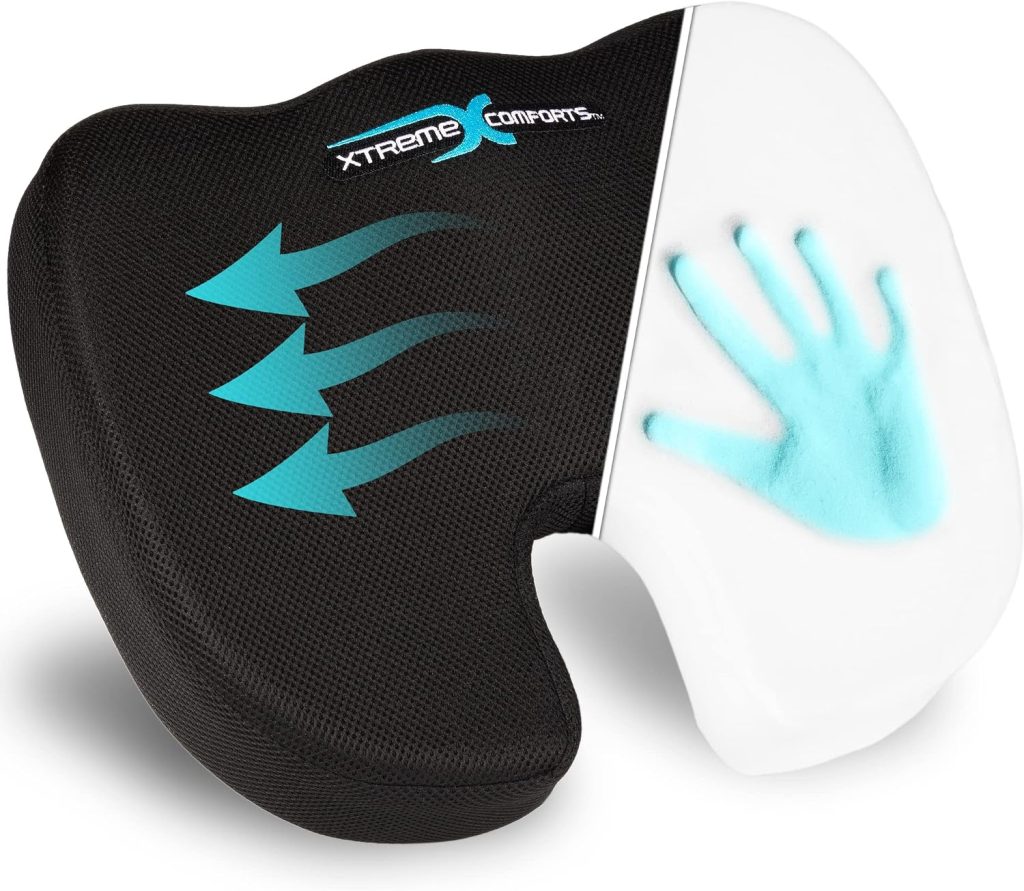
| Xtreme Comforts Coccyx Cushion | Memory foam with a rear opening | Shoppers comparing a straightforward cutout design | Check current availability and the exact listing |
| Tush-Cush Orthopedic Seat Cushion | Coccyx cutout with different firmness options | People who want to compare firmer cushion designs | Choose firmness carefully; firm does not automatically mean better |
Product availability, model names, features, and prices can change. Verify the current product listing before purchasing. The picks below are comparison candidates, not a ranking based on personal product testing.
1. ComfiLife Gel Enhanced Seat Cushion — Gel and Foam Combination
The ComfiLife Gel Enhanced Seat Cushion is one option to investigate if you want a foam cushion with a gel layer and a rear coccyx opening. This style combines a shaped foam base with a surface layer intended to change the feel of the seat.
For office use, focus on whether the opening actually clears your tailbone when you sit in your normal working position. The cushion should support the surrounding sitting-bone area rather than forcing you to perch forward or slump away from the backrest.
- Consider it if: You want to compare a gel-and-foam design with a traditional foam cushion.
- Check before buying: The exact dimensions, cover-washing instructions, base grip, and current cutout shape.
- Potential drawback: A gel layer does not guarantee that a cushion will feel cool to every user.
2. Everlasting Comfort Coccyx Seat Cushion — Everyday Office Use
Everlasting Comfort offers coccyx-style seat cushions designed for use in settings such as an office chair or vehicle seat. When comparing its current listings, look for a clearly shown rear opening and a shape that fits your chair rather than relying on the word “orthopedic” alone.
A good everyday cushion should feel supportive without pushing your hips too far above the chair’s original seating position. If you use an adjustable office chair, test the cushion with your feet, desk, armrests, and backrest all set to a comfortable position.
- Consider it if: You want a dedicated coccyx cushion for routine desk work.
- Check before buying: Whether the specific model uses plain or gel-infused foam, its height, and its return policy.
- Potential drawback: Foam firmness and heat retention vary by construction and individual preference.
Check Everlasting Comfort on Amazon
3. Xtreme Comforts Coccyx Cushion — A Traditional Cutout Design
Xtreme Comforts coccyx cushions are another option to compare if your priority is a conventional memory foam seat pad with a rear opening. A simple design can be sufficient if the cutout sits in the right place and the cushion’s shape suits your body.
Pay particular attention to the depth of the opening and the cushion’s front edge. An opening that is too short or positioned incorrectly may fail to keep pressure away from the tailbone; a cushion that is too long may press against the backs of your knees or prevent you from sitting back against the chair.
- Consider it if: You prefer a straightforward foam-and-cutout design.
- Check before buying: Current model dimensions, foam construction, cover care, and availability.
- Potential drawback: A basic foam cushion may not suit people who dislike the feel or heat retention of foam.
Check Xtreme Comforts on Amazon
4. Tush-Cush Orthopedic Seat Cushion — Compare Firmness Options
Tush-Cush sells orthopedic seat cushions with a coccyx cutout, including options with different firmness levels. This makes it worth comparing if you already know that very soft cushions feel unstable or compress too much for your preference.
However, firmer is not always better. A cushion that feels supportive for one person may create uncomfortable pressure for another. Look for a balance between enough support to prevent excessive sinking and enough cushioning to feel comfortable during normal desk work.
- Consider it if: You want to compare a firmer cushion with softer memory foam options.
- Check before buying: The exact firmness variant, dimensions, and return terms.
- Potential drawback: A firm cushion may feel too hard if you prefer a more enveloping surface.
What Makes a Good Tailbone Cushion for an Office Chair?
1. A cutout that clears the tailbone
The main feature to inspect is the opening at the rear of the cushion. U-shaped and V-shaped cutouts are intended to create space around the coccyx, but their dimensions and placement differ. Look for a design that leaves your tailbone clear without making the rest of the seat feel narrow or unstable.
2. Enough support without excessive sinking
Memory foam can contour to the body, but the result depends on the foam’s construction and firmness. A cushion that compresses too much may offer little separation from a hard chair seat. On the other hand, a very firm pad may feel uncomfortable at the sitting bones. Choose based on the actual feel and fit rather than the label alone.
3. A suitable height and seat depth
A cushion raises your sitting position. That can change your relationship to the desk, armrests, backrest, and floor. OSHA’s computer workstation chair guidance recommends a seat setup that allows the feet to rest flat on the floor or a footrest and avoids seat edges pressing into the backs of the knees.
Measure your chair before buying. Compare the cushion’s width and depth with the usable seat area, and check whether adding its height will leave your feet unsupported or your thighs poorly positioned.
4. A stable, non-slip base
If the cushion slides every time you shift, it may be difficult to keep the cutout in the correct position. Look for a grippy base or another secure attachment method, and check whether it is suitable for your chair’s fabric or mesh surface.
5. A cover you can maintain
For everyday office use, a removable cover can make cleaning easier. Confirm the care instructions before purchase rather than assuming that the entire cushion can be machine-washed.
Coccyx Cushion vs. Regular Seat Cushion
| Feature | Coccyx Cushion | Regular Seat Cushion |
|---|---|---|
| Main design | Usually has a rear cutout | May be flat or generally contoured |
| Primary consideration | Whether the tailbone clears the opening | Whether the surface improves overall seat comfort |
| Potential limitation | The cutout may not align with every body or chair | May not create a dedicated space around the tailbone |
| Best starting point | When direct tailbone contact is a concern | When general cushioning is the main goal |
If you mainly want a softer seat rather than a specific rear cutout, compare more general options in our seat cushion buying guide.
How to Set Up Your Office Chair with a Coccyx Cushion
- Place the cushion fully on the seat. Align the rear cutout with the back of the chair and make sure the cushion does not overhang in a way that makes it unstable.
- Sit back in your normal working position. Check that the tailbone sits over the opening rather than on its edge.
- Recheck your feet and knees. Your feet should be supported, and the front edge should not dig into the backs of your knees. Adjust the chair or use a suitable footrest if needed.
- Check the desk and armrests. Raising your seat can change elbow height and shoulder position. Adjust the workstation rather than leaning forward to compensate.
- Change position regularly. A cushion does not replace movement breaks or a chair that fits your body.
Frequently Asked Questions
What is the best coccyx cushion for an office chair?
The best choice depends on your body and chair. Start with a cushion that has a well-positioned rear cutout, suitable width and depth, and a firmness you find comfortable. Compare the ComfiLife, Everlasting Comfort, Xtreme Comforts, and Tush-Cush options by checking the exact current listing and return policy.
Does a tailbone cushion help when sitting at a desk?
A coccyx cushion may reduce direct contact around the tailbone for some people, but it does not work equally well for everyone. Fit matters: if the cutout is misaligned, the cushion is unstable, or the seat height becomes unsuitable, it may not improve comfort.
Is memory foam or gel better for tailbone comfort?
Neither material is automatically better. Memory foam can contour to the body, while gel layers or grid structures change how the surface feels and may affect airflow. For a coccyx cushion, prioritize the cutout’s shape, the underlying support, and the fit before choosing by material.
Should a coccyx cushion be thick?
Not necessarily. A thicker cushion adds more height and can affect your feet, knees, desk position, and backrest contact. Choose a thickness that provides comfortable support without disrupting your seated posture. For a closer comparison, see our seat cushion thickness guide.
Can a coccyx cushion treat tailbone pain?
No cushion should be treated as a guaranteed treatment. It may change pressure on the tailbone while sitting, but persistent, severe, worsening, or unexplained pain deserves medical evaluation, especially if it follows an injury or occurs with other concerning symptoms.
Final Recommendation
When choosing a coccyx cushion for an office chair, start with the cutout and fit—not the number of layers or the word “orthopedic.” ComfiLife is worth comparing if you want a gel-and-foam design; Everlasting Comfort and Xtreme Comforts are alternatives to investigate for a conventional coccyx-style cushion; and Tush-Cush is worth a look if you want to compare firmness options.
Before ordering, measure your chair, check the latest product details, and make sure the added height will still let you sit with your feet supported. If a cushion increases discomfort or fails to keep pressure away from the tailbone, stop using it and reconsider the fit.
Explore More Seat Cushion Guides
Affiliate disclosure: As an Amazon Associate, SitBetterLab earns from qualifying purchases. This article is for general informational purposes and is not a substitute for professional medical advice.