
SITBETTERLAB BUYING GUIDE
Best Seat Cushions for Sciatica Pain: 7 Buying Tips
Sitting for hours can be uncomfortable when pain travels from your lower back into your buttock or leg. The right seat cushion may make your office chair or car seat more comfortable by changing how pressure is distributed across your sitting area.
In this guide, we compare four seat cushion options, explain what to look for in a coccyx cutout, and cover the differences between memory foam and gel designs. The goal is to help you find a cushion that fits your body, chair, and daily routine—not to promise a cure for sciatica.
Disclosure: As an Amazon Associate, SitBetterLab may earn from qualifying purchases. This article is for informational purposes and does not replace medical advice.
Quick recommendation: Start by comparing a supportive coccyx cushion with a contoured seat cushion. A U-shaped cutout may help reduce direct tailbone contact, while a broader ergonomic design may suit people who prefer more even support under the hips. Your comfort and sitting position matter more than any product’s marketing claims.
4 Seat Cushions to Consider for Sciatica-Related Sitting Discomfort
These products represent different approaches to seat comfort: gel-enhanced memory foam, traditional memory foam, ergonomic contouring, and a flexible grid surface. They are options to compare, not a clinically validated ranking of sciatica treatments. Check current specifications, availability, and return policies before purchasing.
01 · BEST STARTING POINT
ComfiLife Gel Enhanced Seat Cushion
The ComfiLife Gel Enhanced Seat Cushion combines memory foam with a cooling gel layer and a U-shaped coccyx cutout. Its portable design, non-slip bottom, carrying handle, and removable washable cover make it a practical option to consider for an office chair or other compatible seat.
- Material: Memory foam with a gel layer.
- Shape: Coccyx cutout to reduce direct contact around the tailbone.
- Convenience: Removable cover, non-slip base, and carrying handle.
- Consider if: You want to compare a gel-enhanced cushion with a conventional foam design.
- Check before buying: Its dimensions and recommended weight limit; the manufacturer’s FAQ lists a 250 lb recommended maximum.
Best for shoppers who want a portable, gel-enhanced coccyx cushion. The gel layer should not be assumed to guarantee all-day cooling or sciatica relief.
02 · MEMORY FOAM OPTION
Everlasting Comfort Memory Foam Seat Cushion
Everlasting Comfort offers memory foam seat cushions with ergonomic contours, a coccyx cutout, a removable cover, and a non-slip base. Check the exact version carefully because the brand sells several seat cushion designs, including different sizes and models intended for office or car use.
- Material: Memory foam.
- Design: Contoured support with a tailbone cutout on applicable models.
- Convenience: Portable design and removable cover on the listed models.
- Consider if: You prefer a conventional foam feel and want to compare different sizes.
- Check before buying: The selected model’s dimensions, firmness, and cover-care instructions.
Best for shoppers who want a traditional memory foam option without necessarily choosing a gel-enhanced design.
03 · ERGONOMIC CONTOUR
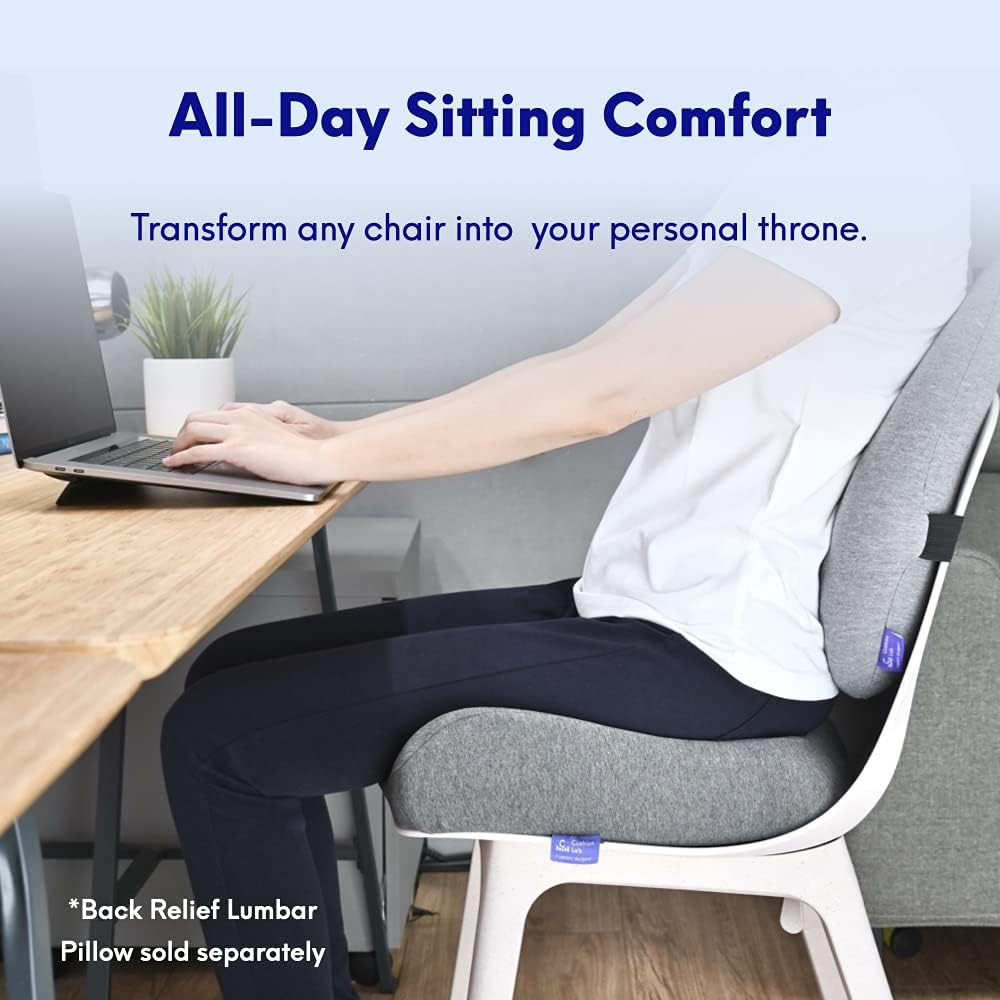
Cushion Lab Pressure Relief Seat Cushion
The Cushion Lab Pressure Relief Seat Cushion uses a contoured foam surface designed to distribute pressure across the sitting area. It is an alternative to a conventional U-shaped coccyx cushion for people who want to compare a broader ergonomic shape.
- Material: Proprietary memory foam.
- Design: Multi-region contours intended to support the hips and sitting area.
- Convenience: Removable, washable cover on the manufacturer’s listed model.
- Consider if: You prefer a sculpted surface rather than choosing a cushion solely for its tailbone cutout.
- Check before buying: Available size options and whether the cushion’s height fits your chair.
Best for shoppers comparing ergonomic contouring. The product’s pressure-relief positioning is a design claim, not proof that it will relieve every cause of sciatica.
04 · GRID MATERIAL
Purple Double Seat Cushion
Purple’s Double Seat Cushion uses the brand’s flexible grid material rather than a conventional all-foam surface. Its reversible design provides two different firmness feels, making it an interesting comparison for shoppers who are unsure whether they prefer a soft or firmer seat.
- Material: Purple Grid.
- Design: Reversible surface with different feels on each side.
- Convenience: Removable cover and a design intended for office-chair use.
- Consider if: You want to compare a grid surface with foam-based cushions.
- Check before buying: Weight, dimensions, cleaning instructions, and compatibility with your chair.
Best for shoppers interested in an alternative to memory foam. It is heavier than many portable foam cushions, so consider how often you plan to move it between seats.
How to Narrow Down Your Options
- Want a gel layer and a U-shaped cutout? Start by comparing ComfiLife.
- Prefer a conventional foam cushion? Compare the exact Everlasting Comfort model.
- Prefer a contoured surface? Look at Cushion Lab’s pressure-relief design.
- Want to try a different surface feel? Compare Purple’s reversible grid cushion.
These are shopping distinctions, not medical recommendations. The most suitable cushion is the one that fits your chair, feels stable, and does not worsen your symptoms.
7 Buying Tips for Choosing a Seat Cushion for Sciatica
1. Choose a Shape That Matches Your Pressure Points
A U-shaped coccyx cutout leaves space around the tailbone and may help if direct tailbone contact is uncomfortable. However, sciatica can involve symptoms caused by irritation or compression of nerve roots or the sciatic nerve, so a tailbone cutout is not a universal solution.
If the main issue is pressure under your sitting bones or around your hips, compare a broader contoured design as well. Avoid a cushion whose edges create new pressure points.
2. Look for Balanced Pressure Distribution
The goal is comfortable, stable support—not maximum softness. A cushion that compresses too much may leave you feeling as though you are sitting directly on the chair, while a very firm cushion can feel uncomfortable under sensitive areas.
Foam density, thickness, shape, and body weight all affect how a cushion feels. Product labels such as “orthopedic” or “medical-grade” do not independently establish clinical effectiveness.
3. Check Cushion Thickness and Hip Position
A thick cushion raises your hips relative to the desk and floor. This can affect knee angles, foot support, and the distance between your body and the backrest. Choose a height that allows you to sit comfortably without sliding forward or placing pressure behind your knees.
If necessary, adjust your chair height or use a footrest. For more buying advice, visit the Seat Cushions Hub.
4. Compare Memory Foam and Gel
Memory foam typically conforms to your shape, while a gel layer may change the cushion’s surface feel and heat response. Some products combine the two materials, so the choice is not always strictly foam versus gel.
Do not assume that gel automatically stays cool all day or that memory foam is always more supportive. Look at the complete construction, cover, firmness, and return policy.
5. Check the Cushion’s Width and Seat Compatibility
A cushion should fit your chair without excessive overhang or unwanted movement. Make sure it does not push you too far forward or interfere with the chair’s lumbar support. If you plan to move it between an office chair and a car, check the fit on both seats.
6. Consider Breathability and Cleaning
For long work sessions, a removable, washable cover can make maintenance easier. Mesh covers and ventilated surfaces may feel less warm than some dense foam constructions, but cooling performance depends on the full design and your environment.
7. Review Return Policies Before Buying
Comfort is personal, and you may not know whether a cushion suits you until you have tried it in your usual sitting position. Review the return window, product condition requirements, and warranty before ordering. Do not rely on advertised relief claims alone to make your choice.
Memory Foam vs. Gel Seat Cushions
Memory Foam
- Conforms to the shape of your body.
- Available in different firmness levels.
- May retain heat, depending on construction.
- Can feel too soft if it compresses excessively.
Gel or Gel-Enhanced Foam
- Offers a different surface response.
- Often combined with foam rather than used alone.
- Cooling depends on the entire cushion design.
- Does not guarantee better relief from sciatic symptoms.
Neither material has been established as the best choice for every person with sciatica. Choose based on comfort, pressure distribution, fit, and the conditions under which you use the cushion.
Using a Seat Cushion in an Office Chair
A cushion can change the height and depth of your seat, so reassess your workstation after placing it on the chair.
- Keep your feet supported. Use the floor or a footrest where needed.
- Check seat depth. Leave comfortable space behind your knees.
- Maintain back support. Make sure the cushion does not push you away from the backrest.
- Prevent sliding. A stable, non-slip base can help the cushion stay in place.
- Change positions. Stand, walk, and move regularly instead of sitting continuously for hours.
If your backrest is also uncomfortable, explore our lumbar support guides. A lumbar cushion and a seat cushion serve different purposes, and you may not need both.
Choosing a Seat Cushion for Driving
A cushion suitable for a desk may not be suitable for a car. Vehicle seats have different contours and safety requirements, so check the fit and stability carefully.
- Make sure the cushion does not interfere with seat-belt fit, buckles, or safety systems.
- Check that the added height does not compromise visibility or pedal control.
- Choose a cushion that stays in place and does not cause you to slide forward.
- Test your seating position while parked before driving.
- Take breaks during longer journeys when practical and safe.
Never use a cushion if it compromises safe vehicle control or the operation of vehicle safety equipment.
Common Mistakes to Avoid
Buying the Thickest Cushion
Extra height may affect foot support, knee position, and seat depth.
Assuming a Cutout Cures Sciatica
A coccyx cutout targets tailbone contact, not every possible cause of nerve-related pain.
Ignoring Chair Fit
An oversized or unstable cushion may create new pressure points or change your posture.
Sitting Without Breaks
A cushion does not eliminate the need to change position and move throughout the day.
Frequently Asked Questions
What is the best seat cushion for sciatica?
There is no single best cushion for everyone. Look for stable support, comfortable pressure distribution, and a shape that fits your chair and symptoms. A coccyx cutout may be useful for tailbone pressure, while a broader contoured design may suit other preferences.
Is memory foam or gel better for sciatic nerve pain?
Neither material is proven to be universally better. Memory foam offers a conforming feel, while gel-enhanced designs provide a different surface response. Fit, shape, firmness, and personal comfort are important considerations.
Do U-shaped cushions help with sciatica?
They may help reduce direct contact around the tailbone for some people, but they do not address every cause of sciatica. If the cutout creates new pressure or makes symptoms worse, stop using it and consider another design.
Can I use the same cushion in my office chair and car?
Possibly, if it fits both seats and remains stable. For driving, you must also preserve visibility, pedal control, proper seat-belt fit, and the function of vehicle safety systems.
Can a seat cushion cure sciatica?
No. A cushion may improve sitting comfort for some people, but it does not treat every underlying cause. Seek medical advice for persistent, recurring, or worsening symptoms.
When should I seek medical care?
Seek prompt medical advice for persistent pain, numbness, or weakness. New loss of bladder or bowel control, difficulty urinating, numbness around the groin or saddle area, or severe or progressive weakness requires immediate emergency assessment.
Find the Right Seat Cushion for Your Needs
Compare cushion materials, contours, dimensions, and return policies before choosing. The best option is one that fits your chair, feels stable, and supports a comfortable sitting position without worsening your symptoms.
Disclaimer: This article is for general informational purposes only and is not a diagnosis or treatment plan. Seat cushions may improve comfort but cannot guarantee relief from sciatica or replace appropriate medical assessment.