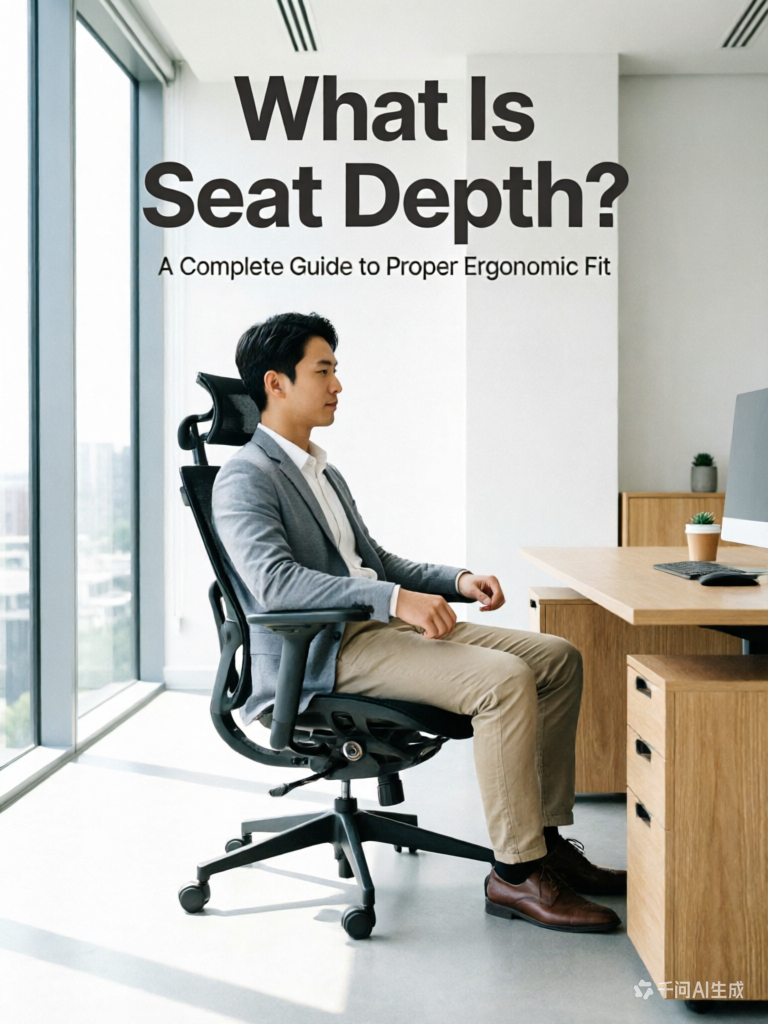
You have probably seen “adjustable seat depth” listed as a feature on premium ergonomic chairs. But what does it actually mean? And why does it matter?
Here is the truth: seat depth is one of the most overlooked ergonomic adjustments — yet it can make the difference between a chair that feels great and one that causes leg pain, poor circulation, or constant fidgeting.
In this guide, I will explain exactly what seat depth is, how to measure it, how to adjust it, and why getting it right is essential for your comfort and health.
Quick Answer: What Is Seat Depth?
Seat depth is the distance from the backrest to the front edge of the seat. It determines how much of your thigh is supported by the chair and where the front edge hits the back of your knees.
Proper seat depth leaves about 2–3 finger widths of space between the back of your knee and the front edge of the seat. Too deep, and the chair presses into the back of your knees. Too shallow, and your thighs lack support.
If you have ever sat in a chair and felt pressure behind your knees or felt like you were constantly sliding forward, you have experienced poor seat depth fit.
Why Seat Depth Matters for Ergonomics
Seat depth might seem like a minor detail, but it affects multiple aspects of your sitting comfort and health:
1. Blood Circulation
When a seat is too deep, the front edge presses into the popliteal fossa — the soft area behind your knees where major blood vessels and nerves pass through. This pressure can restrict blood flow to your lower legs and feet, leading to numbness, tingling, or a “falling asleep” sensation.
Over time, poor circulation from incorrect seat depth can contribute to varicose veins, deep vein thrombosis risk, and leg fatigue.
2. Lower Back Support
Here is the key insight: you cannot use the backrest if the seat is too deep. When the seat presses into the back of your knees, you naturally slide forward to relieve the pressure. This moves your lower back away from the backrest, eliminating lumbar support and forcing you into a slouched posture.
This is one of the most common ergonomic mistakes. People buy chairs with good lumbar support but never actually use it because the seat is too deep for their legs.
3. Thigh Support
If the seat is too shallow, your thighs are not fully supported. This puts extra pressure on your sit bones (ischial tuberosities) and can lead to soreness, fatigue, and the feeling that you are “perching” rather than sitting.
The ideal seat supports most of your thigh without touching the back of your knee.
4. Posture and Spinal Alignment
When your seat depth is correct, you can sit all the way back in the chair with your feet flat on the floor and your back against the lumbar support. This is the foundation of good seated posture. Incorrect seat depth breaks this foundation.
How to Measure Proper Seat Depth
Here is a simple test you can do in any chair to check if the seat depth is right for you.
The Finger Test (2–3 Finger Rule)
Step 1: Sit all the way back in the chair so your back is touching the backrest.
Step 2: Make sure your feet are flat on the floor (adjust seat height if needed).
Step 3: Make a fist with your hand.
Step 4: Place your fist sideways between the back of your knee and the front edge of the seat.
The result:
- If your fist fits with a little room to spare: The seat depth is correct. You should have about 2–3 fingers of space.
- If your fist does not fit (too tight): The seat is too deep. It is pressing into the back of your knee.
- If your fist fits with a lot of extra space: The seat is too shallow. Your thighs lack support.
This test works for most people. If you have especially large or small hands, adjust accordingly — the goal is roughly 2–4 inches of space (5–10 cm).
Professional Ergonomic Guidelines
According to ergonomic standards (ISO 9241-5 and BIFMA G1-2019), proper seat depth should be 80–95% of your thigh length for the average workstation. For most people, that translates to:
- Short users (under 5’4″): 15–17 inches
- Average users (5’4″ – 5’11”): 17–19 inches
- Tall users (6’0″+): 19–21 inches
Fixed vs Adjustable Seat Depth
Not all chairs have adjustable seat depth. Here is the difference:
Fixed Seat Depth
Most chairs under $400 have a fixed seat depth. The seat is a single piece that cannot slide forward or backward. You must choose a chair with a fixed depth that matches your leg length.
Pros: Simpler construction, lower cost, fewer parts to break.
Cons: Only fits a narrow range of body types. If your legs are longer or shorter than average, a fixed-depth chair may never fit you properly.
Examples of chairs with fixed seat depth:
- Herman Miller Aeron (but comes in 3 sizes — A, B, C — each with different fixed depths)
- Most chairs under $300 (Ticova, Hbada E3, etc.)
Adjustable Seat Depth
Premium ergonomic chairs feature a sliding seat mechanism. You pull a lever or knob, and the seat pan slides forward or backward, usually 1–4 inches of range.
Pros: Fits almost any leg length, allows fine-tuning, great for chairs shared by multiple users.
Cons: More expensive, adds weight and complexity, can be noisy if poorly designed.
Examples of chairs with adjustable seat depth:
- Steelcase Leap v2
- Steelcase Gesture
- Haworth Fern
- Branch Ergonomic Chair Pro
- Autonomous ErgoChair Pro
- SIHOO Doro C300
How to Adjust Seat Depth (Step by Step)
If your chair has adjustable seat depth, follow these steps to set it correctly:
Step 1: Set Your Seat Height First
Always adjust seat height before seat depth. Your feet should be flat on the floor with your thighs parallel to the ground (or slightly angled down).
Step 2: Sit All the Way Back
Scoot back until your lower back is firmly against the lumbar support. This is your reference position.
Step 3: Find the Adjustment Mechanism
Look under the front of the seat. Most chairs have a lever, knob, or handle. Pulling or turning unlocks the seat pan.
Step 4: Slide the Seat
While seated (or standing, depending on the mechanism), slide the seat forward or backward.
Step 5: Test the 2–3 Finger Gap
Check the space between the back of your knee and the seat edge. Adjust until you have the proper gap (2–4 inches).
Step 6: Lock the Mechanism
Release the lever to lock the seat in place. Test by shifting your weight — the seat should not move.
Step 7: Fine-Tune
Sit for 5–10 minutes. If you feel pressure behind your knees, slide the seat back (shallower). If your thighs feel unsupported, slide the seat forward (deeper).
Ideal Seat Depth by Height
Here is a general guide to what seat depth works for different heights. Note that leg length varies between individuals, so use this as a starting point rather than an absolute rule.
User HeightTypical Thigh LengthIdeal Seat Depth (Fixed Chair)Recommended Seat Depth Range (Adjustable)
| Under 5’2″ (under 157 cm) | Under 17″ | 15–16″ | Adjustable, but look for chairs with low minimum depth |
| 5’2″ – 5’4″ (157–163 cm) | 17–18″ | 16–17″ | 15–19″ range |
| 5’4″ – 5’7″ (163–170 cm) | 18–19″ | 17–18″ | 16–20″ range |
| 5’7″ – 5’10” (170–178 cm) | 19–20″ | 18–19″ | 17–21″ range |
| 5’10” – 6’1″ (178–185 cm) | 20–21″ | 19–20″ | 18–22″ range |
| 6’1″ – 6’4″ (185–193 cm) | 21–22″ | 20–21″ | 19–23″ range |
| Over 6’4″ (over 193 cm) | 22″+ | 21″+ (hard to find in fixed-depth) | Adjustable with extended range or tall-specific model |
Seat Depth and Your Body Type
Short Users (Under 5’4″)
Short users face the biggest challenge with seat depth because most chairs are designed for average-height users (5’6″ – 5’11”). A standard 18″ fixed-depth seat will likely be too deep, causing knee pressure.
What to look for: Fixed-depth chairs with 15–17″ depth OR adjustable seat depth that goes down to 15–16″. The Herman Miller Aeron Size A has a 16.5″ depth, making it one of the best for short users.
What to avoid: Fixed-depth chairs with 18″+ depth. You will slide forward and lose lumbar support.
Average Users (5’4″ – 5’11”)
Most fixed-depth chairs in the 17–19″ range will fit average users well. However, individual leg length varies — adjustable depth still provides a better fit.
What to look for: 17–19″ fixed depth OR adjustable depth with 16–20″ range. Either works.
Tall Users (6’0″+)
Tall users need deeper seats — at least 19″ ideally 20–21″. Many fixed-depth chairs top out at 19″, which may be too shallow for very tall users with long femurs.
What to look for: Adjustable seat depth highly recommended. The Steelcase Leap (adjustable to 18.75″) works for many tall users, but very tall users (over 6’4″) may need specialized chairs like the Aeron Size C (19.5″ fixed depth).
Users with Long Legs (Disproportionate to Height)
Some people have longer legs relative to their torso. If you are average height but always feel like seats are too short, you may need deeper depth. Adjustable seat depth is essential for you.
Users with Short Legs (Disproportionate to Height)
If you have a long torso but shorter legs, standard depth chairs may be too deep. Look for adjustable depth or fixed-depth chairs with shallow options.
Common Seat Depth Problems and Solutions
Problem 1: Seat Is Too Deep
Symptoms: Pressure behind your knees, numb/tingling feet, sliding forward in the chair, unable to use backrest.
Solutions:
- If your chair has adjustable depth: slide the seat backward (shallower).
- If fixed depth: add a lumbar cushion to push your body forward slightly, effectively shortening the seat depth. This is a hack that works surprisingly well.
- If nothing works: consider returning the chair and buying one with adjustable depth or a shorter fixed depth.
Problem 2: Seat Is Too Shallow
Symptoms: Thighs feel unsupported, you feel like you are “perching” not sitting, extra pressure on sit bones, legs fatigue quickly.
Solutions:
- If adjustable: slide the seat forward (deeper).
- If fixed depth: there is no good solution. You need a chair with deeper depth or adjustable features.
Problem 3: Seat Depth Adjusts but Feels Loose
Symptom: The seat slides forward or backward on its own when you shift weight.
Solution: The locking mechanism may be worn or broken. Try tightening any visible screws. If that does not work, contact the manufacturer for replacement parts.
Seat Depth vs Seat Height vs Seat Width
Seat depth is often confused with other seat measurements. Here is the distinction:
MeasurementWhat It MeasuresWhy It Matters
| Seat Depth | Front to back (backrest to front edge)Whether your thighs fit without knee pressure |
| Seat Height那样From floor to top of seat
那样Whether your feet are flat on the floor |
|
| Seat Width | Side to sideWhether your hips fit comfortably without spilling over |
All three are important. Seat depth is the most overlooked, but incorrect seat height or width can also cause discomfort.
Best Chairs with Adjustable Seat Depth by Budget
If you decide you want adjustable seat depth, here are the best options at different price points:
Under $300 (Limited options)
- Ticova Ergonomic Chair: Fixed depth (~18″), but generally fits average users. No adjustment.
- Hbada E3: Fixed depth. No adjustment in this price range.
Verdict: Adjustable seat depth is rare under $400.
$300–600 (Good options start here)
- SIHOO Doro C300: Adjustable depth. ~$460.
- Branch Ergonomic Chair Pro: Adjustable depth. ~$499.
- Autonomous ErgoChair Pro: Adjustable depth (19–21.5″). ~$499.
- Hbada E3 Pro: Adjustable depth. ~$550.
$800+ (Premium options)
- Steelcase Leap v2: Adjustable depth (15.75–18.75″). Refurbished ~$500–700, new ~$1,200.
- Steelcase Gesture: Adjustable depth (15.75–18.5″). ~$1,200+.
- Haworth Fern: Adjustable depth. ~$1,100+.
- Herman Miller Aeron: Fixed depth but comes in 3 sizes. Size A (16.5″), B (18″), C (19.5″). ~$1,300+.
Frequently Asked Questions (FAQ)
What is seat depth on an office chair?
Seat depth is the distance from the backrest to the front edge of the seat. It determines how much of your thigh is supported and where the front edge hits your legs.
How do I know if my seat depth is correct?
Sit all the way back in the chair. You should have 2–4 inches (2–3 finger widths) of space between the back of your knee and the front edge of the seat.
Why does seat depth matter?
Incorrect seat depth can cause knee pressure, poor circulation, lower back pain (because you slide forward), and poor posture. Correct seat depth allows you to use the backrest and maintain proper spinal alignment.
What is a good seat depth for my height?
Short users (under 5’4″): 15–17″. Average users (5’4″ – 5’11”): 17–19″. Tall users (6’0″+): 19–21″.
Do I need adjustable seat depth?
Not necessarily. If you are average height (5’4″ – 5’11”) and find a fixed-depth chair in the 17–19″ range, you may be fine. However, adjustable depth is highly recommended for:
- Users under 5’4″ or over 6’0″
- Users with leg lengths disproportionate to their height
- Anyone who wants a perfect fit
- Chairs shared by multiple users of different sizes
Can I fix a seat that is too deep?
Yes — try adding a lumbar cushion behind your lower back. This pushes your body forward, effectively shortening the seat depth. This is a common hack used by ergonomists.
Can I fix a seat that is too shallow?
No — there is no good solution for a seat that is too shallow. You need a chair with deeper depth or adjustable features.
What seat depth do tall people need?
Tall users (6’0″+ ) typically need 19–21″ of seat depth. Look for adjustable depth or fixed-depth chairs with large sizes (Aeron Size C: 19.5″).
What seat depth do short people need?
Short users (under 5’4″) typically need 15–17″ of seat depth. The Aeron Size A (16.5″) and chairs with adjustable depth are good options.
Does seat depth affect leg circulation?
Yes — a seat that is too deep presses into the back of your knees, compressing blood vessels and nerves. This can cause numbness, tingling, and leg fatigue.
Final Verdict: Get Seat Depth Right
Seat depth is one of the most overlooked ergonomic adjustments — and one of the most important. Getting it right allows you to sit all the way back in the chair, use the lumbar support, maintain good posture, and avoid knee pressure and leg fatigue.
If you are buying a new chair: Prioritize adjustable seat depth if you are outside the average height range (5’4″ – 5’11”) or want a perfect fit. If you are average height, a fixed-depth chair in the 17–19″ range may be sufficient.
If you already have a chair: Perform the finger test. If the seat is too deep, try a lumbar cushion hack. If it is too shallow, consider upgrading to a chair with adjustable depth.
Your legs and back will thank you.
Related Articles
Want to learn more about ergonomic chairs? Check out these related guides:
🪑 Best Ergonomic Chairs Under $500
Top 5 picks for budget-conscious buyers who want real ergonomics.
📏 How to Choose an Ergonomic Chair
Complete buyer’s guide covering lumbar support, armrests, materials, and more.
💺 Best Ergonomic Chairs for Back Pain
7 chairs specifically designed to relieve lower back, sciatica, and tailbone pain.
🔧 Mesh vs Cushion Office Chair
Which material is better for breathability, comfort, and durability?
📐 Are Ergonomic Chairs Worth It?
Cost-benefit analysis: cheap chairs vs premium ergonomics.
🔍 Steelcase Leap vs Gesture
Which premium Steelcase chair is right for you? Full comparison.