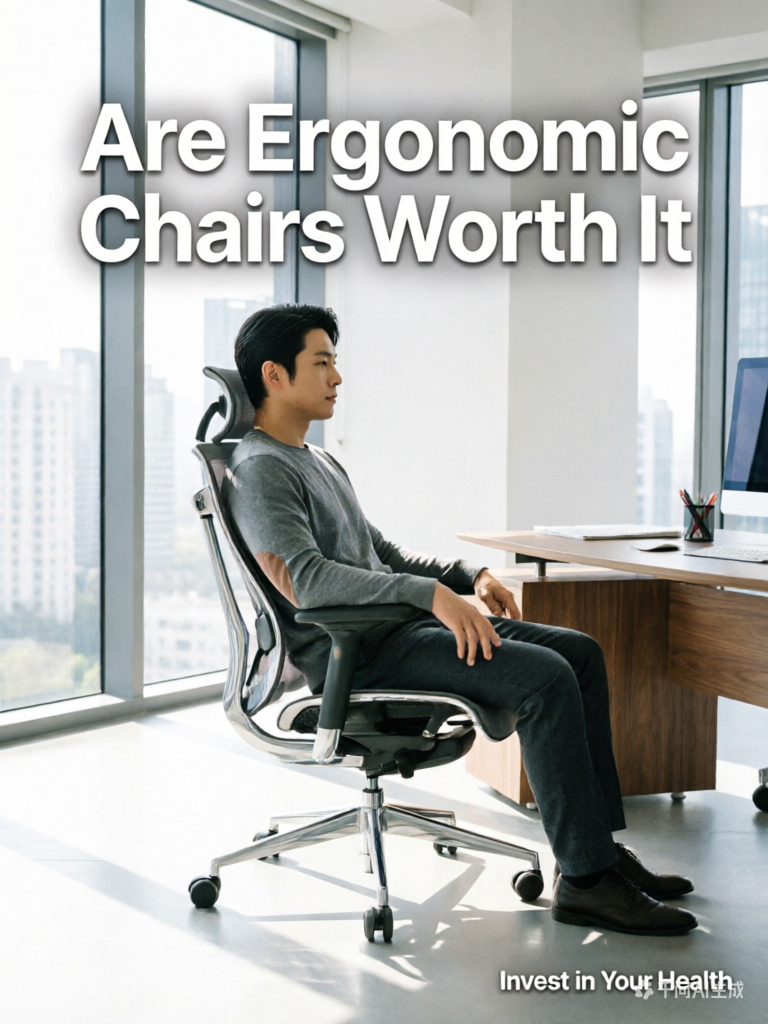
You have seen them everywhere: the sleek mesh backs, the adjustable armrests, the price tags that make your eyes water. The question is simple but nagging: are ergonomic chairs actually worth the money?
Can a $1,000 chair really be that different from a $200 one? Or is it all just clever marketing?
As someone who has spent hundreds of hours researching, testing, and sitting in everything from $50 clearance specials to $1,500 premium chairs, I am going to give you an honest, data‑driven answer. No fluff. No affiliate hype. Just the facts you need to decide.
The Short Answer: Yes — But Only If You Sit for More Than 4 Hours a Day
Here is the simple truth:
- If you sit less than 4 hours a day: A standard $150–250 chair is probably fine. You are not sitting long enough for poor ergonomics to cause significant problems.
- If you sit 4–8 hours a day: A quality ergonomic chair ($300–$600) is worth it. You will notice the difference in your back after a few weeks.
- If you sit 8+ hours a day: A premium ergonomic chair ($800–$1,500) is absolutely worth it. Consider it an investment in your spine that will pay dividends for decades.
Now let me explain the “why” behind this answer.
The Real Cost of a Cheap Chair (What You Cannot See)
When you buy a $100–200 chair, you are not just buying a chair. You are buying a series of hidden costs that add up over time.
1. Back Pain (The Most Obvious Cost)
The human spine is not designed to sit for long periods — especially not in a chair with no lumbar support. When you sit in a cheap chair, your lower back flattens out. This puts pressure on your spinal discs, leading to:
- Chronic lower back pain
- Sciatica (nerve pain running down your leg)
- Neck and shoulder tension
- Headaches from poor posture
Estimated cost: Chiropractor visits ($50–150 per session), physical therapy ($75–200 per session), over‑the‑counter pain relievers ($10–50/month). Over a year, back pain can easily cost you $500–2,000+ in medical expenses and lost productivity.
2. Reduced Productivity
When you are uncomfortable, you do not work as well. Studies have shown that discomfort reduces cognitive performance, increases error rates, and makes you less likely to stay focused. If you bill by the hour or value your time, this adds up quickly.
Estimated cost: If discomfort reduces your productivity by just 5%, and you earn $50/hour for 2,000 hours a year, that is $5,000 in lost value annually.
3. Frequent Replacement
Cheap chairs are not built to last. The foam flattens within 6–12 months. The gas lift fails. The armrests crack. The mesh sags. A $150 chair that lasts 2 years costs $75/year. A $1,000 chair that lasts 12 years costs $83/year — almost identical annual cost for dramatically better comfort.
Estimated cost: $75–150/year in chair replacements.
4. Poor Sleep Quality
Back pain does not stop when you leave the office. Many people with poor office chairs carry their pain into bed, leading to difficulty falling asleep, staying asleep, and waking up rested. Poor sleep affects everything: mood, immune function, weight, and long‑term health.
Estimated cost: Difficult to quantify, but chronic poor sleep is linked to $1,000s in healthcare costs annually.
The Bottom Line Hidden Costs:
Hidden CostAnnual Impact (Conservative)
| Back pain treatment | $200 – $1,000 |
| Productivity loss | $1,000 – $5,000+ |
| Chair replacement | $75 – $150 |
| Sleep quality impact | Difficult to quantify but significant |
| Estimated total | $1,275 – $6,150+ per year |
Suddenly, a $500–1,500 ergonomic chair does not seem so expensive, does it?
What You Actually Get With an Ergonomic Chair
Let me break down the specific features that make ergonomic chairs worth the money.
1. Proper Lumbar Support (The Spine Saver)
Your spine has a natural S‑curve. A cheap chair has a flat backrest or a fixed “lumbar pillow” that often misses your curve entirely. An ergonomic chair has adjustable lumbar support that you can raise, lower, or push in/out to match your exact spine. This single feature prevents the majority of lower back pain caused by sitting.
2. Adjustable Armrests (The Shoulder Saver)
When your armrests are at the wrong height, you hunch your shoulders. Over time, this leads to chronic neck and shoulder tension. Ergonomic chairs offer 3D or 4D armrests that adjust in height, width, depth, and pivot — allowing you to keep your shoulders relaxed while typing.
3. Seat Depth Adjustment (The Leg Saver)
If the seat is too short, your thighs are unsupported. If it is too long, it presses into the back of your knees, cutting off circulation. Adjustable seat depth solves both problems. This feature alone is worth hundreds of dollars for anyone with long or short legs.
4. Breathable Materials (The Sweat Saver)
Cheap chairs use bonded leather or cheap fabric that traps heat. After a few hours, your back and thighs are sweaty and uncomfortable. Quality ergonomic chairs use breathable mesh that allows air to flow, keeping you cool and dry.
5. Recline and Tilt (The Disc Saver)
Sitting perfectly upright all day is actually bad for your spinal discs. They need movement to stay healthy. Ergonomic chairs allow you to recline, shift positions, and change angles — reducing static spinal pressure by up to 40%.
6. Build Quality (The Wallet Saver)
A good ergonomic chair uses commercial‑grade components: metal bases, high‑density foam, durable mesh, and replaceable parts. These chairs last 10–15 years instead of 1–2 years. The 12‑year warranty on premium chairs is not a gimmick — it reflects real durability.
Ergonomic Chair Costs: What to Expect at Each Price Point
Price RangeWhat You GetWhat You MissBest For
| Under $150 | Height adjustment only, thin foam, basic materials | Lumbar support, adjustable armrests, breathability, durability | Part‑time sitting (<4 hours/day) |
| $150 – $300 | Basic lumbar (often fixed), mesh back, foam seat, 1D/2D armrests | Seat depth adjustment, 4D armrests, premium materials, long warranty | Entry‑level ergonomics (4–6 hours/day) |
| $300 – $600 | Adjustable lumbar (height + sometimes depth), 3D/4D armrests, breathable mesh, adjustable seat depth (on some) | Premium build quality, 12+ year warranty, advanced lumbar systems | Serious home office (6–8 hours/day) |
| $600 – $1,000 | All features above plus premium build, better lumbar systems, longer warranties | Premium brand name, highest‑end materials | Full‑time desk workers (8+ hours/day) |
| $1,000 – $2,000 | Best in class: LiveBack, Pellicle mesh, 4D armrests, 12+ year warranties, commercial durability, high resale value | Nothing — this is the premium tier | Serious back pain sufferers, lifetime investment |
Case Study: The Math of Buying a Premium Chair
Let me walk you through a real‑world comparison.
Scenario A: Buy a cheap $150 chair every 2 years
- Initial cost: $150
- Replacement every 2 years: $75/year
- Back pain treatment (conservative): $200/year
- Productivity loss (5%): $2,500/year (based on $50/hour, 2,000 hours)
- Total annual cost: ~$2,775
Scenario B: Buy a premium $1,200 chair once every 12 years
- Initial cost: $1,200
- Annualized cost: $100/year
- Back pain treatment: $50/year (much lower need)
- Productivity loss (1%): $500/year
- Total annual cost: ~$650
Difference: The premium chair saves you over $2,000 per year — and that is not even counting improved sleep, reduced stress, and better quality of life.
Over a 12‑year period, the cheap chair strategy costs approximately $33,300 in cumulative expenses. The premium chair strategy costs approximately $7,800. That is a savings of over $25,000. Investing in your spine pays off.
But I Do Not Have $1,000 — What Should I Do?
Not everyone can drop $1,200 on a chair today. I understand that. Here are realistic alternatives:
1. Buy Refurbished (Best Value)
Companies like BTOD, Crandall Office Furniture, and Madison Seating sell refurbished premium chairs for 50–70% less than new. A refurbished Steelcase Leap v2 often costs $500–700 instead of $1,200+. These chairs are professionally cleaned, reupholstered, and fitted with new casters and gas lifts. Many come with warranties similar to new chairs.
Recommendation: This is the single best way to get premium ergonomics on a budget.
2. Buy the Best You Can Afford Today
A $300 ergonomic chair like the Ticova, Hbada E3, or Sihoo B100 Pro is significantly better than a $150 cheap chair. You do not have to jump straight to $1,200. Upgrade incrementally as your budget allows.
3. Check Your Workplace Benefits
Many employers offer wellness spending accounts or ergonomic equipment stipends for remote workers. Ask your HR department. You might be able to get a premium chair partially or fully covered.
4. Look for Sales
Premium chairs go on sale during major holidays: Black Friday, Cyber Monday, Amazon Prime Day, and New Year sales. You can often save 15–25% off retail prices.
👉 Check current sale prices for Steelcase Leap on Amazon →
What About Health Conditions? When Is a Good Chair Essential?
For most people, a good ergonomic chair is a preventative investment. But for some, it is medically essential. If you have any of the following conditions, a quality ergonomic chair is not a luxury — it is a necessity:
- Chronic lower back pain (herniated disc, sciatica, spinal stenosis)
- Chronic neck or shoulder pain
- Previous back surgery
- Osteoarthritis or rheumatoid arthritis
- Fibromyalgia
- Pregnancy (proper back support becomes critical)
If any of these apply to you, the cost of a quality chair is trivial compared to the cost of medical treatment, physical therapy, and lost workdays.
Frequently Asked Questions (FAQ)
Are ergonomic chairs worth it for back pain?
Yes — absolutely. For people with existing back pain, an ergonomic chair with adjustable lumbar support is often the single most effective intervention after seeing a doctor. Many users report their pain disappearing within weeks of switching to a proper chair.
Are expensive ergonomic chairs really better than cheap ones?
Yes — but only if they have the right features (adjustable lumbar, seat depth, 4D armrests, breathable materials). The price difference reflects build quality, durability, warranty length, and adjustability range. That said, a $300 chair with good features is much better than a $100 chair with none.
How much should I spend on an ergonomic chair?
Simple answer: Spend 1% of your annual salary. If you earn $50,000/year, spend $500. If you earn $100,000/year, spend $1,000. This rule of thumb aligns investment with the time you spend sitting.
Can a cheap chair be adjusted to be ergonomic?
No. You cannot “adjust” a chair that lacks the necessary mechanisms. You cannot add lumbar adjustment to a chair without it. You cannot add seat depth adjustment. Cheap chairs lack the fundamental adjustability required for proper ergonomics.
How long do ergonomic chairs last?
- Cheap chairs ($100–200): 1–2 years
- Mid‑range chairs ($300–600): 3–7 years
- Premium chairs ($800–1,500): 10–15+ years
The 12‑year warranties on premium chairs are not marketing — they reflect real durability.
Do I need a $1,000 chair if I work from home full‑time?
If you work from home full‑time (8+ hours/day, 5 days/week), you spend more time in your office chair than in your car, on your couch, or at your dining table. Most people do not hesitate to spend $1,000+ on a mattress (1/3 of your life) or $500+ on tires for their car. Your office chair deserves a similar investment.
What is the best ergonomic chair for the money?
For most people, the Steelcase Leap v2 (refurbished) offers the best value: premium ergonomics for $500–700. For new chairs, the Ticova (under $300) or HON Ignition 2.0 (under $500) are excellent values. For those who can afford it, the Herman Miller Aeron or Steelcase Gesture are lifetime investments.
👉 See refurbished Leap prices on Amazon →
Is it worth buying an ergonomic chair for gaming?
Yes — gamers often sit for longer continuous sessions than office workers. The same ergonomic principles apply. In fact, many serious gamers have abandoned racing‑style “gaming chairs” for ergonomic office chairs because the back support is vastly better.
What is the difference between a $300 and $1,000 ergonomic chair?
The main differences are:
- Build quality and durability (plastic vs metal components)
- Warranty length (1–3 years vs 12 years)
- Adjustability range (2D armrests vs 4D)
- Lumbar adjustability (height only vs height + depth + firmness)
- Materials (bonded leather vs breathable mesh)
- Resale value (near zero vs 50–70% after years)
Can an ergonomic chair fix my posture?
Yes — but it is not automatic. A good ergonomic chair enables good posture by providing support in the right places. You still need to adjust the chair correctly and be mindful of your sitting habits. But with the right chair, maintaining good posture becomes natural rather than a constant effort.
Are standing desks better than ergonomic chairs?
This is not an either/or question. The best solution is both: an ergonomic chair and a standing desk that allows you to alternate positions throughout the day. Standing all day has its own problems (leg fatigue, foot pain, varicose veins). The human body needs movement — not any single static position.
Final Verdict: Are Ergonomic Chairs Worth It?
After all the research, testing, and number‑crunching, here is my honest conclusion:
Yes — ergonomic chairs are worth it for anyone who sits more than 4 hours a day. They are not a luxury. They are a tool — like a good mattress, supportive shoes, or prescription glasses. They solve real problems: back pain, neck tension, reduced productivity, poor sleep.
The key is to buy the right chair for your budget and body. You do not need to spend $1,500. A $300 chair with adjustable lumbar and breathable mesh is a massive upgrade over a $150 basic chair. And a refurbished premium chair can give you 90% of the benefit for 50% of the price.
Do not wait until you are in pain. Back pain is much harder to fix than to prevent. The best time to buy an ergonomic chair was five years ago. The second best time is today.
👉 See top‑rated ergonomic chairs on Amazon →
Disclosure: This post contains affiliate links. If you purchase through our links, we may earn a commission at no extra cost to you. We only recommend products we have researched thoroughly.