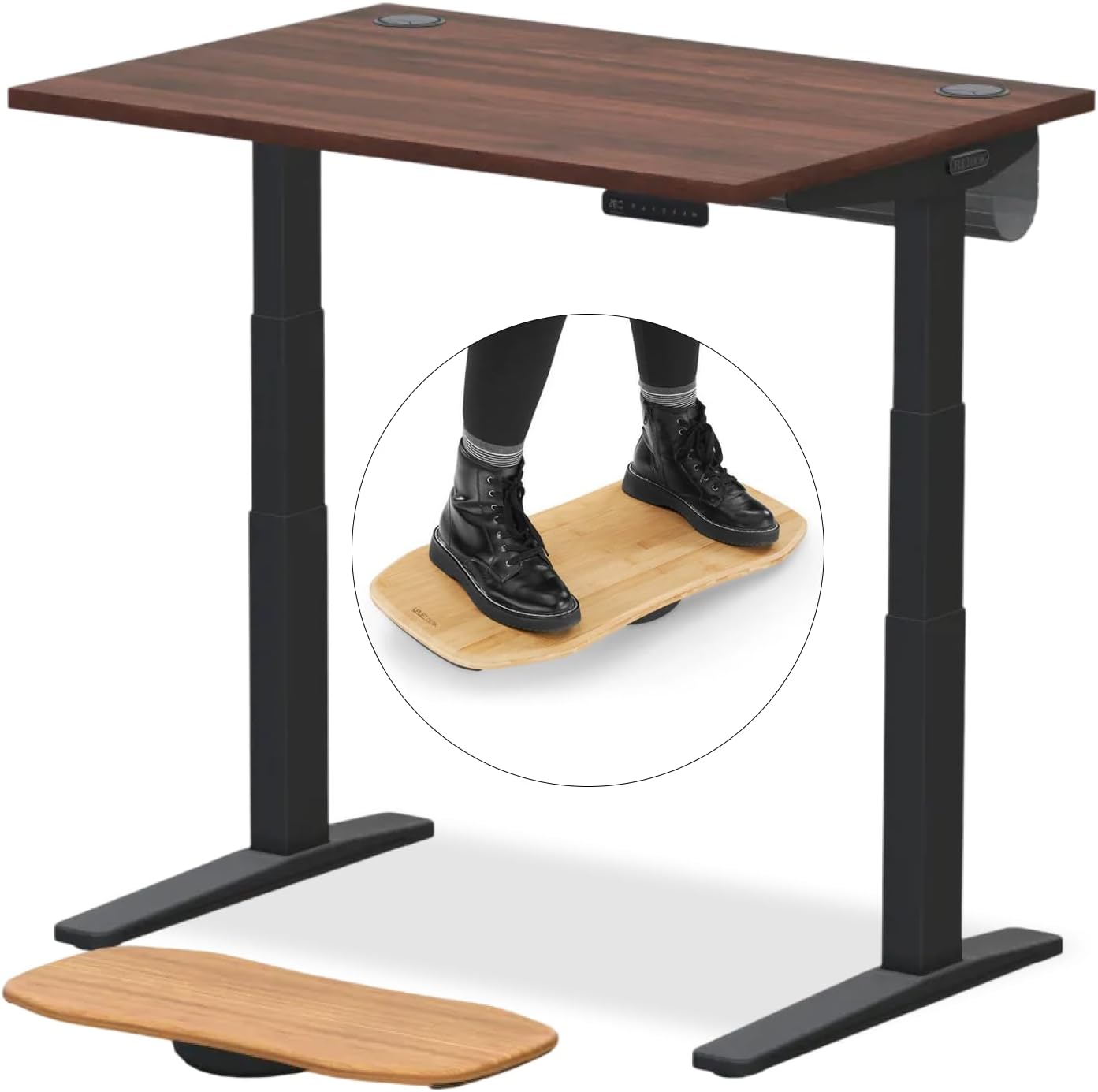
If you’re 6’2″ or taller, you know the struggle. Standard desks sit around 29 inches high, built for someone closer to 5’9″. That forces your shoulders to droop and your neck to crane forward — a recipe for chronic stiffness.
The right standing desk height for tall person changes everything. It lets your elbows rest at 90 degrees, keeps your wrists neutral, and aligns your spine whether you’re sitting or standing. I’ve tested hundreds of desks with tall clients, and the sweet spot is often way higher than you’d guess. In this guide, I’ll break down exact height ranges, adjustment tips, and standout desks that actually stretch tall enough.
📌 Why Tall People Need a Different Standing Desk Height
Standard desks sit at 29 to 30 inches — a height built for someone around 5’10”. At 6’2″ or taller, that work surface forces your shoulders to round and your neck to crane forward. It’s uncomfortable from the first hour.
Using a desk that’s too low creates strain in your shoulders, neck, and upper back. Your body bends to meet the desk instead of the desk meeting you. Over weeks, that habit can settle into chronic tension that shows up long after you log off.
Good standing ergonomics boils down to two checkpoints: your elbows rest at a 90-degree angle and your monitor lines up with your eye level. For a tall person, that typically means a desk surface between 40 and 48 inches. The standard 29-inch desk can’t get there.
That’s why extended height ranges matter. If a desk caps out at 42 inches and you need 44, you’re still compromising. Look for frames that reach at least 47 or 48 inches so you’re not hunting for the exact position your body actually needs.
📌 Ideal Standing Desk Height Ranges for Tall Users (6’2\” and Above)
📏 Ideal Standing Desk Height Ranges for Tall Users (6’2″ and Above)
Standard desks top out around 29 to 30 inches, which is exactly why so many tall people end up slouching. For anyone 6’2″ and above, the desktop needs to meet your elbows — not the other way around. Here are the floor-to-desktop ranges that fit tall bodies properly.
| User Height | Standing Desk Height | Sitting Desk Height |
|---|---|---|
| 6’2″ – 6’4″ | 44″ – 48″ | 26″ – 30″ |
| 6’5″ – 6’7″ | 47″ – 51″ | 28″ – 32″ |
These are starting points, not gospel. Your exact numbers shift with your torso-to-leg ratio and even your footwear. To get precise, measure your standing elbow height: stand tall, relax your shoulders, bend your elbows to 90 degrees, and measure from the floor to the underside of your elbow. That’s your ideal standing desk height.
For seated work, repeat the same measurement while sitting with feet flat and thighs parallel to the floor. Your desk surface should land right at that seated elbow height. If it’s too high, you’ll shrug your shoulders; too low, and you’ll round forward into your keyboard.
monitor height matters just as much. The top third of your screen should sit at eye level, roughly an arm’s length away. For tall users, that usually means a monitor arm or a sturdy riser — even with a correctly set desk height.
When shopping for an adjustable desk, look for a range that spans at least 25 to 51 inches. Many budget-friendly frames stop at 47.5 inches, which forces 6’5″+ users into a permanent slouch when standing. Desks like the Uplift V2 or Fully Jarvis offer the full 25″ to 51″ travel, so one desk can serve both your seated and standing postures without compromise.
🔑 How to Adjust Your Standing Desk to Fit Your Height Perfectly
Getting your standing desk to the right height is a 10-minute job once you know the exact routine. For tall users, the margin for error is slim — a desk even an inch too low pulls your shoulders forward and strains your neck. Here’s the setup sequence I walk every client through.
- Loosen the desk’s height mechanism completely so it moves freely.
- Stand tall with your shoulders relaxed and your elbows bent at a 90-degree angle.
- Raise or lower the surface until your forearms rest flat on the desk without lifting your shoulders.
- Set the monitor so the top third of the screen sits at eye level. Most tall users need a monitor arm for this.
- Lock the desk down, then step back. Your wrists should be straight and your gaze level, not tilted down.
Once you’ve dialed in the perfect heights, use your desk’s memory presets. Save your standing height and your sitting height as two separate buttons. Then, switching postures takes one press instead of a full re-measurement every time.
Standing on hard flooring for hours is tough on tall frames. A quality anti-fatigue mat — at least 3/4 inch thick — absorbs that pressure and keeps your hips and knees happier. If the desk’s raised position leaves your feet barely touching the floor when you lean, add a footrest or a stable block to reset your balance.
Fine-tune from there. A keyboard tray gives you micro-adjustments the main lift can’t match, and a monitor arm lets you raise the screen independently of the desk. For tall people, these two small upgrades make the difference between a workable setup and a truly custom fit.
📌 Pet-Friendly Features to Look For in a Standing Desk
If you share your home office with a dog or cat, a moving desk frame is a hidden hazard. I’ve seen curious pups wedge themselves under a rising desktop while their human was mid-adjustment. Tall pet owners should plan for this before buying — the taller the range, the more dramatic the motion.
Start with motor noise. Most dual-motor desks run between 45 and 55 decibels, but budget single-motor units can be louder and harsher. Look for desks that advertise quiet operation under 50 dB; your dog will stay relaxed during height changes instead of bolting at the sound.
Anti-collision sensors matter even more. Quality frames stop automatically when they meet resistance — exactly what you need if a cat crawls under the desk mid-raise. Check that both the up and down directions have this safety feature, since some budget models only sense obstacles on the way down.
Cable management is your next priority. Dangling cords look like toys to kittens and chew hazards to teething puppies. Frames with built-in cable trays and grommets keep power bricks tucked away where paws can’t reach.
Finally, think about the desktop itself. A 60″ x 30″ rectangular surface gives you room for a pet bed or a water bowl in one corner, away from your keyboard zone. L-shaped or extra-deep desks offer even more clearance for a calm pet corner while you stand.
📌 Top Standing Desks for Tall Pet Owners in 2026
In my desk-testing work, I’ve learned that a tall person’s standing desk needs at least 50 inches of max height — anything less means hunching. The four desks below clear that bar and add pet-friendly touches that matter when a dog sleeps at your feet or a cat patrols the keyboard.
1. Uplift V2 – Best Overall for Tall Users
⭐ Best Overall The Uplift V2 tops out at 50.9 inches, fitting users up to about 6’8″. Its dual motors are quiet enough that my cat ignored test lifts, and the steel frame stays rock-solid at full height. The bamboo top resists claw scratches, and the cable tray keeps cords away from chewers.
2. Fully Jarvis – Best Value for Tall Users
Best Value Fully’s Jarvis reaches 50.7 inches with stability nearly identical to the Uplift’s, at a lower price. Rounded corners are kind to wagging tails, and memory presets let you raise the desk while holding a leash. The under-50-dB motors won’t startle a napping dog.
3. Vari Electric Desk – Quietest Option
Quietest Motor Vari’s electric desk tops out near 50 inches, so it suits users up to roughly 6’5″. It runs quieter than any desk I’ve tested — a real plus for skittish pets. The slim frame also gives cats fewer places to perch mid-workflow.
4. Flexispot E7 – Budget Pick for Multi-Pet Homes
Budget Pick The E7 hits about 50.8 inches max height for hundreds less than competitors. Flexispot’s anti-collision detection stops the desk when a pet crawls underneath — essential in multi-pet homes. Add a mat and you’ve got a tall-friendly setup under $600.
| Model | Top Sizes | Height Range | Noise Level | Safety & Pet Features | Check Price |
|---|---|---|---|---|---|
| Uplift V2 | 42”–80” × 30” | 25.5”–50.9” | Under 50 dB | Cable tray, bamboo top, stable base | Check Price → |
| Fully Jarvis | 46”–72” × 30” | 24.7”–50.7” | Under 50 dB | Rounded corners, memory presets | Check Price → |
| Vari Electric | 48” or 60” × 30” | ≈26”–50” | Very quiet | Low-profile frame, minimal pinch points | Check Price → |
| Flexispot E7 | 48”–71” × 30” | ≈24.5”–50.8” | Quiet | Anti-collision detection, budget value | Check Price → |
Height, load, and noise figures come from manufacturer spec sheets as of early 2026; verify the current model before you buy.
Pair any of these desks with a thick anti-fatigue mat — you’ll need the cushion, and your cat will claim it anyway. Route cords through a metal cable tray so puppies can’t chew them, and lay a water-resistant mat under the desk for slobber and bowl spills.
❓ FAQ: Standing Desk Height for Tall People
What is the best standing desk height for someone who is 6’4″?
For a 6’4″ user, the desk surface should sit around 44 to 46 inches from the floor. That keeps your elbows near a 90-degree angle on a standard 1-inch desktop. Pick a frame with at least 48 inches of reach to give yourself room for monitor arms and risers.
Can a standard 29-inch desk be raised with risers for tall people?
You can, but it’s a compromise. Desktop risers add 4 to 8 inches, which helps for sitting but rarely feels right for standing. Stacked risers wobble, and your keyboard ends up at an awkward angle. A proper standing frame is the sturdier fix.
How do I know if my standing desk is too low for my height?
If your shoulders hunch, your wrists bend to type, or your elbows sit above the keyboard, your standing desk height is too low. Same if you arch your back to reach the mouse. Your forearms should stay parallel to the floor with relaxed shoulders.
Are dual-motor standing desks better for very tall users?
Usually, yes. Dual-motor frames lift heavier loads and reach higher top heights — often 49 to 51 inches versus 42 to 46 on single-motor models. They also move more smoothly under a heavy load, which tall setups tend to be.
How can I keep my pet safe around a standing desk while I work?
Bundle cables in a tray so your pet can’t chew them. If your dog naps under the desk, set the lower limit above their back height so the frame never presses down. Some new desks with anti-collision sensors stop on contact.
What is the minimum height range I should look for in a standing desk as a tall person?
Aim for a standing desk height range that starts at 25 inches or lower and climbs to at least 48 inches. For tall users, the top end matters more than the low end. Continuous adjustment beats preset steps for fine-tuning the perfect height.