
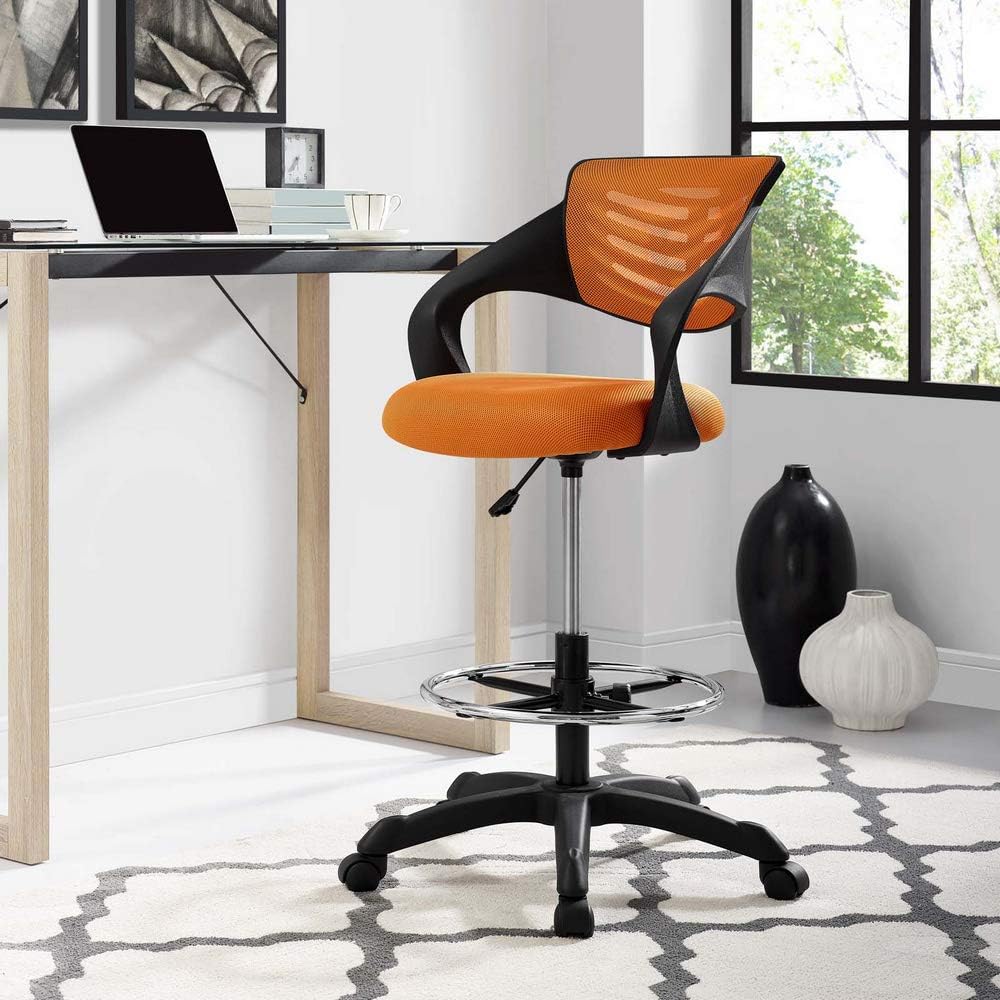
Standing Desk Chair vs Drafting Chair: What’s the Difference?
A standing desk chair and a drafting chair can look very similar, but they are not always the same thing. The right choice depends mainly on your desk height, how often you switch between sitting and standing, and how much height you actually need.
Quick answer:
A drafting chair is generally a taller chair designed for elevated work surfaces and commonly includes a foot ring. A standing desk chair is a broader term for seating intended to work with a raised or height-adjustable desk. In many cases, a drafting chair can serve as a standing desk chair, but not every standing desk chair has the same height range or design as a traditional drafting chair.
Standing Desk Chair vs Drafting Chair at a Glance
| Feature | Standing Desk Chair | Drafting Chair |
|---|---|---|
| Main purpose | Seating for raised or height-adjustable desks | Seating for elevated work surfaces |
| Seat height | Varies significantly by model | Usually designed to reach higher work surfaces |
| Foot support | May use a foot ring or separate footrest | Often includes a built-in foot ring |
| Best for | Sit-stand workstations and flexible home offices | Higher desks, counters and elevated workstations |
| Typical posture | Can support normal sitting or a higher perch | Often encourages a taller, more upright sitting position |
| Flexibility | Often better when desk height changes frequently | Excellent for consistently elevated surfaces |
What Is a Standing Desk Chair?
A standing desk chair is a broad category rather than one specific chair design. It generally refers to seating that works with a standing desk or another elevated workstation.
Unlike a conventional office chair, a standing desk chair needs to work at a different relationship between the seat and the work surface. Depending on the model, it may function as a taller office chair, a perch-style seat, or a drafting-style chair with a foot ring.
This makes the term standing desk chair useful when shopping, but it is not enough by itself to determine whether a chair will actually fit your workstation. The most important specification is still the chair’s usable seat-height range.
What to check on a standing desk chair
- Minimum and maximum seat height
- Foot support at the higher settings
- Seat depth and width
- Backrest and lumbar support
- Armrest height and clearance
- Whether the chair works when the desk is lowered
What Is a Drafting Chair?
A drafting chair is a taller type of task chair originally associated with drafting tables and other elevated work surfaces. Modern drafting chairs are also commonly used with standing desks, counter-height workstations and studio work areas.
The defining characteristic is the ability to raise the seat higher than a conventional office chair. Many models also include a circular or adjustable foot ring, which gives your feet somewhere to rest when the seat is elevated.
That combination of extra height and foot support is why drafting chairs are often a natural fit for standing desks that are used at a raised position.
Standing Desk Chair vs Drafting Chair: The Biggest Difference
The easiest way to understand the difference is to think about category versus design.
“Standing desk chair” describes what the chair is intended to work with. “Drafting chair” describes a particular type of taller chair designed to reach elevated work surfaces.
Therefore, there is considerable overlap between the two. A drafting chair can be an excellent standing desk chair, especially when you need a higher seat and built-in foot support. However, a standing desk chair may use a different design and may have a lower minimum height that makes it more versatile with a height-adjustable desk.
Better for flexibility
A good option when your desk frequently moves between sitting and standing positions and you want the chair to work across a wider range of desk heights.
Better for elevated work
A strong choice when you regularly work at a higher surface and need extra seat height plus a foot ring for comfortable leg support.
Which Is Better for a Standing Desk?
Neither is automatically better. The right choice depends on how you use the desk.
Choose a standing desk chair if you:
- Use an electric sit-stand desk that regularly moves between sitting and standing height.
- Want the chair to work at a conventional seated position as well as a raised position.
- Need more flexibility in seat height.
- Switch between sitting and standing throughout the workday.
- Prefer a chair that behaves more like a conventional ergonomic office chair.
Choose a drafting chair if you:
- Keep your desk relatively high for long periods.
- Need more seat height than a standard office chair provides.
- Work at a drafting table, counter-height surface or elevated workstation.
- Want a built-in foot ring for elevated seating.
- Prefer a higher perch rather than lowering the desk every time you sit.
Seat Height Matters More Than the Name
One of the biggest mistakes when comparing a standing desk chair and a drafting chair is shopping by the product name instead of the actual specifications.
A chair labeled “standing desk chair” may not rise high enough for your preferred desk setting. Likewise, a drafting chair may reach the required height but sit too high when you lower the desk.
Before buying, compare the chair’s minimum and maximum seat height with the height range of your standing desk. You want enough adjustment to position your arms comfortably at the keyboard without raising your shoulders or forcing your wrists into an awkward angle.
Important buying rule
Do not choose a chair simply because the listing says “drafting” or “standing desk.” Compare the actual seat-height range with the height of your desk and the position where you normally work.
Why the Foot Ring Matters on a Drafting Chair
When a chair is raised significantly above a normal office-chair position, your feet may no longer rest comfortably on the floor. A foot ring provides another support point for the feet and lower legs.
This is one of the most important differences between a conventional office chair and a drafting chair. If you need a tall seat but the chair has no practical foot support, the extra height may not translate into better comfort.
An adjustable foot ring is especially useful because users have different leg lengths. The chair should allow you to find a position where your feet are supported without creating excessive pressure behind the knees.
Drafting Chair vs Standing Desk Chair for Long Hours
If you work for several hours at a time, chair height alone is not enough. Back support, seat depth, cushioning, armrest position and foot support all become important.
A drafting chair can work well for long periods at an elevated workstation, but it should not be selected simply because it is taller. You still need a seat and backrest that fit your body.
If long-hour comfort is your main priority, see our dedicated guide:
Best Standing Desk Chair for Long Hours.
What About Back Pain?
If back comfort is your primary concern, neither category should automatically be considered better. A well-fitting chair at the correct height is more important than the label on the product.
Look for an appropriate seat depth, supportive backrest, adjustable height and stable foot support. Your workstation should also allow your elbows and wrists to remain in a comfortable position rather than forcing you to reach upward toward the desk.
For a more focused comparison of this use case, see:
Best Standing Desk Chair for Back Pain.
Can a Drafting Chair Be Used at a Regular Desk?
Sometimes, but this depends on the chair’s minimum seat height.
Some drafting chairs can be lowered enough for a higher-than-standard desk or even certain conventional workstations. Others have a minimum height that remains too high for a normal office desk.
This is why the lower end of the adjustment range is just as important as the maximum height. If you regularly lower your standing desk, make sure the chair can follow it down to a useful sitting position.
Standing Desk Chair vs Drafting Chair for Short People
Shorter users should pay particular attention to the minimum seat height and seat depth. A chair that starts too high can make it difficult to maintain comfortable leg and foot support.
A drafting chair is not automatically a poor choice for a shorter person, but the height range needs to match the individual user rather than simply matching the desk.
See our dedicated guide:
Best Standing Desk Chair for Short People.
Standing Desk Chair vs Drafting Chair for Tall People
Taller users usually have the opposite problem: the chair may not rise high enough to match the desk, or the seat may be too shallow for comfortable leg support.
When comparing models, look at maximum seat height, seat depth, backrest height and foot-ring position. A drafting chair can provide the extra elevation needed for a tall workstation, but the rest of the chair still needs to fit your body.
For more detailed guidance, see:
Best Standing Desk Chair for Tall People.
How to Choose Between the Two
| Your situation | Better starting point | Why |
|---|---|---|
| Desk frequently moves up and down | Standing desk chair | Greater flexibility is useful |
| Desk stays raised most of the day | Drafting chair | Extra height and foot support are useful |
| Need a lower sitting position | Check standing desk chair first | Minimum seat height matters |
| Fixed high workstation | Drafting chair | Designed for elevated surfaces |
| Want built-in foot support | Drafting chair | Foot rings are common in this category |
7 Things to Check Before Buying
- Seat-height range: Make sure the chair reaches your preferred desk position.
- Minimum height: Check whether you can lower the chair enough when the desk is lowered.
- Foot support: If your feet cannot comfortably reach the floor, look for a foot ring or another stable support.
- Seat depth: Make sure the seat does not force excessive pressure behind your knees.
- Back support: Look for a backrest that fits your body and intended working position.
- Armrest clearance: Make sure the armrests do not prevent you from getting close enough to the desk.
- Desk-chair compatibility: Judge the chair and desk as one workstation rather than buying either item independently.
Standing Desk Chair vs Drafting Chair: Final Verdict
The best choice comes down to how high you need the chair to go and how often your desk changes height.
Choose a standing desk chair when you want flexible seating for a height-adjustable desk and expect to move between sitting and standing positions regularly.
Choose a drafting chair when your workstation stays elevated or you need more seat height than a conventional office chair can provide. A built-in foot ring can also make elevated seating much more practical.
Most importantly, don’t choose based on the product name alone. Compare the chair’s actual height range, foot support, seat dimensions and back support with your desk and your body. The best chair is the one that lets the entire workstation work together comfortably.