
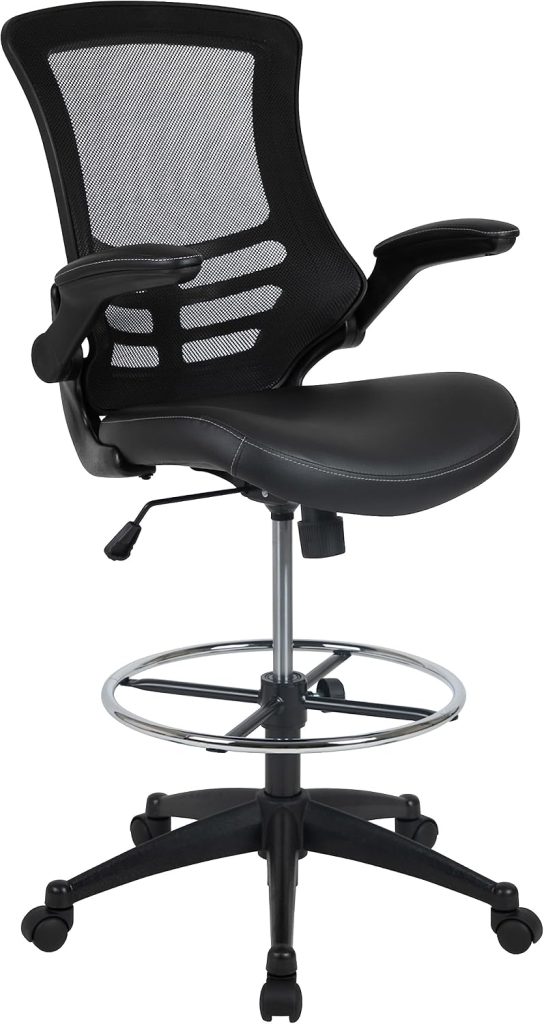
The best standing desk chair for short people should provide enough height for an elevated desk without forcing your feet, knees, or lower back into an uncomfortable position. Seat height, seat depth, foot support, and backrest fit are especially important for shorter users.
Why Is Finding a Standing Desk Chair Harder for Short People?
Standing desk chairs are often designed with elevated work surfaces in mind. That means their seats may sit considerably higher than those of conventional office chairs. For shorter users, this can create a difficult combination: the chair needs to be high enough to reach the desk, but not so high that the feet are left unsupported.
Seat depth can also become an issue. A deep seat may prevent a shorter user from sitting far enough back to use the backrest comfortably while keeping the knees in a natural position.
This is why the best standing desk chair for short people is not necessarily the chair with the greatest maximum height. A better choice is one that provides an appropriate adjustment range and allows you to create a comfortable relationship between your body, chair, and desk.
Standing Desk Chairs
covers the main types, features, and buying considerations for elevated sit-stand workstations.
What Short People Should Look for in a Standing Desk Chair
Lower Minimum Seat Height
A lower minimum height gives shorter users more flexibility when the desk and chair need to work together.
Moderate Seat Depth
A seat that is too deep can make it difficult to sit against the backrest without placing excessive pressure behind the knees.
Adjustable Foot Support
A stable foot ring can help support your legs when your feet cannot comfortably reach the floor.
Supportive Backrest
The backrest should contact the areas it is intended to support without forcing your shoulders or lower back into an awkward position.
Adjustable Armrests
If the chair has armrests, adjustable height can make it easier for shorter users to maintain comfortable upper-body positioning.
Stable Base
A stable five-star base becomes especially important when the chair is used at a higher seating position.
Best Standing Desk Chairs for Short People
The following drafting-style and elevated chair options are worth considering for a standing desk setup. Product configurations can vary, so check the current height range, seat dimensions, foot support, and other specifications before purchasing.
1. Office Star DC Series Deluxe Mesh Back Drafting Chair
The Office Star DC Series is a drafting-style chair that can work well with elevated workstations. Its mesh back design provides a more breathable alternative to heavily padded seating, while the drafting-chair format provides the additional height needed for a standing desk.
For shorter users, the most important consideration is whether the chair’s lower adjustment range works with your desk height. If the minimum setting is still too high, the chair may not be a good fit even if its overall design is otherwise comfortable.
2. Flash Furniture Mid-Back Mesh Drafting Chair
The Flash Furniture Mid-Back Mesh Drafting Chair is another style worth considering for an elevated workstation. Its mid-back design can provide a less bulky seating option for users who do not need a large executive-style chair.
Shorter users should pay particular attention to the seat depth and minimum seat height. A chair that allows you to sit against the backrest without the seat extending too far beneath your legs is generally easier to fit.
3. HUANUO Ergonomic Drafting Chair
HUANUO offers several drafting-style ergonomic chairs designed for elevated work surfaces. Models with a foot ring and adjustable seat height can be useful when a standing desk requires a higher sitting position.
For shorter users, compare the minimum seat height rather than focusing only on the chair’s maximum height. A wide adjustment range can make it easier to find a position that works with both your body and your desk.
4. KERDOM High-Back Drafting Chair
A high-back drafting chair can be appealing if you want the general feel of a conventional office chair while working at an elevated desk. The larger backrest may provide more upper-back coverage than a simple stool-style design.
However, shorter users should make sure the seat depth and backrest geometry are appropriate for their body size. A tall backrest alone does not guarantee a good ergonomic fit.
5. Carnegy Avenue Kelista Mesh Drafting Chair
The Carnegy Avenue Kelista is another drafting-style option to consider when shopping for elevated seating. A mesh back can provide airflow, while the drafting-chair format is designed for higher work surfaces.
For shorter users, verify the chair’s current seat-height range and seat dimensions before buying. The right fit depends on your body proportions as well as the height of your standing desk.
Standing Desk Chair Measurements That Matter for Short People
| Measurement | Why It Matters | What Shorter Users Should Check |
|---|---|---|
| Minimum seat height | Determines how low the chair can be adjusted | Lower settings generally provide more flexibility |
| Seat depth | Affects how far you need to sit back | Avoid excessively deep seats |
| Seat width | Affects overall seating fit | Choose a width that does not make armrests difficult to use |
| Foot-ring height | Supports the legs when the chair is elevated | Make sure your feet can rest naturally |
| Backrest position | Affects contact with your back | Check that the lumbar area is appropriately positioned |
Why Seat Depth Is Important for Short People
Seat depth is one of the most overlooked measurements when choosing an ergonomic chair. A chair can have excellent padding and a supportive backrest but still feel uncomfortable if the seat is too deep for your legs.
When a seat is too deep, a shorter user may need to move forward to avoid pressure behind the knees. This can leave the back unsupported and make it harder to use the chair’s lumbar area effectively.
A better-fitting seat allows you to sit sufficiently far back while maintaining comfortable space behind the knees. This is one reason smaller users should pay close attention to dimensions rather than relying only on general labels such as “ergonomic” or “drafting chair.”
How to Use a Standing Desk Chair If Your Feet Do Not Reach the Floor
This is one of the most important considerations for shorter users. Because standing desks are higher than conventional desks, the chair may need to be raised high enough that your feet no longer rest comfortably on the floor.
In this situation, a stable foot ring can provide a place to support your feet. The goal is to avoid leaving your legs unsupported while sitting at an elevated workstation.
A simple setup check
- Raise the chair enough to work comfortably with the desk.
- Place your feet on the floor or a stable foot support.
- Make sure your knees and lower legs are not left unsupported.
- Sit back against the backrest rather than perching on the edge.
- Change position regularly instead of remaining seated in one posture for the entire workday.
Standing Desk Chair vs. Regular Office Chair for Short People
| Feature | Standing Desk Chair | Regular Office Chair |
|---|---|---|
| Typical height | Higher adjustment range | Usually lower |
| Short-user challenge | Minimum height may still be high | May not reach an elevated desk |
| Foot support | Often uses a foot ring | Usually uses the floor |
| Best use | Elevated sit-stand workstations | Conventional desks |
How to Choose the Right Standing Desk Chair Height
Do not choose your chair based solely on your height. Your desk height, keyboard position, monitor position, leg length, and seating preference all affect the correct setup.
Start by determining the working height you need at your standing desk. Then check whether the chair can reach that height while still allowing you to sit comfortably. For shorter users, the minimum seat height is particularly important because an elevated chair may otherwise leave the body in an awkward position.
Before buying, check these five measurements
- Minimum seat height
- Maximum seat height
- Seat depth
- Seat width
- Foot-ring or footrest position
Common Mistakes Short People Make When Buying a Standing Desk Chair
Choosing by Maximum Height
A high maximum height is useful for an elevated desk, but shorter users also need a sufficiently low minimum height.
Ignoring Seat Depth
A deep seat can make it difficult to use the backrest comfortably.
Ignoring Foot Support
If the chair is elevated, unsupported feet can become an important comfort issue.
Assuming One Size Fits All
Two chairs with similar height ranges can feel very different because of differences in seat depth and backrest geometry.
Who Should Buy a Standing Desk Chair for Short People?
- Shorter users who work at a height-adjustable standing desk.
- People who need elevated seating but find conventional drafting chairs too tall.
- Users who want a foot ring for additional lower-leg support.
- People who need a shallower or more compact seating configuration.
- Users who alternate between sitting and standing during the workday.
Related SitBetterLab Guides
- Standing Desk Chairs
— explore the complete category and related buying guides. - Best Standing Desk Chair for Long Hours
— compare options for extended work sessions. - Best Standing Desk Chair for Back Pain
— focus on back support and workstation fit. - Best Office Chair for Lower Back Pain
— consider conventional ergonomic office chairs if you spend most of your time seated.
Frequently Asked Questions
What is the best standing desk chair for short people?
The best standing desk chair for short people is one with an appropriate minimum seat height, manageable seat depth, and reliable foot support. The chair should also work with the actual height of your standing desk.
What seat height is best for short people?
There is no single seat height that works for every shorter user. Leg length, desk height, seat design, and foot support all affect the correct setting. Instead of relying on a universal number, compare the chair’s adjustment range with your own measurements and workstation.
Are drafting chairs good for short people?
Some drafting chairs can work well for shorter users, but many are designed for relatively high work surfaces. The most important specifications to check are minimum seat height, seat depth, and foot-ring position.
Should short people use a footrest with a standing desk chair?
A stable foot support can be useful if your feet cannot comfortably reach the floor when the chair is adjusted for your desk. Some standing desk chairs include a built-in foot ring, while other setups may require a separate support.
Is a standing desk chair better than a regular office chair for short people?
It depends on your workstation. A standing desk chair may be the better option if you regularly use an elevated desk, while a conventional ergonomic chair may be easier to fit if you primarily work at a standard desk height.
Bottom Line
For shorter users, the best standing desk chair is not necessarily the tallest or most heavily padded model. Focus on the minimum seat height, seat depth, foot support, and backrest fit. A chair that works with both your body proportions and your standing desk will generally be easier to use comfortably.
Explore the complete Standing Desk Chairs hub for more buying guides.
Note: This article provides general information about ergonomic seating and workstation setup. It is not medical advice. If you have persistent, severe, or worsening pain, consult an appropriate healthcare professional.