
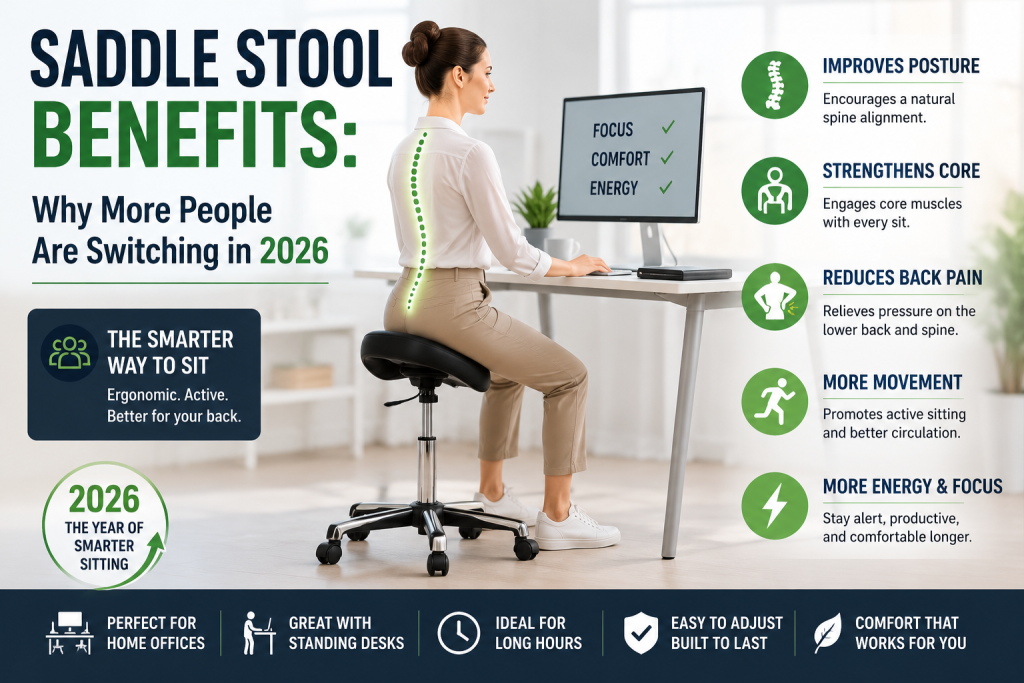
You have likely seen them in dental offices or design studios: the unusual, horse‑saddle‑shaped stools that look nothing like a traditional office chair. Perhaps you have wondered if they are a gimmick or a genuine solution for the back pain that creeps in after a few hours at your desk. In 2026, saddle stools are moving out of niche industries and into home offices, standing desks, and remote workspaces worldwide.
Why the sudden shift? The answer lies in a growing body of research, the evolution of remote work, and a fundamental rethinking of what “sitting” should actually look like. This guide explores the evidence‑backed benefits of saddle stools, explains the key features that set them apart, and shows why more people are making the switch.
The 90‑Degree Problem: Why Traditional Chairs Fail You
Most office chairs force your hips into a 90‑degree angle. This mechanically rolls your pelvis backward — a posterior pelvic tilt — which flattens your lower back into a damaging C‑curve. This C‑slump dramatically increases anterior disc compression, stretches spinal ligaments, and leads to chronic back pain. It is this flexion of the spine that increases static loading on the intervertebral discs and creates mechanical deformation of the surrounding soft tissue structures, thus causing pain.
The human spine is naturally shaped like an “S” (lumbar lordosis). When you stand, your pelvis is neutral, and this curve is effortlessly maintained, distributing gravity evenly across your intervertebral discs. Sitting in a 90‑degree chair breaks that curve.
To maintain this lordosis, an angle of 135° between the hip and trunk is thought to be required. This can be done with the use of a saddle chair, which opens your hip angle, tilts your pelvis forward (anterior pelvic tilt), and preserves your spine’s natural standing posture while seated.
Key Benefits of Saddle Stools (2026 Evidence)
Scientific research supports what many users have discovered through experience: saddle stools provide genuine, measurable health benefits compared to traditional seating.
1. Significant Lower Back Pain Reduction (p<0.001)
A landmark 2003 study of 25 dental surgeons with existing low back pain found that the saddle chair had a significant positive effect on both lumbar spine range of motion and pain levels at the 0.1% level (p<0.001). The null hypothesis was rejected: saddle chairs do have a significant effect on low back pain and range of movement. This is not a subtle effect—it is a statistically robust, clinically meaningful improvement that is rare to see in ergonomic interventions.
Further studies have confirmed these findings. A 2017 study found that sitting on a saddle chair caused the positive effect of an increase of lumbar lordosis. The study measured significantly higher lumbar lordosis depth when sitting on a saddle chair compared to an office chair with a backrest. Another study noted that the most appropriate posture for the lumbopelvic region was produced by the saddle chair.
Saddle chairs are beneficial for reducing low back pain, promoting better spinal postures including those in the upper body, head, and neck, and helping to maintain the natural “S” curve of the spine, thus preventing discs from being put under pressure. The seat can reduce back strain allowing your spine to function in its optimal, balanced axis, resulting in improved posture and reduced fatigue.
2. Active Sitting and Core Muscle Engagement
Unlike traditional chairs that promote passive sitting and can lead to core muscle atrophy, saddle stools activate your deep trunk stabilizing muscles, which have been shown to help prevent low back pain. By requiring balance and stability, the design naturally engages core muscles, strengthening the abdominal and lower back muscles over time.
The saddle design allows the spine and pelvis to work together to create balance and mobility in the upright position, encouraging “dynamic” seating where body weight is additionally taken on the feet, further promoting health. This helps not only to reproduce the stress‑free ‘S’ shape of the spine but also to maintain it effortlessly all day long.
3. Improved Circulation (The Open Hip Angle Advantage)
Slouching results in restricted blood flow by forcing the spine into an unnatural “C” shape rather than the neutral “S” we have while standing. A saddle stool’s open 135° hip angle enhances blood flow to the legs, reducing the risk of swelling and numbness. The improved blood flow helps keep you alert and reduces leg fatigue.
By shifting the sitting angle, saddle seating helps distribute body weight more evenly, reducing pressure on the lumbar discs and improving overall comfort. The open hip angle also reduces tension on the neck and shoulders, common problem areas for desk workers. One user with a prolapsed L5/S1 disc reported that “the stool is fantastic and has helped my back a lot. Once I overcame the initial saddle soreness I found the position really comfortable”.
4. Enhanced Mobility and Better Task Performance
Saddle chairs maximize mobility, allowing practitioners to work closer to their desks. The saddle posture, with legs spread apart and supported by the feet and buttocks only, supports good natural back posture and allows better blood flow than sitting with the thighs.
In healthcare, creative, and technical fields, the improved stability and balance from saddle seating have been shown to enhance fine motor control and task precision. For artists, hairdressers, and others working with their hands in front of them, saddle chairs improve stability and balance.
5. Natural Micro‑Movements Reduce Stiffness
A saddle stool naturally encourages small but steady micro‑movements in the legs and back, which keep stiffness from settling in too fast. Research shows that healthy individuals change their sitting posture up to 13 times per hour—roughly every 4‑5 minutes. Your intervertebral discs do not have a direct blood supply; they rely on compression and decompression cycles to pump nutrients in and waste products out. Static posture, even perfect static posture, is essentially starving the disc. Saddle stools naturally facilitate this movement variety.
Incorporating slight movement into the design, as seen in dynamic models, can further enhance these benefits. Stools with gentle tilting capabilities promote subtle motion, which can improve circulation and prevent stiffness.
6. Split‑Seat Saddle Stools (Crucial for Men)
For men and anyone concerned with perineal pressure, split‑seat saddle stools (such as the Salli Sway or Premium models) are a critical upgrade. The patented gap in the middle of the two‑part seat eliminates uncomfortable pressure on the genital area, which is a common problem on one‑piece saddle chairs.
On a one‑piece saddle chair, users often move their feet forward to reduce pressure and warmth on the genital area, which inevitably leads to a rounded back, compromising the ergonomic benefits of the saddle design. The gap not only makes the chair more comfortable to sit on but also improves the genital health of both genders through improved circulation and nerve functions.
Why More People Are Switching in 2026
Several converging trends are driving the rapid adoption of saddle stools in 2026:
1. Remote and Hybrid Work Models Have Changed the Game
Remote and hybrid work is no longer a temporary trend—it is the new standard. As of 2024, 35% of employed individuals performed some or all of their work at home on workdays, up from 34% in 2022. This shift has fundamentally changed how people view their home workspaces. Without the constraints of corporate office furniture, employees are now free to choose seating that actually works for their bodies, not just what the facilities department orders in bulk. The global ergonomic home office furniture market is projected to grow from $7.18 billion in 2026 to $12.25 billion by 2034. People are consciously investing in their work‑from‑home space with ergonomic furniture that supports the spine and maintains good posture.
The expansion of remote and hybrid work models is expected to drive the growth of the ergonomic office chairs market in the coming years. Ergonomic office chairs offer comfort and support during extended working hours at home or in flexible office environments, which increases demand and encourages manufacturers to innovate and develop adaptable seating solutions that address diverse work settings and user preferences, ultimately improving employee productivity and well‑being.
2. Growing Awareness of Musculoskeletal Health
With over 80% of office workers experiencing back pain at some point in their careers, employers and individuals alike are taking proactive steps. Rising awareness of musculoskeletal health and the long‑term costs of poor posture—both financial and physical—has accelerated the search for more effective seating solutions. The ergonomic office chairs market grew from $14.49 billion in 2025 to $15.27 billion in 2026 at a CAGR of 5.4%.
The growth in the forecast period can be attributed to rising musculoskeletal health awareness, increasing government and education procurement, and demand for customizable seating solutions. Major trends in the forecast period include rising demand for adjustable seating solutions, growing focus on employee health and posture, increased adoption in hybrid work environments, and preference for sustainable chair materials.
3. Standing Desk Integration Has Become Seamless
Saddle stools pair perfectly with standing desks, creating a sit‑stand‑perch ecosystem that keeps you moving throughout the day. With height‑adjustable options, saddle chairs work seamlessly with standing desks, supporting smooth transitions between sitting and standing. This compatibility makes them an attractive addition for anyone who already uses a standing desk or is planning to incorporate one.
4. Split‑Seat Designs Have Solved the Perineal Pressure Problem
One of the historical barriers to saddle stool adoption—discomfort in the genital area—has been significantly addressed by the emergence of high‑quality split‑seat designs. The patented gap allows you to tilt the pelvis into the natural standing posture without feeling pressure in the genital area. In addition to the chair being more comfortable to sit on, the gap improves the genital health of both genders through improved circulation and nerve functions. This innovation has made saddle stools viable for all‑day, everyday use, even for men.
When sitting on a regular padded chair, the padding causes pressure on the soft tissues on the pelvic opening. Using a divided saddle chair reduces the risky pressure on the pelvic floor and improves circulation and pelvic health. The use of a two‑part saddle chair will significantly reduce the pressure on the soft tissues in the pelvic area, keep the clothes looser, widen the angles of the limbs, and activate muscle function, thus activating circulation and the lymphatic system.
5. The Aesthetic Shift: Workspaces Are Now Personal Spaces
Ten years ago, office chairs were almost entirely driven by ergonomics. Today, they also communicate brand identity, personality, and work culture. This shift accelerated when remote work blurred the boundary between professional and personal spaces. Home offices increasingly blend with living spaces, and employees want furniture that looks good as well as feels good. Saddle stools, with their distinctive sculptural form, fit this trend perfectly. Remote tech workers prioritize ergonomic adjustability and long‑hour comfort, while minimalist offices favor lightweight seating that supports focus and mobility.
Executive home offices increasingly use statement chairs as design anchors. A saddle stool fits this trend perfectly—it looks distinct, signals that you care about ergonomics, and serves as a conversation piece during video calls.
Potential Drawbacks (And How to Avoid Them)
Saddle stools are not without their challenges. Understanding these common issues will help you have a positive experience:
- Initial “Saddle Soreness” (1‑2 weeks): Most new users experience mild discomfort in their sit bones (ischial tuberosities) as their body adapts to bearing weight differently. This is normal and typically resolves within two weeks. One user noted: “Once I overcame the initial saddle soreness I found the position really comfortable”.
- Desk Height Adjustment Is Non‑Negotiable: A 2012 study showed that when saddle chairs were not accompanied by proper desk height adjustment, subjects developed poor neck posture. You must raise your desk and monitor to match your new seated eye level. If you skip this step, you will trade lower back pain for neck pain.
- Proper Seat Sizing Matters: A saddle that is too narrow will pinch; one that is too wide will splay your legs uncomfortably. Measure your pelvic width before buying. Not all saddles are created equal, and using one that doesn’t fit your unique body, or not sitting on it correctly, can kill the comfort factor or create discomfort.
- Not for Everyone: Saddle stools are not recommended for users with certain hip or knee conditions. The externally rotated hip position may exacerbate some joint issues. Always consult your physician before switching to alternative seating if you have pre‑existing conditions.
- Quality Matters: A cheap saddle stool with thin foam will flatten within months and provide no real support. The best saddle stools are constructed with high‑density memory foam (4+ PCF), have a 5‑star steel or aluminum base, and offer adequate height range to fit your desk. Studies overwhelmingly show that saddle stools reduce pain, but only when you use a properly constructed model.
Who Are Saddle Stools Best For in 2026?
Saddle stools are highly versatile and are being adopted across a wide range of professions:
Office workers and remote professionals: Saddle seating promotes proper posture, reducing strain during long hours of desk work. The open hip angle reduces lower back pressure and keeps you engaged during video calls and focused tasks.
Healthcare professionals (dentists, hygienists, surgeons, therapists): Mobile designs provide ergonomic support and easy movement, making them ideal for practitioners who need to lean forward while maintaining spinal alignment. A 2003 study of dental surgeons with low back pain found the saddle chair significantly improved pain levels at the p<0.001 level.
Creative professionals (artists, designers, hairdressers, tattoo artists): For those working with their hands in front of them, saddle chairs improve stability and balance, enhancing fine motor control and reducing upper back and shoulder tension.
Standing desk users: Height‑adjustable saddle stools create a perfect sit‑stand‑perch ecosystem, allowing seamless transitions throughout the day.
Anyone with sitting‑related low back pain: The evidence is clear: saddle stools reduce low back pain and increase lumbar lordosis. If you have tried traditional ergonomic chairs and still experience discomfort, a saddle stool may be the solution you have been looking for.
Laboratory workers, technicians, and assembly line workers: The enhanced mobility and ability to swivel 360° while maintaining spinal alignment makes saddle stools ideal for technical environments where workers need to pivot between workstations.
Frequently Asked Questions (FAQ)
Are saddle stools good for lower back pain?
Yes. A 2003 study of dental surgeons with low back pain found that saddle chairs had a significant positive effect on pain levels at the p<0.001 level. A 2017 study found that sitting on a saddle chair caused a positive effect of an increase of lumbar lordosis. The saddle chair showed better neck posture than the kneeling chair when the workstation was properly adjusted. However, success depends on proper fit (seat width), desk height adjustment, and an initial 1–2 week adaptation period.
How long does it take to get used to a saddle stool?
Most users need 1–2 weeks to adapt to the new seated posture. During this period, you may experience mild “saddle soreness” in your sit bones as they adjust to bearing more weight. One user noted: “Once I overcame the initial saddle soreness I found the position really comfortable”. If pain persists beyond two weeks, re‑evaluate your seat size and desk height adjustments.
Do I need a special desk for a saddle stool?
Yes—you will almost certainly need to adjust your desk height. A 2012 study showed that when the workstation was not adjusted for the saddle chair, users developed poor neck posture (forward head position). You must raise your desk and monitor to match your new seated eye level. The study that raised the desk height for the saddle chair showed better neck posture results. A height‑adjustable desk is the best companion to a saddle stool.
What is the difference between a split‑seat and solid saddle stool?
Split‑seat stools (like the Salli Sway) have a gap in the middle of the seat, which reduces pressure on the perineal area and improves circulation. This is especially important for men and for anyone sitting 8+ hours a day. The gap not only makes the chair more comfortable to sit on but also improves the genital health of both genders through improved circulation and nerve functions. Solid saddle stools are more common in budget models but can concentrate pressure on the pelvic floor.
How long do saddle stools last for daily use?
High‑density memory foam and PU leather saddle stools last 3–5 years with daily use. Budget stools with low‑density foam may flatten within 6–12 months. Look for high‑density foam (4+ PCF) and steel or aluminum bases for durability.
Can I use a saddle stool all day?
Yes—many professionals use saddle stools for 8‑10 hour shifts. However, because the saddle stool keeps your core muscles engaged, you may feel more fatigue at the end of the day compared to a passive ergonomic chair. It is recommended to alternate between sitting on a saddle stool, standing, and using a conventional chair throughout the day for the best spinal health. Research shows that healthy individuals change their sitting posture up to 13 times per hour—roughly every 4‑5 minutes. Variety is the key, not a single chair used all day.
Final Verdict: Should You Make the Switch in 2026?
After reviewing the evidence and analyzing the research, here is my final recommendation:
👉 Make the switch if: You have sitting‑related lower back pain, you work at a desk for 6+ hours a day, you are willing to adjust your desk height to match the new seating position, you are ready for a 1‑2 week adaptation period, and you can invest in a quality model (not a cheap $50 knock‑off).
👉 A saddle stool is NOT the right choice if: You have significant hip or knee arthritis, you are unwilling to adjust your desk height or purchase a new desk, you are on a very tight budget (under $100) and cannot afford a quality model, or you simply want a passive, lounging chair to lean back in.
👉 The best saddle stool for most users: For premium all‑day comfort with a backrest, choose a model with memory foam, tiltable lumbar support, and a high weight capacity (400‑500 lbs). For the best value with a backrest, look for a saddle stool with a 5‑year upholstery warranty and dense sponge padding. For a backless option that forces active sitting, choose a stool with thick padding and a stainless steel base at an affordable price.
Most important advice: No chair, no matter how well‑designed, can replace movement. Even with the best saddle stool, you must stand up, stretch, and walk every 30–45 minutes. Research shows that your intervertebral discs rely on compression and decompression cycles to pump nutrients in and waste products out. Static posture—even perfect static posture—is essentially starving your discs. Use your saddle stool as one tool in a movement‑rich system that includes standing, walking, and switching positions. That is what actually helps your back.