
Most office chairs actively work against your spine. When you sit in a traditional flat chair with your hips and knees at 90°, your pelvis rolls backward, your lower back flattens, and pressure on your spinal discs increases—sometimes by as much as 90% compared to standing. If you live with chronic lower back pain, that familiar ache after sitting for an hour isn’t just “normal office discomfort.” It’s your body’s response to a posture that flattens your lumbar curve, compresses your discs, and strains your surrounding ligaments and muscles.
More than 60% of desk workers now report experiencing regular low back pain, which is why a growing number of people are turning to an alternative: saddle stools. Instead of forcing you into the conventional 90° seated posture, a saddle stool positions your thighs at a downward slope (typically around 45°), opening your hip angle, tilting your pelvis forward, and keeping your spine in its natural, neutral alignment throughout the workday.
But do saddle stools actually relieve back pain—or do they simply trade one problem for another? This guide breaks down everything you need to know: how they work, what the research says, the real pros and cons, and whether a saddle stool is the right choice for your specific back pain.
Quick Answer: Do Saddle Stools Actually Help Back Pain?
Yes—for many people with sitting‑related lower back pain, a properly sized and adjusted saddle stool can significantly reduce discomfort. By maintaining an open hip angle (120–135°) and an anterior pelvic tilt, a saddle stool helps preserve the natural inward curve (lordosis) of your lower back, which directly counters the flattening effect that causes disc pressure and muscle strain.
A 2003 study of dental surgeons with chronic low back pain found that using a saddle chair produced a significant positive effect on both spinal range of motion and pain levels (p<0.001). The average pain intensity reported after using a saddle stool was significantly lower compared to conventional chairs.
However, saddle stools are not a cure‑all. The same research shows that while lower back discomfort decreases, some users experience new discomfort in the hips and buttocks, especially during the initial adjustment period. Saddle stools also require a correct fit (seat width, height, and tilt) and are not recommended for everyone, particularly those with certain hip or knee conditions.
How a Saddle Stool Affects Your Spine (The Biomechanics)
To understand why saddle stools can relieve back pain, you must first look at how your pelvis behaves during sitting. When you stand, your pelvis is in a neutral position, maintaining the natural S‑curve of your spine. The angle between your spine and thighs is roughly 135°.
When you sit on a traditional flat stool or office chair with your thighs parallel to the floor, your hips are forced into a 90° angle. This rolls your pelvis backward (posterior pelvic tilt), which flattens your lumbar spine and increases static loading on your intervertebral discs. Researchers have shown that sitting in this flexed position significantly decreases lumbar lordosis and encourages the very spinal flexion that is known to be a primary cause of chronic low back pain.
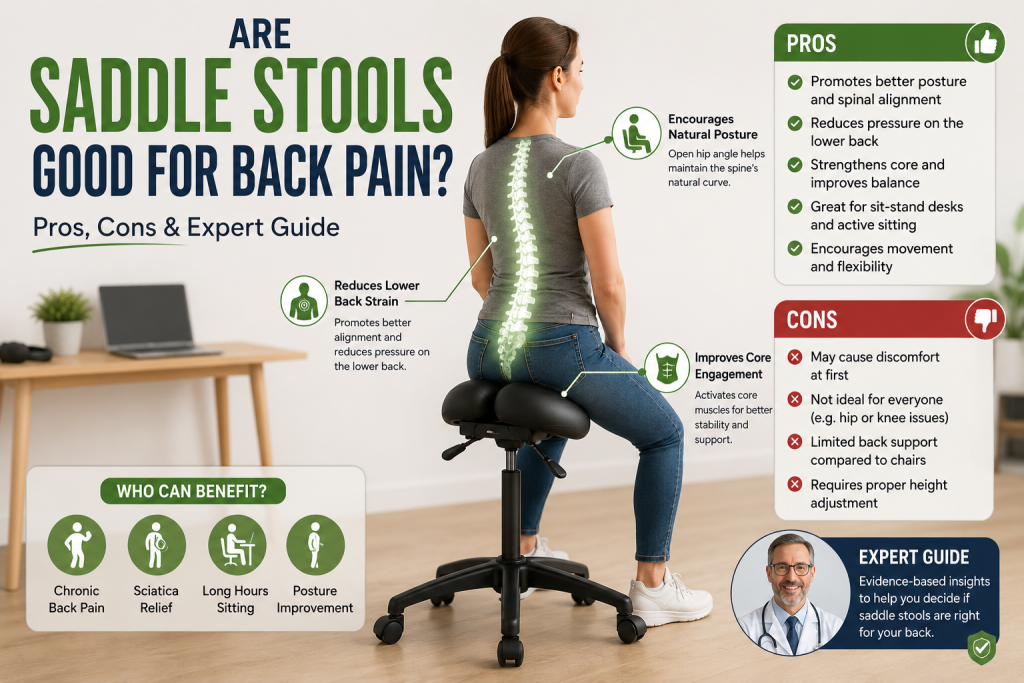
A saddle stool changes this entirely. The seat is shaped like a horse’s saddle, wide at the back and tapering toward the front. Your thighs slope downward at roughly 45°, and your knees sit lower than your hips. This geometry opens your hip angle to the natural 120–135° range, which tilts your pelvis forward (anterior pelvic tilt) and restores your lumbar curve. The result is a seated posture that mirrors your standing posture—often called “supported standing.”
The saddle stool places you in a “tripod” position with the hips slightly flexed and spread apart, which is the most stable and biomechanically efficient position for the hip joint. Only when the lower body is stable can the upper body move with ease and precision. This is why clinicians who perform precision work, such as dentists and surgeons, have widely adopted saddle stools: the improved pelvic stability allows for more controlled and precise upper body movements, and the back stays supported without conscious effort.
When your pelvis is correctly aligned, your spine supports your upper body weight efficiently and your back muscles can remain relaxed, rather than constantly straining to hold you upright.
What the Research Says: Clinical Studies on Saddle Stools and Back Pain
The evidence supporting saddle stools for back pain relief is not merely anecdotal. Multiple peer‑reviewed studies have examined the biomechanical and clinical effects of saddle seating, and the results consistently point toward significant benefits for users with lower back pain.
Key Research Findings
Reduced Lower Back Discomfort: A 2007 study published in Work comparing the Bambach saddle seat to a standard office chair found that the saddle seat provided reduced levels of lower back discomfort. The open hip posture allowed participants to maintain a more neutral spinal alignment throughout a full workday, leading to less cumulative strain on the lumbar region.
Significant Pain Reduction (p<0.001): A 2003 clinical study involving 25 general practicing dental surgeons—all of whom were actively experiencing low back pain—investigated the effectiveness of saddle chairs. The results demonstrated that saddle chairs had a significant positive effect on both lumbar spine range of motion and the level of pain experienced by the participants at the 0.1% level (p<0.001). The null hypothesis was rejected, meaning the improvement was not due to chance.
Increased Lumbar Lordosis: Research has documented that sitting on a saddle chair actually increases lumbar lordosis (the natural inward curve of your lower back). This is crucial because flattening of the lumbar curve (hypolordosis) is a primary driver of disc degeneration and chronic back pain. By restoring this curve, the saddle stool helps maintain uniform intervertebral disc pressures, significantly reducing the risk of disc herniation.
Improved Comfort Compared to Conventional Chairs: A 2023 comparative study evaluated three types of dental chairs and measured the average intensity of discomfort using the Corlett and Bishop local discomfort questionnaire. The results showed that the saddle chair had the lowest increase in discomfort after a full work shift, significantly outperforming two other conventional chair designs. The final posture evaluation scores (RULA method) also demonstrated that saddle chairs promote a more neutral, less risky seated posture.
Trade‑off: Lower Limb Discomfort: The 2007 study also noted a limitation: while the saddle seat reduced lower back discomfort, it demonstrated higher discomfort in the lower limbs, particularly the hips and buttocks. This is likely due to the widened hip angle and the fact that your sitting bones bear more weight than they do on a flat seat. This finding underscores that saddle stools are not universally perfect; they require an adjustment period and may not be suitable for all body types without proper sizing.
What the Experts Say
Occupational health professionals are clear on the root cause of sitting‑related back pain. Studies overwhelmingly show that saddle stools reduce pain. However, not all saddles are created equal, and using one that doesn’t fit your unique body, or not sitting on it correctly, can kill the comfort factor or create discomfort.
It is dangerous to assume the saddle design that works well for a colleague would also be your best option. This plan only works if you are the exact same size and shape. For some, an inexpensive, basic saddle cannot offer the same experience as a well‑constructed saddle specifically designed for the spatial demands of a workspace. There is still truth to the old adage “you get what you pay for.”
Pros and Cons of Saddle Stools for Back Pain
Before investing in a saddle stool, you should understand both the benefits and the limitations.
✅ Pros: How Saddle Stools Help Back Pain
1. Maintains Your Spine’s Natural Curve
A properly fitted saddle stool supports your lumbar spine’s inward curve (lordosis), reducing pressure on your intervertebral discs. This is the single most important factor in preventing sitting‑related back pain.
2. Opens Your Hip Angle
Thighs at a 45° downward slope create an open 120–135° angle between your torso and thighs, mirroring your standing posture. This relieves tension in your hip flexors—muscles that often tighten and pull on your pelvis during prolonged sitting.
3. Engages Core Stabilizing Muscles
Without a backrest to lean on, your deep trunk muscles must remain active to keep you upright. This constant micro‑engagement has been shown to help prevent low back pain by strengthening your natural “muscular corset.”
4. Reduces Pressure on Your Tailbone
The forward pelvic tilt shifts weight from your coccyx to your sitting bones, providing relief for those with tailbone pain (coccydynia).
5. Improves Circulation
The open hip position reduces pressure on the blood vessels behind your knees and thighs, promoting better circulation in your legs and reducing the risk of numbness and varicose veins.
6. Encourages Natural Movement
Because saddle stools have no backrest and a narrow front profile, you can easily reach, swivel, and lean without straining your back. This reduces the awkward reaching movements that often trigger back pain.
7. Deepens Breathing
When your spine is properly aligned and your chest is open, diaphragmatic breathing improves, which increases oxygen delivery to your muscles and reduces overall tension.
❌ Cons: Potential Drawbacks of Saddle Stools
1. Initial Adjustment Period
The saddle seat design may require an adjustment period for those new to this seating style. Most new users need 1–2 weeks to adapt as their back and core muscles activate in new ways. Some users report mild soreness during this period.
2. Hip and Buttock Discomfort
The most common trade‑off is that while lower back pain decreases, some users experience new discomfort in the hips and buttocks. This is because your sitting bones bear more weight in the saddle position than on a flat seat. Proper cushioning and seat width are critical to mitigating this issue.
3. Higher Cost
A quality saddle stool with proper ergonomic features (high‑density foam, 5‑star base, split‑seat design) typically costs $150–500. Budget models under $100 often have thin foam, poor adjustability, and may not last.
4. Requires Correct Fit
A saddle that is too narrow for your pelvis can cause compression and be uncomfortable. Likewise, a saddle that is too wide for a smaller operator can cause uncomfortable splaying of the hips. Without proper sizing, a saddle stool can be worse than a conventional chair.
5. Not Ideal for Everyone
Individuals with certain hip or knee conditions, limited hip flexibility, or recent hip replacement surgery may not be able to adopt the saddle posture comfortably. Always consult your physician before switching to a saddle stool.
6. Requires a Desk Height Adjustment
Saddle stools raise your seated eye level by 4–8 inches compared to a standard office chair. To maintain proper ergonomics, you will likely need a height‑adjustable desk or a desk riser, which adds to the overall cost.
7. Pressure Concerns for Male Users
Men should consider either a highly padded style saddle or a split‑seat saddle chair to decrease compression on the perineal area.
Saddle Stool vs. Ergonomic Office Chair vs. Kneeling Chair
Choosing the right seating solution depends on your specific back condition and work style. Here is how saddle stools compare to other popular ergonomic seating options.
Ergonomic Office Chair (e.g., Steelcase Leap, Herman Miller Aeron):
Most effective for passive, reclined sitting. Provides excellent lumbar support and adjustability (seat depth, 4D armrests, headrest). Best for spreadsheet work, programming, and tasks where you stay mostly upright or slightly reclined. However, the 90° hip angle still flattens your lumbar curve, and leaning forward disengages the backrest, increasing disc pressure.
Saddle Stool:
Most effective for active, forward‑leaning work (typing, writing, dentistry, surgery). Maintains open hip angle and lumbar curve even when leaning forward. Encourages core engagement and micro‑movements. However, it has no backrest, can cause hip/buttock discomfort, and requires an adjustment period. Best for users with low back pain who want to maintain a posture similar to standing.
Kneeling Chair:
Shifts weight forward onto your shins, opening the hip angle and reducing pressure on your lower back. Effective for some back pain types. However, the kneeling position can cause knee and shin discomfort, and prolonged use can lead to reduced circulation in the lower legs.
How to Choose a Saddle Stool for Back Pain
If you decide to purchase a saddle stool, these features are non‑negotiable for effective back pain relief and long‑term durability.
1. Seat Pan Shape and Width
The most important factor. Your seat pan must match your pelvic width. A narrow saddle (ideal for smaller builds) reduces thigh pressure and keeps your legs closer together. A wider saddle is necessary for taller or broader users. The most important consideration is to find a seat pan that supports your buttocks and thighs and feels comfortable in your hips. A narrow saddle will not work properly for a person with a larger frame, and conversely a clinician who barely fits into adult‑sized pants will be terribly uncomfortable with a medium or large seat pan.
Split‑seat designs (two halves with a gap in the middle) are the gold standard because they reduce perineal pressure and improve circulation. This is especially important for men and for anyone sitting 8+ hours per day.
2. Seat Height Adjustment
Forget the “thighs parallel to the floor” rule. That does not apply here. While keeping your feet flat on the ground, bring the seat up as much as possible. If it is too low, your spine flattens and your shoulders tense and fall forward. Most quality saddle stools offer a height range of 20–32 inches, allowing you to perch at a height that matches your standing desk.
3. Gel or High‑Density Foam Cushioning
Sitting should not feel like a punishment. Gel cushioning adapts to your body, distributes weight evenly, and adds longevity to the stool. Avoid stools with thin, low‑density foam that flattens within weeks.
4. Tilt Adjustability
Pan tilt is not just a bonus—it is a necessity. The ability to adjust the angle of the seat pan allows for optimization of the pelvis. A slight forward tilt often works best for maintaining a neutral spine, but adjustability allows for unique anatomy and posture changes. However, make sure you never tilt a saddle stool seat forward excessively, as this can cause hyperlordosis and low back pain.
5. Weight Capacity and Base Construction
Look for a saddle stool with a 5‑star wheelbase and smooth‑gliding casters. The base should be steel or reinforced aluminum to prevent wobbling. Weight capacities vary from 250 lbs to 500+ lbs on heavy‑duty models.
6. Backrest (Optional)
Most saddle stools are backless, as the design naturally encourages an upright posture without one. However, if you have severe lumbar instability or simply prefer the security, some models offer an optional backrest. Note that adding a backrest moderately reduces abdominal activity—the very core engagement that is one of the main benefits of a saddle stool—so use it sparingly.
Also, note that the chair we use the most is our chair at work. Dental operator chairs are not furniture; they are meant to be individualized tools that reduce fatigue and musculoskeletal injury. The same principle applies to your home office: your saddle stool should fit your specific body, not the other way around.
Real User Experiences with Saddle Stools for Back Pain
Real‑world feedback from users who have switched to saddle stools underscores both the benefits and the potential challenges.
One user on Reddit reported that their saddle chair essentially cured them of their lower back pain, noting that the open hip posture completely removed the pressure that had been causing their chronic discomfort. Another user shared, “I finally have found a way to sit with much reduced pain. I have a fractured tail‑bone and cannot sit for long, but this cushion is large and soft and has a cut‑out section for the coccyx to rest in. No pressure point.”
A dental professional who switched to a saddle stool noted that their back pain decreased significantly after just a few weeks, and that they could not say enough great things about the chair. They also emphasized that they could now “work longer without as much fatigue.” Another user, a long‑time sufferer of back pain, described the saddle stool as a “godsend,” explaining that it placed them in a correct posture position and took a great deal of strain off their back.
On the other hand, some users report that the initial adjustment period can be uncomfortable. One reviewer noted that while the stool definitely improved their posture and helped their back, their “seat bones start to hurt after a while.” Another user mentioned that the cushion was stiff and narrow for their frame, and they wished the seat separation were more adjustable. This emphasizes the critical need for proper sizing—a saddle stool is not a one‑size‑fits‑all product.
Some users in a forum discussion expressed concerns about potential long‑term pressure on the genitals from solid saddle stools, which is why experts strongly recommend a split‑seat design for men. However, a user with back pain that runs in their family noted that “personally this was the chair that essentially cured me of my lower back pain.”
Frequently Asked Questions (FAQ)
Can a saddle stool make my back pain worse?
Yes—if the saddle stool is the wrong size for your pelvis or adjusted incorrectly. A seat pan that is too narrow will compress your hips; one that is too wide will force your legs uncomfortably apart. If the seat is too low, your spine will flatten and your shoulders will round forward, nullifying the ergonomic benefits.
How long does it take to get used to a saddle stool?
Most users need 1–2 weeks to adapt to the new seated posture. During this period, you may experience mild soreness in your hips, buttocks, or lower back as your core muscles activate in new ways. If pain persists beyond two weeks, re‑evaluate your seat size and height adjustments.
Do I need a special desk for a saddle stool?
Yes, you will almost certainly need a height‑adjustable desk or desk riser. Saddle stools raise your seated eye level by 4–8 inches compared to a standard office chair. If your desk is fixed at standard height, you will be forced to look down at your monitor, causing neck strain. A height‑adjustable desk is the best companion to a saddle stool.
Are saddle stools good for sciatica?
Yes—many users with sciatica report significant relief from saddle stools. The open hip angle reduces pressure on the lower spinal discs and sciatic nerve pathway. Additionally, the forward pelvic tilt helps alleviate the hamstring tension that often contributes to sciatic pain.
Can I use a saddle stool if I have hip arthritis?
Consult your physician first. The widened hip position may be uncomfortable for some with hip osteoarthritis or labral tears. However, some users with mild hip discomfort find that the open hip angle actually reduces joint pressure. Start with short sessions (20–30 minutes) and gradually increase duration.
What is the best saddle stool for back pain?
The best saddle stool is one that is properly fitted to your pelvic width and height. Look for a split‑seat design with gel or high‑density foam cushioning, a 5‑star base, and height adjustment of at least 20–32 inches. Reputable brands include Salli, Bambach, and Humanscale, though affordable options from Everlasting Comfort and DR.LOMILOMI receive positive reviews.
Can I sit on a saddle stool all day?
Yes, many professionals (dentists, hygienists, tattoo artists, and estheticians) use saddle stools for 8‑10 hour shifts. However, because the saddle stool keeps your core muscles engaged, you may feel more fatigue at the end of the day compared to a passive ergonomic chair. It is recommended to alternate between sitting on a saddle stool, standing, and using a conventional chair throughout the day for the best spinal health.
Final Verdict: Should You Try a Saddle Stool for Back Pain?
After reviewing the biomechanical evidence, clinical studies, and real‑world user experiences, here is my honest conclusion.
👉 A saddle stool is an excellent choice for back pain relief if: You have sitting‑related lower back pain (especially from disc issues or poor posture), you spend long hours at a desk but want to maintain an active, engaged seated posture, you are willing to invest in a properly sized model and a height‑adjustable desk, and you have the time to adapt to the new seated position during a 1–2 week adjustment period.
👉 A saddle stool is NOT the right choice if: You have significant hip or knee arthritis, you are unwilling to adjust your desk height or purchase a new desk, you are on a very tight budget (under $100) and cannot afford a quality model, or you simply want a passive, lounging chair to lean back in.
Most important advice: No chair, no matter how well‑designed, can replace the need for movement. Even with a perfect saddle stool, you must stand up, stretch, and walk every 30–45 minutes. Your spinal discs rely on compression and decompression cycles to receive nutrients and expel waste products. Static sitting—even on the most ergonomic saddle stool—will eventually lead to fatigue and discomfort.
👉 See today’s best‑rated saddle stools for back pain on Amazon →