
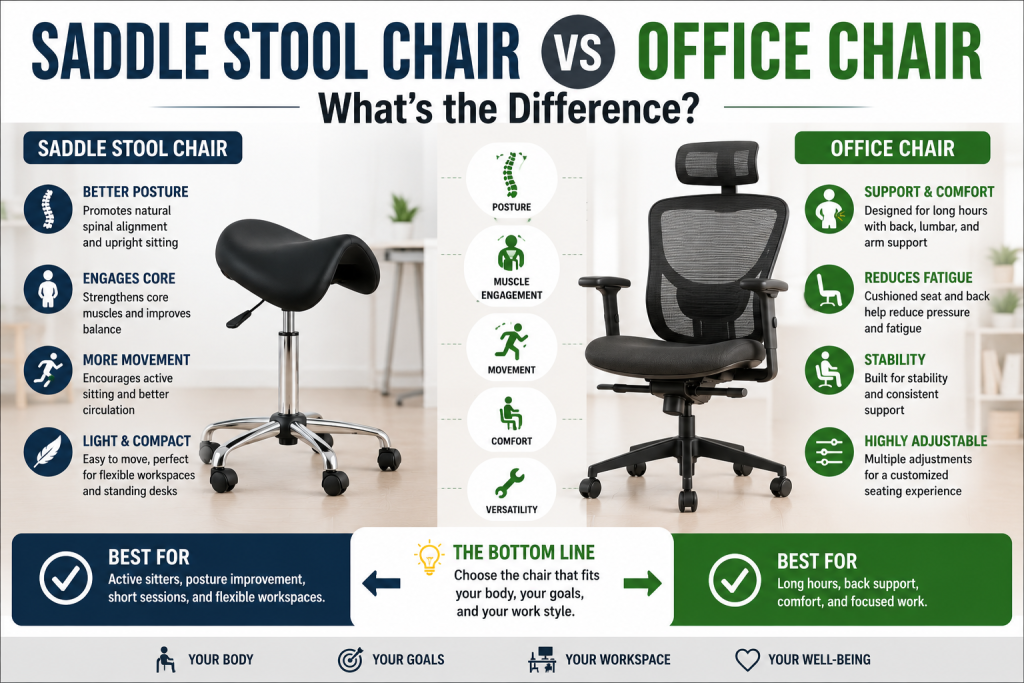
If you spend hours grooming dogs, examining animals, assisting with procedures, or working over a veterinary treatment table, your chair is more than a place to sit. The difference between a saddle chair vs office chair can affect how easily you can reach, pivot, change position, and work close to an animal.
A conventional office chair is designed primarily for desk work. A saddle chair uses a raised, contoured seat that encourages a more open hip position and makes it easier to perch close to a workstation. That can make saddle seating particularly interesting for pet groomers, veterinary technicians, veterinarians, dental teams, and other animal-care professionals.
But a saddle chair isn’t automatically better for everyone. The right choice depends on your work surface, how much you lean forward, how often you move between stations, and whether you also spend substantial time doing computer or administrative work.
This guide compares saddle chairs vs standard office chairs for pet grooming and veterinary work, explains the main ergonomic differences, and shows what to look for before buying.
⚡ Saddle Chair vs Office Chair: Quick Answer
For pet grooming, veterinary examinations, dental procedures, and other close-up animal-care tasks, a saddle chair can be a useful alternative to a conventional office chair because its seat shape makes it easier to sit close to the work surface and change position.
For computer work, charting, billing, scheduling, and long periods of traditional desk work, a well-adjusted ergonomic office chair may be more familiar and versatile.
The important point is not that one chair type is universally superior. It’s that the chair should match the working position you use most often.
📌 What Is a Saddle Chair?
A saddle chair is a type of ergonomic seat with a raised, contoured cushion inspired by the shape of a riding saddle. Instead of placing your legs straight forward like a conventional office chair, the design encourages a more open hip position and a more upright, forward-oriented working posture.
Many saddle chairs are designed so you can sit slightly higher and closer to a work surface. That can be useful when you’re working over a grooming table, veterinary exam table, dental station, or treatment surface.
Some models also use a split or two-part saddle seat. This gives the legs more freedom to move and can make it easier to reposition yourself during detailed work.
- Raised, contoured seat — encourages a more open hip position than many flat office chairs.
- Height adjustment — useful when your work surface is higher than a typical desk.
- Optional backrest — available on some models for users who want additional support.
- Caster base — makes it easier to reposition around a workstation.
- Wipe-clean upholstery — particularly useful in grooming and veterinary environments.
For professional animal-care environments, also consider whether the upholstery can tolerate frequent cleaning and whether replacement casters, cylinders, or other components are available.
If you’re also considering active seating for a home workspace, see our guide to active sitting office chairs and how they differ from traditional desk chairs.
📌 What Is a Standard Office Chair?
A standard ergonomic office chair typically combines a horizontal seat, backrest, swivel base, casters, and some combination of adjustable seat height, armrests, lumbar support, recline, and tilt tension.
The main advantage is versatility. A conventional office chair works well for typing, reading, video calls, charting, billing, scheduling, and other tasks where you’re facing a desk or monitor.
Higher-quality models may also offer adjustable seat depth, lumbar positioning, armrest height and width, recline resistance, and forward-tilt features. These adjustments can make a significant difference when the chair is properly fitted to the user.
The limitation for pet-care work is that a conventional office chair is generally designed around a desk rather than a high grooming or examination surface. If you frequently lean forward and need to get close to an animal, the backrest and larger seat can sometimes make positioning less convenient.
That is why the saddle chair vs office chair comparison becomes especially relevant for groomers and veterinary professionals.
⚡ Saddle Chair vs Office Chair: Key Differences
The biggest differences involve working posture, hip position, mobility, back support, and the type of workstation each chair is designed to complement.
| Feature | Saddle Chair | Standard Office Chair | Best Fit |
|---|---|---|---|
| Seat shape | Raised and contoured | Mostly flat or gently contoured | Depends on working position |
| Hip position | Encourages a more open hip angle | Usually more traditional seated posture | Saddle for close-up work |
| Back support | Optional on many models | Usually integrated | Office chair for desk-focused work |
| Mobility | Easy to pivot and reposition | Stable and familiar | Saddle for multi-directional tasks |
| Desk work | Can work, but not always ideal | Usually well suited | Office chair |
| Animal-care work | Easy access to work surface | May feel restrictive around tables | Saddle chair |
The table doesn’t mean a saddle chair is automatically more ergonomic. Fit and adjustment matter more than the chair category alone. A poorly adjusted saddle chair can create new pressure points, while a properly adjusted office chair can work very well for many people.
📌 Why Saddle Chairs Can Work Well for Pet Groomers and Veterinary Professionals
Pet grooming and veterinary work is different from ordinary desk work. You may spend part of the day leaning over a grooming table, moving around an animal, reaching for instruments, or turning toward equipment positioned beside you.
A saddle chair can make these movements easier because the seat allows you to sit relatively close to the work surface while keeping your legs positioned around the base of the chair.
- Closer access to the workstation: the compact seat can make it easier to work near an animal without repeatedly reaching across a large chair.
- Freedom to reposition: a mobile saddle stool can make short movements between the animal and nearby equipment easier.
- Open hip position: the seat shape encourages a different hip and pelvic position from a conventional flat office chair.
- Smaller footprint: many saddle stools take up less visual and physical space around a grooming or examination station.
However, the chair cannot eliminate the physical demands of grooming or veterinary work. Reaching, lifting, bending, standing, and handling animals still place demands on the body. The goal is to create a workstation that lets you change position comfortably and avoid staying in one awkward posture for too long.
Featured Saddle and Office Chair Options
| Chair | Type | Typical Use | What to Check | Check Price |
|---|---|---|---|---|
| Bambach Saddle Seat | Saddle chair | Professional close-up work | Seat height, configuration and current availability | Check Price → |
| Salli Saddle Chair | Split saddle | Veterinary and clinical work | Seat width, split-seat design and height range | Check Price → |
| HÅG Capisco | Saddle-style office chair | Sit-stand and mixed work | Height range, seat configuration and accessories | Check Price → |
| Steelcase Leap | Ergonomic office chair | Desk and administrative work | Seat depth, lumbar adjustment and armrests | Check Price → |
Product configurations, prices, colors, accessories, and availability can vary by seller and region. Check the current listing before purchasing.
🔄 How to Transition to a Saddle Chair
If you’ve always used a conventional office chair, a saddle chair may feel unusual at first. The seat height, hip position, and pressure distribution are different, so there’s no need to make it your only chair immediately.
- Start with shorter sessions: use the saddle chair for part of the day rather than forcing yourself to use it continuously.
- Adjust the height carefully: your feet should remain supported and your working surface should be at a comfortable height.
- Change positions regularly: alternate between sitting, standing, walking, and different working positions when your job allows.
- Pay attention to pressure: persistent numbness, sharp pain, or worsening symptoms are signs to stop and reassess the setup.
A saddle chair should feel like a useful change in working position, not something you have to tolerate through increasing pain. If you’re dealing with persistent hip discomfort, you may also want to read our guide to office chair cushions for hip pain.
🔑 How to Choose the Right Chair for a Pet-Care Workspace
Start with your daily tasks rather than the chair’s marketing claims. If you spend most of your day leaning toward a grooming table or examination surface, a saddle chair deserves consideration. If your schedule is dominated by charting, billing, phone calls, and computer work, a conventional ergonomic office chair may be easier to fit.
1. Match the Chair to Your Work Surface
Measure the height of your grooming or examination surface before buying. A chair that cannot rise high enough can force you to reach downward, while one that sits too high may leave your feet unsupported.
2. Check the Height Range
Don’t buy based on a generic height number. Compare the chair’s actual minimum and maximum seat height with your workstation. Your feet should have appropriate support, and you should be able to work without repeatedly shrugging your shoulders or reaching excessively.
3. Look at the Seat Shape and Firmness
A saddle seat should support your position without creating uncomfortable pressure. Firmness is highly personal, so return policies are especially valuable when buying online.
4. Choose Pet-Friendly Upholstery
For grooming salons and veterinary clinics, smooth upholstery is usually easier to wipe down than heavily textured fabric. Mesh can also be easy to clean, but fur, disinfectants, moisture, and sharp claws can affect different materials differently.
5. Consider Casters and Floor Type
A chair that rolls well on a hard veterinary or salon floor may behave differently on rubber mats, thick anti-fatigue flooring, or carpet. Make sure the caster design matches your actual workspace.
6. Don’t Ignore the Return Policy
A saddle chair has a very different feel from a conventional office chair. If possible, choose a seller with a reasonable return window so you can evaluate the seat during normal work rather than deciding after a five-minute test.
🐾 Which Chair Fits Your Workday?
- Mostly grooming: consider a saddle chair or saddle stool that allows close access to the grooming table.
- Mostly veterinary exams: a mobile saddle chair can be useful if you frequently reposition around an examination surface.
- Mostly computer work: a conventional ergonomic office chair may offer more useful back, arm, and recline adjustments.
- Mixed work: consider a chair that supports both higher sitting and conventional desk tasks, or use two seating options for different stations.
- Frequent standing: a height-adjustable saddle-style chair can complement a sit-stand workstation.
🛠️ Simple Ergonomic Setup Tips for Groomers and Vets
Even a high-quality chair cannot compensate for a poorly arranged workstation. Use the chair as one part of the overall setup.
- Keep the animal or work surface close enough that you don’t need to repeatedly reach forward.
- Position frequently used tools within easy reach to reduce unnecessary twisting.
- Alternate positions throughout the day rather than remaining seated or standing continuously.
- Adjust the chair whenever the task changes. A position that works for grooming may not be ideal for computer work.
- Use appropriate anti-fatigue flooring when standing for long periods, especially on hard floors.
More ergonomic reading:
If you’re experiencing discomfort while using a conventional office chair, see our guides on
why an office chair may hurt your tailbone
and
office chair cushions for hip discomfort.
❓ Saddle Chair vs Office Chair FAQ
Is a saddle chair better than an office chair for pet grooming?
A saddle chair can be a practical fit for grooming because its raised, contoured seat can make it easier to sit close to a grooming table and move around the animal. However, the best option depends on your height, table height, work habits, and personal comfort. A conventional ergonomic chair may still be preferable if you spend a large portion of the day at a computer.
Can a saddle chair help with lower-back discomfort?
Changing to a saddle-style seat may change your hip position and working posture, which some people find more comfortable. However, a chair should not be viewed as a treatment for a back condition. If discomfort is persistent, severe, or worsening, professional medical advice is more appropriate than relying on a different chair alone.
How long does it take to get used to a saddle chair?
There is no universal adjustment period. Some users adapt quickly, while others need more time. Start with shorter periods and alternate with your usual seating. If you experience persistent pain, numbness, or other concerning symptoms, stop using the chair and reassess the setup.
Are saddle chairs good for veterinarians who also do desk work?
They can be useful for veterinarians who frequently move between examination tables and other workstations. For extended charting, email, billing, or computer tasks, however, a conventional ergonomic office chair may provide more useful backrest, armrest, recline, and seat-depth adjustments.
What height range should I look for in a saddle chair for grooming?
There is no single ideal height because grooming tables and users vary considerably. Measure your actual work surface first, then compare it with the chair’s published minimum and maximum seat heights. You should be able to work close to the animal without repeatedly reaching upward or downward.
Can I get a saddle chair with a backrest?
Yes. Some saddle chairs offer optional or integrated backrests. A backrest can be useful if you spend part of the day sitting in a more conventional position, although it may reduce some of the freedom of movement that makes saddle seating attractive for close-up work.
Which is better for an all-day pet-care schedule: saddle chair or office chair?
It depends on what your day actually looks like. If most of your work happens around grooming or examination tables, a saddle chair may fit the workflow better. If your schedule includes several hours of computer work, a conventional ergonomic office chair may be more versatile. For mixed schedules, using different seating for different stations can make sense.
🎯 Bottom Line: Saddle Chair or Office Chair?
The saddle chair vs office chair decision comes down to your actual workflow.
Choose a saddle chair if you regularly work close to grooming tables, veterinary examination surfaces, or other elevated workstations and value easy repositioning.
Choose a conventional ergonomic office chair if most of your work involves computers, records, phone calls, administrative tasks, or longer periods where back and arm support are priorities.
And if your workday includes both, you don’t necessarily have to choose one chair for every task. A saddle chair at the treatment station and an ergonomic office chair at the desk can create a more flexible workspace.
Important: This article provides general ergonomic and product-selection information and is not medical advice. A saddle chair or office chair cannot diagnose, treat, or cure a back, hip, or musculoskeletal condition. If you have persistent or worsening pain, numbness, weakness, or other concerning symptoms, consult an appropriately qualified healthcare professional.