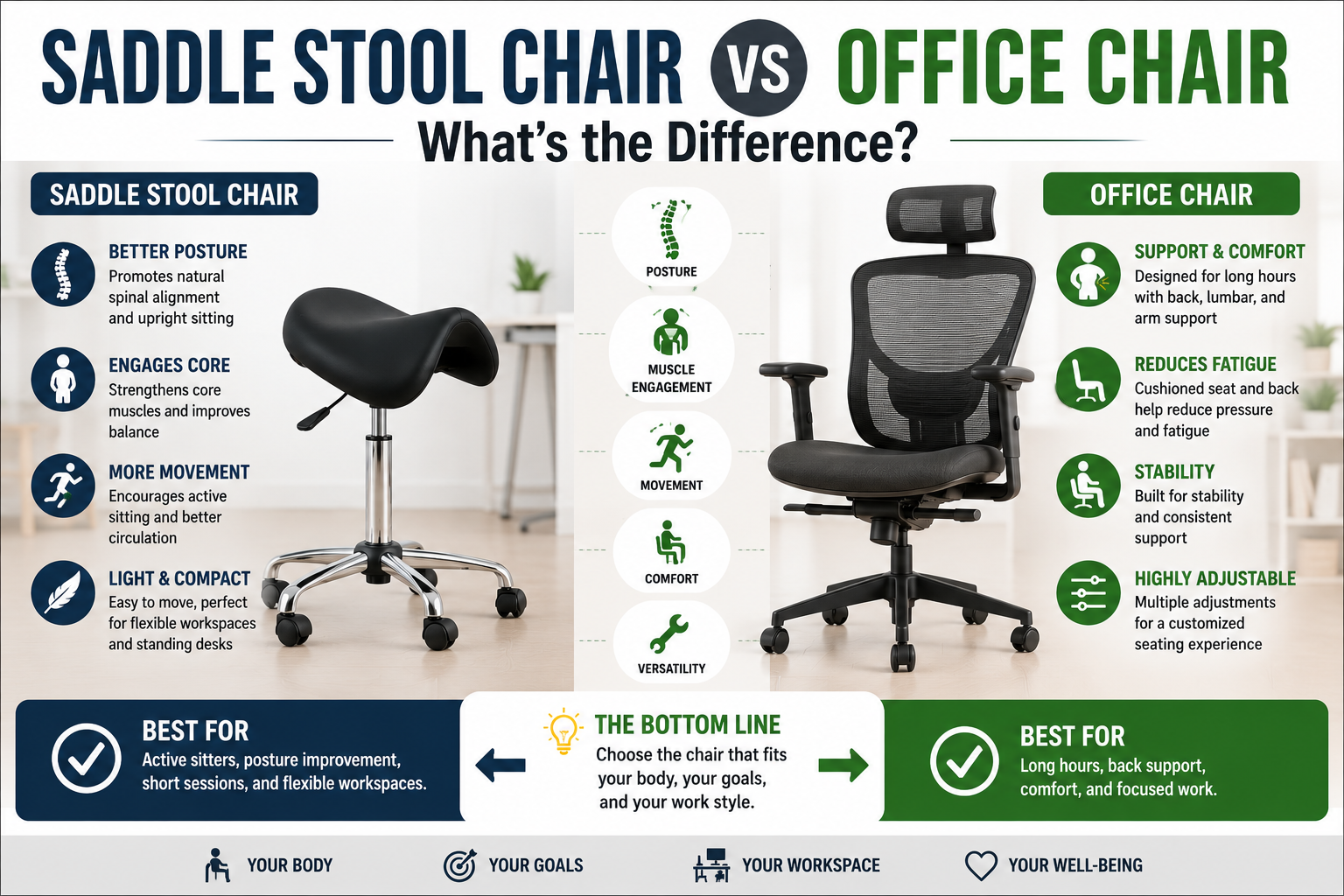
Your back knows the truth: eight hours hunched over a grooming table or exam table takes a brutal toll. If you’re a pet groomer or vet, you’ve likely asked whether the saddle chair vs office chair choice really matters for your work. It does — more than you’d think.
Standard office chairs are built for sitting upright at a desk. But groomers and vets rarely sit upright — you lean forward, twist, and reach across animals all day. That’s exactly the motion a saddle chair is designed to support.
I’ve spent years helping clinics and grooming salons pick seating that protects their team’s bodies. Here’s what I’ve learned.
📌 What Is a Saddle Chair?
A saddle chair is exactly what it sounds like — a seat shaped like a horse saddle that changes how your hips and spine line up the second you sit down. Instead of a flat pan that lets you collapse into a slouch, the seat slopes forward toward your knees.
Your hip angle opens to roughly 135 degrees rather than a cramped 90, which makes a huge difference when you’re hunched over a grooming tub all day.
This is what ergonomists call active seating. Your leg and core muscles make constant tiny adjustments to hold you upright, so you never freeze into one stiff posture. That continuous micro-movement keeps blood flowing and reduces the strain on your lower back compared to parking in a static office chair. On the practical side, most saddle chairs share these features:
- Pneumatic height adjustment — typically 20 to 30 inches of seat range
- An angled saddle seat, sometimes split into two independent halves that move with your legs
- Optional backrest, footring, and armrests on many models
- A five-star base with hard-floor or dual-wheel casters for rolling between stations
For grooming salons and vet clinics, durability matters more than anything else. Look for commercial-grade vinyl or PU leather that wipes clean after fur, clipper oil, and disinfectant spray.
Dense molded foam keeps its shape for years, and a heavy-duty gas cylinder prevents that annoying wobble when you shift weight toward your feet. Expect to pay roughly $150 to $600 for a saddle chair built to survive clinic life — anything cheaper tends to flex in the column and break down fast.
📌 What Is a Standard Office Chair?
A standard office chair is the classic desk setup: a padded seat, a backrest, armrests, and a swivel base with casters. It has been around for decades, and it’s built for exactly one thing — sitting upright at a desk.
Most models let you adjust seat height, lumbar support, tilt tension, and armrest positions. Higher-end chairs add seat depth adjustment and a forward-tilt lock, which is genuinely handy for typing and long meetings.
Here’s the catch: a standard chair locks your hips at roughly 90 degrees of flexion. Sit like that for hours — which groomers and vets constantly do — and your lower back, glutes, and hamstrings start complaining. Your tailbone gets pressure too.
Pet workstations almost always start with a standard office chair because it’s cheap, familiar, and easy to replace. But grooming and vet work isn’t desk work. You’re leaning over tubs, twisting toward tables, and working at awkward heights all day. A chair that keeps your hips flexed and your spine rounded will quietly undo your posture by lunchtime.
That’s exactly why the saddle chair vs office chair question matters. Once you see what a standard chair can — and can’t — do for your body, you’ll know whether the switch is worth it.
⚡ Saddle Chair vs Office Chair: Key Differences Compared
Here’s the short version: saddle chairs win for posture and movement, standard chairs win for familiarity and adjustability. Which suits you depends on how much time you spend leaning over a grooming or exam table.
| Feature | Saddle Chair | Standard Office Chair | Check Price |
|---|---|---|---|
| Posture | Anterior pelvic tilt keeps your spine’s natural S-curve | 90-degree hip angle that encourages slouching | Check Price → |
| Pressure distribution | Weight spreads across sit bones and thighs | Concentrated on tailbone and backs of thighs | Check Price → |
| Back support | Works with your core; backrest optional | Built-in lumbar and full backrest | Check Price → |
| Adjustability | Seat height, tilt, and angle | Height, armrests, lumbar, recline, tension | Check Price → |
| Movement | Glides, swivels, and lets you perch dynamically | Stable base, designed for static sitting | Check Price → |
| Learning curve | Takes days to weeks to feel natural | Feels familiar from day one | Check Price → |
| Best for | Grooming, vet exams, surgical prep | Desk work, typing, long computer sessions | Check Price → |
Posture is the biggest difference. A saddle chair tilts your pelvis forward (anterior pelvic tilt), which keeps the spine in its natural S-curve. A standard office chair holds your hips at a 90-degree angle — comfortable at first, but that position encourages slouching over a pet.
Pressure distribution changes too. On a saddle chair, your weight lands on your sit bones and thighs, not your tailbone. That wider base can reduce lower back strain during long grooms or surgeries. Office chairs concentrate pressure on the tailbone and backs of your thighs.
Mobility is where saddle chairs shine. Because you’re perched rather than sunk in, you can shift weight, pivot, and lean toward pets with less effort. Many vets and groomers love the dynamic movement — it keeps hips and knees active during procedures.
Be honest about the learning curve. Saddle chairs take time to acclimate — typically a few days to two weeks. Office chairs feel natural immediately, but that instant comfort can lock you into a static position.
📌 Why Pet Groomers and Veterinary Professionals Prefer Saddle Chairs
Spend one afternoon hunched over a grooming tub and you’ll feel it in your lower back. That constant forward fold is the real enemy. A saddle chair solves this by tilting your pelvis forward, so your spine keeps its natural S-curve even when you’re leaning over a table or a squirming 60-pound Lab.
For vet techs and groomers, the difference is noticeable fast. Research on saddle-style seating suggests the open hip angle reduces lumbar flexion compared to conventional chairs, which may help prevent the repetitive strain that builds up over years of awkward bending. You still lean — but you lean from the hips, not the lower spine.
- Less back fatigue: the forward-tilted seat keeps your torso stacked, so your back muscles don’t work overtime just to hold you upright.
- Active sitting: the slight instability of a saddle seat triggers micro-movements that engage your core and keep circulation flowing to your legs during long procedures.
- Better mobility: a compact base and smooth casters let you pivot from clipper to table to tub without twisting your spine on every single move.
The groomers and vet nurses I’ve worked with describe the same shift in their bodies: they still get tired at the end of a busy day, but their backs aren’t the part that screams. That’s the whole point — a saddle chair doesn’t remove the physical demands of the job, just the spinal stress that makes it punishing.
Recommended Models: Saddle Chairs vs Office Chairs
| Chair | Type | Price Range | Key Specs | Best For | Check Price |
|---|---|---|---|---|---|
| Bambach Saddle Seat | Saddle chair | ~$850–$1,000 | Forward-tilting seat, gas lift, 22–28″ height range | Groomers leaning over tubs and tables for hours | Check Price → |
| Salli Swing Saddle Chair | Two-part split saddle | ~$700–$1,100 | Split seat for leg freedom, 24–31″ height, tilt adjustable | Vets who need close exam-table access | Check Price → |
| HÅG Capisco | Saddle-style sit-stand | ~$800–$1,200 | Sculpted seat, sit or perch position, full adjustability | Pet pros who alternate between sitting and standing | Check Price → |
| Steelcase Leap | Standard office chair | ~$1,000–$1,500 | Adjustable lumbar, seat depth, 4D armrests | Desk work, phone calls, admin and booking tasks | Check Price → |
Transitioning to a Saddle Chair Safely
Jumping into a full eight-hour shift on a saddle chair is a setup for soreness. Your hips and glutes need time to adapt to the new angle. Here’s a safe ramp-up:
- Days 1–2: use it 30–45 minutes at a time, then switch back to your regular chair.
- Days 3–5: build up to one to two hours total per shift.
- Week 2: work up to two to four hours, with a short standing break each hour.
Mild muscle fatigue in your thighs and glutes is normal — that’s your postural muscles waking up. Sharp knee or hip pain is not. If that happens, lower the seat height or shorten your sessions until your body adjusts.
🔑 How to Choose the Right Chair for Your Pet-Care Workspace
Start with your daily tasks, not the hype. Grooming, dental work, and surgery prep keep you leaning forward over low tables — exactly what a saddle chair supports. For desk work and record-keeping, a standard office chair with lumbar support is usually the smarter fit.
When shopping for a saddle chair, focus on seat pad firmness (medium-firm is ideal), height range (look for an 18–22 inch floor-to-seat adjustment), seat tilt (5–15° forward), and floor-appropriate casters. An optional backrest helps if you spend hours at a low grooming table.
For office chairs, check lumbar support, synchro-tilt, armrest adjustability, and cushion material. Breathable mesh or wipe-clean upholstery matters in pet-care settings — hair and dander shouldn’t embed into fabric.
Budget is about total cost of ownership. Commercial-grade chairs run $400–$1,200 and last 5–10 years with replaceable parts. Home-use models under $200 rarely survive daily cleaning chemicals.
Two solid picks for pet-care spaces, both with wipe-clean surfaces and replaceable parts:
| Chair | Type | Price Range | Best For | Check Price |
|---|---|---|---|---|
| ⭐ Premium Bambach Saddle Seat | Saddle | $899–$1,100 | Grooming, dental, surgery prep | Check Price → |
| Feature Steelcase Series 1 | Office | $550–$750 | Desk work, record-keeping | Check Price → |
Finally, try before you commit. Choose a retailer with 30-day returns, and plan for a one-to-two-week adjustment period — you’ll feel new core and thigh muscles working, so mild soreness is normal. Your back will tell you quickly which chair wins.
❓ FAQ
Can a saddle chair really help with back pain from pet grooming?
Yes — for most groomers, it can. The forward-tilted seat opens your hip angle to roughly 45–60 degrees, positioning your spine over your pelvis instead of slumping forward. That’s huge when you’re bent over tubs and tables for hours. It won’t fix an existing injury, but many groomers report less lower-back fatigue within a few weeks.
How long does it take to get used to a saddle chair?
Plan on a one to two week adjustment period. Your knees, hips, and core engage differently than in a flat office chair. Start with 30-minute sessions and build up gradually. By week three, most people feel natural moving around their station.
Are saddle chairs good for veterinarians who also do desk work?
Absolutely — this is a common setup. Saddle chairs excel for exams, procedures, and table-side care because the open hip angle keeps you close to the patient. For charting, telemedicine, or X-ray review, they still promote better posture than most flat seats. If your day is split evenly, a sit-to-stand saddle chair is the most versatile choice.
What height range do I need for a pet grooming workstation?
Measure from the floor to your work surface, then subtract 6–8 inches (15–20 cm) for seat height. Grooming tables typically run 30–40 inches tall, so look for a saddle chair with a seat range near 22–34 inches. Your thighs should slope slightly downward, and both feet should stay flat on the floor.
Can I use a saddle chair with a backrest for extra support?
Yes. Many saddle chairs accept an attachable backrest that sits low against your sacrum rather than your mid-back. That small support reinforces the pelvic tilt without restricting movement. If you have a history of disc issues, a backrest model is a safer bet — ideally one that’s adjustable or removable.
Which is better for an all-day pet-care schedule: saddle or office chair?
For a hands-on 8–10 hour shift, I’d pick the saddle chair. The posture keeps your knees below your hips so you get closer to the animal without twisting. But if your day is mostly desk work, a well-fitted office chair with strong lumbar support usually wins. Match the chair to where you spend the most hours.