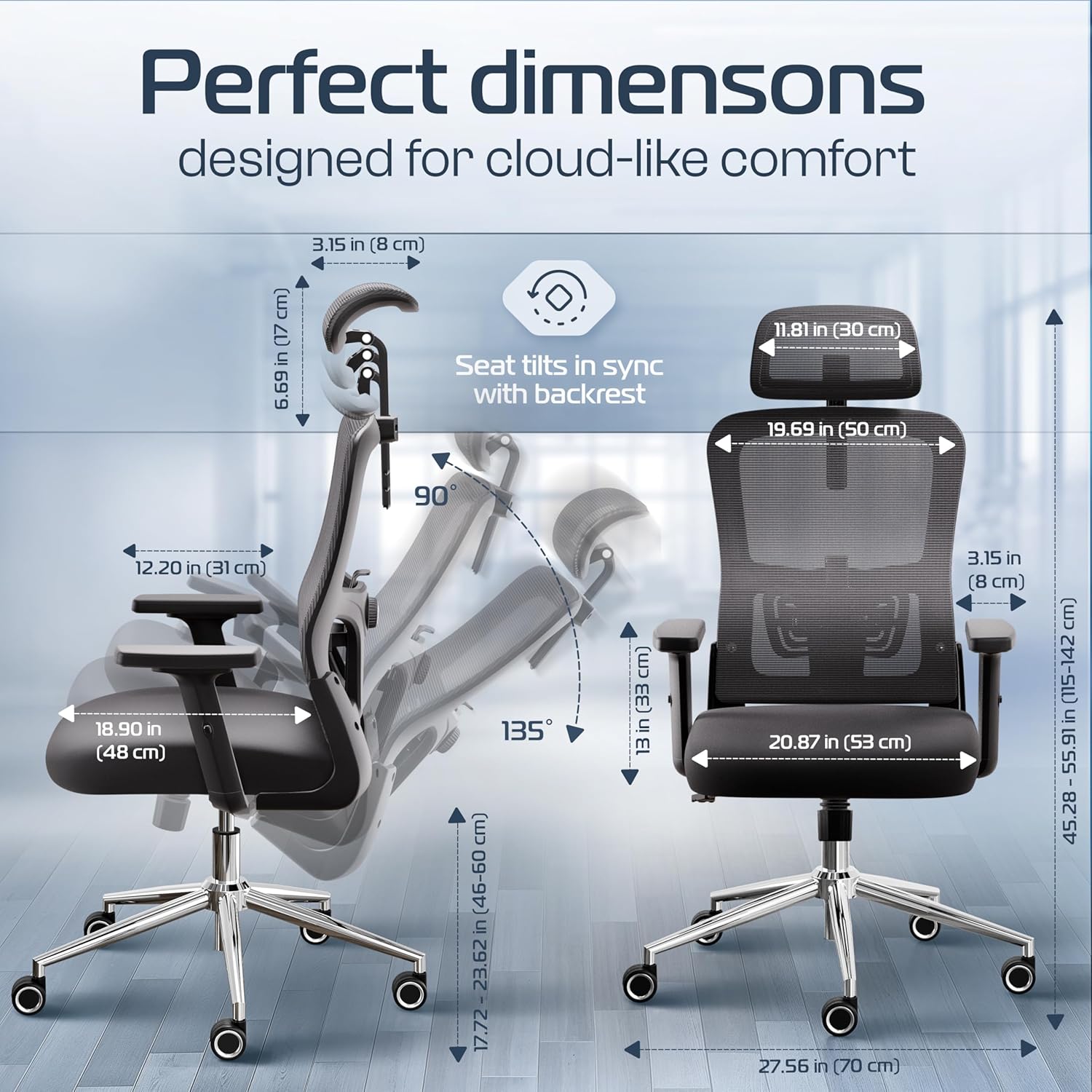
Figuring out how to adjust office chair seat depth is one of the most overlooked steps in setting up a pain-free workspace. Most people fiddle with armrests and lumbar support, then wonder why their legs tingle after an hour of work. The real culprit is often the seat pan sitting too far forward or too far back.
When your seat depth is off, your knees, hips, and lower back all pay the price. You end up slouching to compensate, which creates pressure that can follow you home. The fix takes less than five minutes once you know what to look for.
In this guide, I’ll walk you through how to measure your ideal seat depth, how to adjust the mechanism on common chair types, and what to do when the slider simply won’t budge. No special tools required—just a clear eye and a few simple steps.
📌 What Is Office Chair Seat Depth and Why Does It Matter?
Seat depth is the distance from the front edge of your chair’s seat pan to the backrest. It’s one of the most overlooked adjustments on any office chair — and one of the easiest to get wrong.
When your seat depth is correct, your thighs rest fully on the cushion without pressure behind the knees. A quick test: you should be able to slide 2 to 3 fingers between the front edge of the seat and the back of your knees. That simple check tells you a lot about your current setup.
Why does this matter? A seat that’s too long pushes against the backs of your knees, which can restrict circulation and cause numbness or tingling in your legs. A seat that’s too short leaves your thighs unsupported, forcing your hips to overwork and encouraging slouching.
Seat depth also affects your spine more than people realize. When your hips sit correctly, your pelvis stays neutral, which helps your lower back hold its natural curve. That takes strain off your lumbar region and makes long workdays far more comfortable.
And seat depth doesn’t work alone. It interacts with your lumbar support (which needs to hit the curve of your lower back) and your armrests (which should sit at elbow height so your shoulders stay relaxed). If the depth is off, your other adjustments will never feel quite right.
📌 Signs Your Seat Depth Is Incorrect
Your body tells you when the seat pan is wrong — you just have to know what to look for. Pressure behind the knees is the classic sign of a seat that’s too long. If you can’t sit back against the lumbar support without your calves pressing into the seat edge, your depth is overshooting.
A too-long seat also makes your feet dangle or stretch forward. That kills your posture at the base and rounds your lower back. It’s a domino effect that starts at the knees.
Too short is the opposite problem. When the seat doesn’t reach far enough, your thighs carry almost no weight and your buttocks take all the pressure. Most people respond by leaning forward or slouching to find a stable position.
Here’s a quick way to test your setup — the fist rule:
- Sit back fully against your chair’s backrest.
- Make a fist and slide it between the seat edge and the back of your knee.
- Aim for roughly one fist-width of clearance (about 2 inches).
More clearance than that means the seat is too short; if the edge touches your knee, it’s too long. Also watch for frequent posture shifting, foot restlessness, or leg numbness during long sessions. Those are your chair’s way of saying the pan doesn’t match your body — and fixing it changes everything.
📌 Tools and Parts You May Need for the Adjustment
Good news: adjusting seat depth rarely requires specialized equipment. In most cases, you’ll only need a few basic hand tools you probably already own. Here’s exactly what to gather before you start.
🔧 The Essential Tool Kit
- Allen wrench set (hex keys) — the most common fastener type on office chair mechanisms. A metric set with sizes from 2.5mm to 8mm covers nearly every brand.
- Phillips and flathead screwdrivers — for loosening the screws that hold the seat pan to the sliding rails, plus any plastic trim covers.
- Socket wrench (usually 10mm or 13mm) — needed for bolt-on seat plates on heavier ergonomic chairs like Steelcase or Herman Miller models.
📍 Where to Look for the Adjustment Mechanism
The seat depth mechanism is almost always under the front edge of the seat cushion. Tilt the chair back or kneel beside it, and you’ll spot a lever, a sliding handle, or a row of screw holes beneath the seat pan.
On Steelcase chairs, look for a recessed lever near the right side. Herman Miller places the adjustment on the left. Budget chairs from brands like AmazonBasics or IKEA tend to use exposed screws instead of levers — you’ll need to unscrew the seat plate, slide it, and re-tighten.
🔄 Missing Parts? Here’s How to Get Replacements
If your chair is missing the sliding seat plate, levers, or screws, don’t improvise with hardware-store bolts. Check the manufacturer’s parts diagram first — most brands sell replacement kits directly.
- Search for the model number on a sticker under the seat base, then find the parts page on the brand’s site.
- Contact customer support with your model number and photos of the broken area.
- For generic chairs, universal sliding seat plates are available for around $15–$40 on parts sites.
Finally, pull up your chair’s manual — a PDF is usually a quick Google search away. The manufacturer’s website often posts adjustment videos too. Ten minutes of reading beats an afternoon of guesswork.
🔑 Step-by-Step: How to Adjust the Seat Depth on Your Office Chair
Adjusting the seat depth on your office chair isn’t complicated. Most chairs — even budget ones — include a sliding seat pan mechanism. Here’s how to do it safely, step by step.
- Prep your workspace. Move the chair to a clear area and grab a flashlight. If the adjustment is underneath, flip the chair upside down on a soft surface or have a helper tilt it while you work.
- Find the mechanism. Look under the front edge of the seat or along the side rails. You’ll typically see a lever, a paddle, or a bolt connecting the seat pan to the base.
- Release the lock. If it’s a lever, pull it outward. If it’s a screw or bolt, loosen it a few turns with an Allen key or screwdriver — don’t remove it completely.
- Slide the seat pan. Push the seat forward or backward while keeping the backrest centered. Move it in small increments, not all at once.
- Tighten and test. Secure the mechanism, sit down, and check your knee position. You want about 2–4 fingers of space between the seat edge and the back of your knee.
- Fine-tune. If your thighs feel pressured or your knees are too close to the seat edge, repeat steps 2–5 until the fit feels right.
That’s it. The whole process takes under five minutes once you know what to look for. If your chair has no visible adjustment mechanism, it may have a fixed seat pan — in that case, consider a seat cushion to fill the gap.
🔑 How to Measure the Correct Seat Depth for Your Body
Before you touch a single lever, you need a target number. Measuring your ideal seat depth takes about two minutes and removes all the guesswork.
Sit fully against the backrest with your hips pushed all the way back. Keep your feet flat on the floor. This upright posture matters — slouching will throw the measurement off.
Measure the distance from the back of your knee to the front of your hip or buttock. That’s your full thigh length. Subtract about 2 to 4 centimeters (1 to 2 inches) to leave room for the popliteal fold — the sensitive area behind your knee that shouldn’t press against the seat edge.
Quick check once the pan is set: slide three to four fingers between the back of your knee and the seat edge. Can’t fit them? The pan is too long. Huge gap? You’re not getting enough support.
Your goal is to support 70–80% of your thigh length with the seat pan. That frees the space behind your knee and distributes pressure across your thighs.
Here’s a rough height-based reference, though your thigh length matters more than overall height:
| Your Height | Approximate Target Seat Depth |
|---|---|
| 5’0″ – 5’4″ (152–163 cm) | 38–43 cm (15–17″) |
| 5’5″ – 5’9″ (165–175 cm) | 43–48 cm (17–19″) |
| 5’10” – 6’2″ (178–188 cm) | 48–53 cm (19–21″) |
Use these numbers as a starting point. The measurement you took is more accurate because it reflects your actual proportions. And if your chair’s seat pan is fixed, that measurement tells you whether a cushion is worth buying. Need more than about 4 cm shortened? A wedge cushion that tilts your hips slightly forward can help — more on that in the troubleshooting section.
📌 Troubleshooting Common Seat Depth Adjustment Problems
Seat pan won’t slide forward or back
First, check the lever or handle for a stuck locking pin. This is common if the seat hasn’t been adjusted in months. Lean forward slightly to take your weight off the pan, then pull the lever again. If it still won’t move, debris in the tracks is the usual culprit — vacuum the rails or blow them out with compressed air.
Bolts are stripped or the mechanism feels loose
A wobbly seat pan usually means the bolts worked loose over time. Tighten them with an Allen key, but don’t force it. For stripped threads, a dab of blue thread-locking compound (like Loctite) can help hold everything in place. Serious damage? Contact the manufacturer — most chair brands sell replacement slides and brackets for under $30.
Your chair has no seat depth adjustment at all
Not every chair includes this feature. A seat cushion or lumbar roll can partially compensate for a pan that’s too deep or too shallow. You can also raise the chair height and use a footrest to change your leg angle, which eases pressure behind the knees. These are temporary fixes, though — if the pan is fundamentally wrong for your body, a different chair is the real solution.
Seat feels uneven after adjustment
This usually means one side slid further than the other. Verify both sides move in sync, then re-tighten the hardware evenly, alternating between left and right bolts. Place a small level across the seat to confirm it’s flat before you assume the problem is fixed.
When to get professional help or upgrade
Grinding metal, a bent rail, or a cracked seat frame means it’s time for professional repair — or a new chair. Don’t attempt to DIY structural damage. Even a budget chair with a sliding seat in the $200–$400 range will serve you better than fighting a broken mechanism.
❓ FAQ
How often should I check or adjust my office chair seat depth?
Check it whenever you notice discomfort behind your knees or a slow slide forward in your seat. For most people, that’s every few months of daily use. If you share the chair, recalibrate every time you swap seats — bodies and hip widths differ.
Can I adjust seat depth on a fixed-seat office chair?
Not with a lever, no — but you can still fix the fit. A firm seat cushion adds effective depth, while a lumbar pillow can push you slightly forward if the seat runs long. If the pan is too shallow, a footrest can relieve pressure on your thighs without any hardware changes.
What is the ideal distance between the seat edge and the back of my knees?
Aim for 2 to 4 inches (5–10 cm) of clearance between the seat edge and the back of your knees. Two to three inches is a comfortable baseline for most people. Less than that can compress your legs; more means the seat is too short to support your thighs.
Why does my seat depth adjustment lever not move even after applying force?
Check whether you’re sitting on the chair. Most sliders only move when your weight is off the seat. If it still won’t budge, hunt for a secondary lock or twist-knob tucked under the seat base. Dry silicone lubricant along the rails can free up a seized mechanism.
Does seat depth adjustment affect my chair’s lumbar support and posture?
It absolutely does. A seat that’s too deep tilts your pelvis backward, which rounds your lower back and makes lumbar support useless. Setting the depth correctly keeps your hips level so the backrest can hold your spine’s natural curve.
Is it normal to need different seat depths for different shoes or sitting postures?
Totally normal. Chunky boots or heels change your knee and hip angles, which shifts how much seat surface feels right. Leaning far back does too. Don’t chase one permanent setting — adjust for what you’re wearing and how you’re sitting today.
3 thoughts on “How to Adjust Office Chair Seat Depth: Step-by-Step Ergonomics Guide (2026)”