
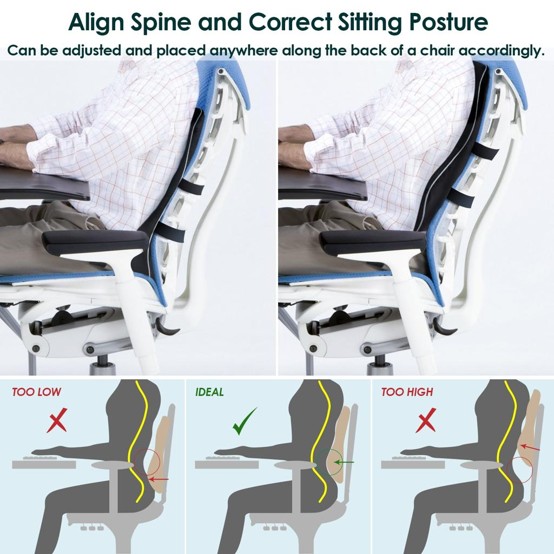
Lumbar Support Setup Guide
A lumbar support pillow can feel uncomfortable even when you have chosen a suitable one. Sometimes the problem is simply its position: a few inches too high, too low, or too far forward can change how the cushion contacts your back.
This guide explains how to position a lumbar support pillow on an office chair, secure its straps, correct common placement mistakes, and readjust it when your sitting posture changes.
Quick Answer: Where Should a Lumbar Support Pillow Sit?
A lumbar support pillow should sit against the natural inward curve of your lower back, usually around your waist or belt-line area. The exact height depends on your torso length, chair shape, and the pillow’s design.
- Start with your hips all the way back against the chair.
- Place the pillow in the gap between your lower back and the backrest.
- Adjust it until the pressure feels broad and comfortable rather than concentrated on one spot.
- Secure the straps so the pillow stays in place when you sit down or recline.
- Recheck the position after changing the chair height, seat cushion, or recline angle.
1. Find the Correct Position Before Tightening the Straps
It is tempting to attach a lumbar pillow wherever its straps happen to fit. A better approach is to find the right contact point first and secure the pillow afterward.
Start here: Sit normally, move your hips back against the backrest, and feel the inward curve of your lower back with one hand. That curved area is the starting point for positioning the pillow.
Step 1: Sit Back in Your Normal Working Position
Move your hips toward the back of the seat instead of sitting on the front edge. Keep your feet supported and your shoulders relaxed. The pillow should support your lower back while you sit in a position you can comfortably maintain, not force you into an exaggerated arch.
Step 2: Locate Your Natural Lower-Back Curve
Place your hand between your waist and the top of your pelvis. You should be able to feel where your lower back curves inward. Position the pillow so its supportive area meets that curve rather than your mid-back or tailbone.
Step 3: Move the Pillow in Small Increments
Start near the belt line, then move the pillow slightly up or down. Make one adjustment at a time and sit back against it again. Small changes are easier to evaluate than repeatedly moving the pillow several inches in either direction.
Do not rely on a fixed measurement alone. Two people of the same height can have different torso proportions, and a thick pillow can contact the back differently from a slim lumbar roll.
Step 4: Secure the Pillow After Finding the Position
Once the pillow feels correctly placed, fasten the straps around the chair back. Tighten them enough to limit slipping, but do not stretch the straps so far that they deform the pillow or pull it away from the intended position.
2. Is Your Lumbar Pillow Too High or Too Low?
The location of the pressure is often the easiest clue. Use the following table to identify what may be wrong before changing the pillow again.
| What You Notice | Possible Cause | What to Try |
|---|---|---|
| Pressure near the mid-back or lower ribs | The pillow may be too high | Lower it a little and test again. |
| Pressure near the tailbone or top of the pelvis | The pillow may be too low | Raise it until it meets the inward curve. |
| Your body is pushed forward | The pillow may be too thick or protrude too far | Try a thinner pillow or a less pronounced shape. |
| The pillow moves down after you sit | The straps may be loose or poorly routed | Refasten the straps and check their grip. |
| One small area feels heavily pressed | The position, contour, or firmness may not suit you | Shift it slightly or try a less aggressive design. |
These are troubleshooting clues, not exact diagnoses. If moving the pillow does not improve comfort, the pillow’s shape or firmness may be a poor match for your back or chair.
For a more detailed explanation of comfortable pressure and common warning signs, read How Should Lumbar Support Feel?
3. How to Adjust Lumbar Pillow Straps So It Stays in Place
A pillow that starts in the right spot but slides down during the day can be frustrating. The goal is to keep it stable without compressing the cushion or restricting normal movement.
Check the Strap Route
Follow the manufacturer’s instructions for routing the strap around the backrest. Make sure it is not twisted, caught on a chair adjustment mechanism, or slipping across a smooth surface. If the chair has a wide or unusually shaped backrest, confirm that the strap is long enough to hold securely.
Tighten Evenly, Not Excessively
If your pillow has two straps, adjust them evenly so the cushion does not tilt. The pillow should remain against the backrest when you sit down and stand up, but the straps should not pull its center into an unnatural curve.
Check the Pillow After Reclining
Lean back in your usual working or reading position. If the pillow slides, rotates, or loses contact with your lower back, return to an upright position and adjust the strap tension or placement. Some pillows fit a vertical office chair well but are less stable on a curved gaming chair or a chair with a very wide backrest.
When the Straps Cannot Hold the Pillow
If the straps repeatedly slip despite correct installation, check whether the pillow is compatible with your chair. A different strap design, a narrower cushion, or a model made for curved backrests may work better. Avoid tying straps to moving parts or modifying the chair in ways that could interfere with its adjustments.
4. Reposition the Pillow When Your Sitting Posture Changes
The correct position is not necessarily identical in every chair or sitting situation. A pillow that feels right at one desk may sit too high or push you too far forward after you change your seat cushion or chair settings.
Upright Typing
Sit back against the chair and check that the pillow fills the lower-back curve without making you arch excessively or lean forward.
Reclining
Lean back slowly and check whether the pillow stays in contact with your lower back. Readjust if it shifts or creates a concentrated pressure point.
Using a Seat Cushion
A seat cushion raises your sitting position and changes where your back meets the backrest. Recheck the pillow height after adding or removing one.
Switching Chairs
Different backrest heights, angles, and widths can change pillow placement. Reposition it instead of assuming the previous setting will work.
You do not need to maintain one rigid posture all day. The aim is to find comfortable support in your normal sitting positions and to move or take breaks as needed.
5. Five Common Lumbar Pillow Positioning Mistakes
Mistake 1: Placing It at the Middle of the Back
A pillow that sits too high may press against the mid-back instead of supporting the lower-back curve. Move it down gradually until the contact point feels more natural.
Mistake 2: Letting It Rest on the Tailbone
A pillow placed too low may press on the pelvis or tailbone area while leaving the lumbar curve unsupported. Raise it slightly and reassess the contact point.
Mistake 3: Choosing the Thickest Pillow Available
A thick pillow is not automatically more supportive. If it pushes your torso forward, reduces the usable seat depth, or makes it difficult to sit back, try a thinner or less contoured design.
Mistake 4: Tightening the Straps Before Positioning the Pillow
Fastening the pillow too early can lock it into an inconvenient position. Find the correct location first, then secure the straps and test the result.
Mistake 5: Ignoring Discomfort Because the Pillow Is Supposed to Help
Lumbar support should feel comfortable enough to use without constantly shifting away from it. Do not force yourself to tolerate sharp pressure, worsening pain, numbness, or tingling. Remove or reposition the pillow and seek appropriate professional advice if symptoms persist.
6. A Two-Minute Lumbar Pillow Position Check
Use this checklist after installing a new pillow or changing your chair setup.
- My hips are back against the chair rather than perched on the seat edge.
- The pillow meets the natural inward curve of my lower back.
- The pressure feels distributed rather than concentrated on one small area.
- I can sit back without feeling pushed forward by the pillow.
- The straps hold the pillow in place without distorting it.
- The pillow stays reasonably comfortable when I change position or recline.
- I can adjust or remove the pillow if it causes discomfort.
If several checks fail, do not keep tightening the straps in the hope that the pillow will fit. Reassess its height and thickness, and consider whether its shape suits your chair and body.
7. What If the Pillow Is in the Right Place but Still Feels Uncomfortable?
Correct placement is only one part of a comfortable setup. A pillow can be at the right height and still feel too firm, too thick, too narrow, or too warm. It may also interact poorly with a chair’s built-in lumbar support.
If the pressure feels excessive, try reducing the amount of contact by moving the pillow slightly or choosing a shallower cushion. If your chair already has a pronounced lumbar curve, test whether an additional pillow is pushing your back too far forward.
For more troubleshooting steps, see Office Chair Lumbar Support Too Hard? Causes, Fixes, and Softer Alternatives.
If you are still choosing a cushion, browse the SitBetterLab Lumbar Support Guide for more options and related advice.
Frequently Asked Questions
Where should a lumbar support pillow sit?
It should sit against the natural inward curve of your lower back, often near the belt line. Adjust the height to your body rather than relying on a universal measurement.
How do I know if my lumbar pillow is too high or too low?
If it presses into your mid-back or lower ribs, it may be too high. If it presses near your tailbone or leaves the lumbar curve unsupported, it may be too low. Move it in small increments and test the contact point again.
Should a lumbar pillow be above or below the waist?
The supportive area should generally align with the inward curve around your waist, rather than sitting entirely above or below it. The best position varies with torso length and pillow shape.
Why does my lumbar pillow keep sliding down?
The straps may be loose, twisted, or incompatible with the chair’s backrest. Check the strap route, tighten both sides evenly if applicable, and make sure the pillow is designed to fit your chair style.
Should I position a lumbar pillow differently when reclining?
Start with the position that supports your lower back in your usual working posture. Then recline and check whether the pillow remains comfortable and in contact. If it shifts or creates pressure, readjust it or reconsider the pillow’s fit.
Can a lumbar support pillow be too thick?
Yes. An overly thick or strongly contoured pillow can push your torso forward, reduce usable seat depth, and create excessive pressure. A thinner design may be more comfortable on chairs that already curve inward.
Final Takeaway
To position a lumbar support pillow correctly, start by sitting back in your chair, locate the natural curve of your lower back, and move the pillow until it provides comfortable, even contact. Secure the straps only after finding the right position, then test it in your normal sitting and reclining positions.
If the pillow feels too high, too low, or too forceful, adjust it in small increments. If it remains uncomfortable despite correct placement, the issue may be its thickness, firmness, shape, or compatibility with your chair. The goal is comfortable support—not forcing your back into one rigid position.
Explore More Lumbar Support Guides
Disclaimer: This article provides general ergonomic information, not a medical diagnosis or treatment plan. Stop using a support that causes worsening pain, numbness, or tingling, and seek appropriate professional advice if symptoms persist.