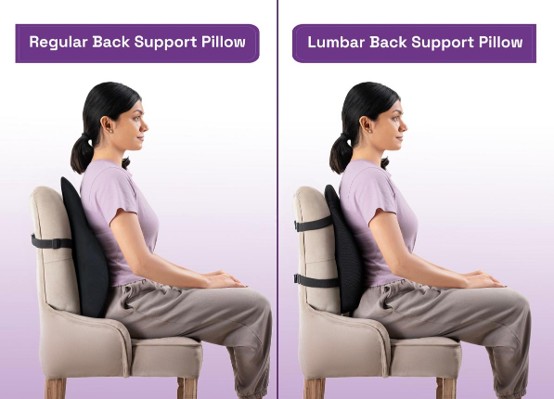
Lumbar Pillow Buying Guide
A lumbar support pillow should fill the gap between your lower back and the chair without pushing you too far forward. But should you choose a firm cushion that holds its shape or a soft lumbar pillow that gently conforms to your body?
The best choice depends on your chair’s existing support, the pillow’s thickness and shape, and how much pressure feels comfortable against your lower back. This guide compares both options and explains how to choose the right firmness for your workspace.
Quick Verdict: Firm vs. Soft Lumbar Support Pillows
A medium-firm lumbar pillow is a reasonable starting point for many office-chair users because it can balance shape retention with cushioning. However, neither firm nor soft is automatically better for everyone.
Choose Firmer Support If…
- Your chair has a relatively flat backrest.
- Soft cushions compress too much for your preference.
- You want a pillow that maintains a more defined shape.
Choose Softer Support If…
- Your chair already has a pronounced lumbar curve.
- Firm cushions create uncomfortable pressure.
- You prefer a more cushioned, conforming feel.
1. What Is the Difference Between Firm and Soft Lumbar Support?
The main difference is how much a pillow compresses under your body and how well it maintains its shape during use. A firmer cushion generally resists compression more strongly, while a softer one yields more readily to pressure.
That difference affects the way the pillow feels against your lower back, but firmness alone does not tell you whether a pillow provides suitable support. Thickness, contour, material, and your chair’s backrest all matter.
| Feature | Firm Lumbar Pillow | Soft Lumbar Cushion |
|---|---|---|
| Feel | More defined and resistant to compression | More cushioned and yielding |
| Shape retention | Often maintains its contour under pressure | May compress more around the body |
| Potential drawback | May feel intrusive or create concentrated pressure | May compress more than some users prefer |
| Possible chair match | Relatively flat backrests that need more pronounced support | Backrests that already provide a strong curve or feel too firm |
| Best selection method | Check pressure, thickness, and whether it pushes you forward | Check whether it retains enough shape to contact your lower back |
These are general tendencies, not guarantees. Two pillows made from the same material can feel very different because their construction, density, thickness, and shape are different.
2. When Should You Choose a Firm Lumbar Pillow for an Office Chair?
A firm lumbar pillow can be a useful option if your chair’s backrest is relatively flat and leaves a noticeable gap behind your lower back. It may also suit people who dislike the feeling of sinking into a cushion.
Your Chair Has Little Built-In Lumbar Support
Some office chairs have a mostly flat backrest with limited shaping around the waist. A firmer pillow with a moderate contour may fill that gap more consistently than a cushion that compresses heavily.
However, do not assume that the firmest pillow will be the best option. A cushion that is too thick or too aggressively curved can push your lower back forward and make sitting uncomfortable.
You Prefer a More Defined Contact Point
Some people prefer feeling a clear support surface rather than a cushion that conforms deeply to their body. A firmer design may provide that sensation, particularly when it has a shape that matches the chair and the user’s lower-back curve.
Your Current Pillow Compresses Too Much
If your existing pillow feels supportive at first but becomes noticeably flatter under pressure, a firmer model may be worth considering. Before replacing it, check whether the cushion has lost its shape or whether the problem is simply that it is too thin.
Watch out: Firmness should not be confused with better posture or medical effectiveness. If a firm pillow creates a sharp pressure point, increases discomfort, or makes you arch excessively, try a different position or a less aggressive cushion.
3. When Is a Soft Lumbar Support Cushion the Better Choice?
A soft lumbar support cushion may be more comfortable if you find hard backrests uncomfortable or if your chair already has a pronounced lumbar contour. The goal is to add a comfortable layer of support without creating excessive pressure.
Your Chair Already Has Built-In Lumbar Support
Adding a thick, firm cushion to a chair with a strong lumbar curve can create too much forward pressure. A thinner or softer cushion may be a better match if you want to soften the contact without adding a large amount of extra projection.
Firm Cushions Feel Uncomfortably Intense
If you constantly shift away from a firm pillow or feel pressure concentrated in one small area, a softer contour may feel more comfortable. You can also try a shallower pillow rather than changing firmness alone.
You Want a More Cushioned Feel
Soft foam can provide a gentler initial feel, particularly when the pillow has a cover and shape that distribute contact comfortably. Keep in mind that very soft foam may compress substantially, so make sure the pillow still reaches your lower back when you sit normally.
Soft does not necessarily mean weak, and firm does not necessarily mean supportive. A well-designed soft pillow may work well for one chair, while a firmer cushion may be more suitable for another.
4. How Foam Rebound Affects Lumbar Support
Foam rebound describes how a material responds after pressure is applied and then released. It is related to, but different from, firmness. Understanding the difference helps explain why two lumbar pillows that feel similarly firm at first can behave differently during a long sitting session.
Slow-Rebound Foam
Some memory foam gradually conforms to pressure and recovers more slowly after you move. This can create a molded, cushioned sensation, but it may also retain more heat depending on the material and cover.
Faster-Rebound Foam
Some conventional polyurethane foams recover more quickly and feel more responsive. Their firmness and durability still depend on formulation, density, construction, and use.
Memory foam is not always soft, and conventional foam is not always firm. A dense memory foam cushion can feel quite firm, while some other foams can feel plush. The material name alone does not tell you how the pillow will feel.
Firmness, Density, and Rebound Are Different
- Firmness: How much the cushion resists compression when you press against it.
- Density: The mass of foam per unit volume. It can help characterize the material, but it is not a direct measure of firmness.
- Rebound: How quickly the foam returns toward its original shape after pressure is removed.
- Thickness: How far the pillow projects from the chair back and how much space it occupies behind your lower back.
When comparing products, look for clear material specifications and dimensions rather than relying on phrases such as “premium foam” or “maximum support.” If a manufacturer does not publish a firmness rating or standardized test, avoid assuming one based on marketing language.
For a closer look at foam-based options, read our guide to Best Memory Foam Lumbar Support Pillows for Office Chairs.
5. Match Pillow Firmness to Your Chair’s Backrest
The chair itself can be just as important as the pillow. Before choosing between firm and soft lumbar support, check the shape and depth of the space between your lower back and the backrest.
| Chair Type | What to Consider | Starting Point |
|---|---|---|
| Flat-back office chair | May leave a larger gap around the lower back | Try a moderately contoured pillow that retains its shape. |
| Chair with built-in lumbar adjustment | An additional cushion may create excessive projection | Adjust the built-in support first; consider a thin cushion if needed. |
| Curved gaming chair | The backrest shape and side bolsters may affect fit | Check pillow width, thickness, strap fit, and contour. |
| Mesh office chair | The flexible backrest may respond differently under pressure | Choose a pillow that stays stable without pushing too far forward. |
These are starting points, not strict rules. If your chair already supports your lower back comfortably, adding a pillow may be unnecessary. First try adjusting the chair’s existing lumbar support and backrest angle, if those features are available.
6. How to Test Whether a Lumbar Pillow Is Too Firm or Too Soft
You do not need to judge a lumbar pillow by pressing it with your hand alone. The more useful test is how it behaves when you sit in your normal working position.
A Simple Fit Checklist
- Sit back with your hips supported and your feet resting comfortably.
- Check that the pillow contacts the natural curve of your lower back.
- Notice whether pressure feels broad and comfortable or concentrated in one spot.
- Check whether the pillow pushes your torso forward or makes the seat feel too shallow.
- Move slightly and recline if that is part of your normal routine.
- Reassess the position and comfort before deciding whether the firmness is unsuitable.
Signs the Pillow May Be Too Firm
- It creates a concentrated pressure point instead of comfortable contact.
- You repeatedly lean away from it to avoid the pressure.
- It feels intrusive even after you adjust its height and position.
Signs the Pillow May Be Too Soft
- It compresses so much that it no longer reaches your lower-back curve.
- You feel that the cushion almost disappears under normal sitting pressure.
- It repeatedly loses its shape or shifts in a way that makes positioning difficult.
These signs can also indicate incorrect height, excessive thickness, poor shape, or a mismatch with the chair. Adjust the pillow’s position before concluding that you need a different firmness.
7. Should You Choose an Adjustable Lumbar Pillow?
If you are uncertain about firmness, an adjustable lumbar support pillow may offer more flexibility than a fixed-shape cushion. Depending on the design, it may allow you to change the pillow’s height, strap position, thickness, or internal support.
However, “adjustable” can mean different things. Some products only have adjustable straps, while others offer a removable insert or a changeable support layer. Read the product description carefully to determine what can actually be changed.
An adjustable model is worth considering if you switch between chairs, have not yet found a comfortable thickness, or want more control over placement. It is not automatically better than a well-fitting fixed pillow, and extra adjustment mechanisms do not guarantee a better fit.
See our guide to Best Adjustable Lumbar Support Pillows for Office Chairs for more options.
8. Common Mistakes When Choosing Lumbar Pillow Firmness
Assuming Firmer Always Means More Support
A very firm cushion can still be a poor match if its contour or thickness is wrong. Comfort and fit matter more than selecting the hardest foam available.
Confusing Foam Density with Firmness
Density describes how much a given volume of foam weighs; it does not directly tell you how hard the pillow feels. Look for actual firmness information when the manufacturer provides it.
Ignoring the Chair’s Existing Support
A thick pillow can add too much curve to a chair that already has strong lumbar support. Try adjusting the chair first and choose a cushion that complements rather than fights its shape.
Choosing Only by Product Photos
Photos rarely reveal the true firmness or compression behavior of foam. Check dimensions, materials, return policies, and customer feedback about the actual feel, while remembering that comfort is subjective.
Ignoring Persistent Discomfort
Do not force yourself to use a pillow that worsens pain or causes numbness or tingling. Remove or reposition it, and seek appropriate professional advice if symptoms persist.
Frequently Asked Questions
Is a firm or soft lumbar support pillow better?
Neither is universally better. A firm pillow may suit a relatively flat backrest or someone who prefers a defined contact point. A soft cushion may feel better against a chair with a pronounced lumbar curve or for someone who finds firm pressure uncomfortable.
Is memory foam better for lumbar support?
Memory foam can conform to the body’s shape, but its firmness, rebound, and heat retention vary by formulation and construction. It is worth comparing the pillow’s actual dimensions and feel rather than choosing by material name alone.
Can a lumbar pillow be too firm?
Yes. A cushion that creates concentrated pressure, pushes your torso forward, or remains uncomfortable after repositioning may be too firm, too thick, or poorly shaped for your chair.
Does a soft lumbar cushion lose its support?
It may compress more under pressure, but softness alone does not determine whether a cushion provides suitable support. Consider its shape retention, thickness, construction, and whether it continues to contact your lower back while seated.
Should I choose a thick or thin lumbar pillow?
Choose a thickness that fills the gap behind your lower back without pushing your torso too far forward. A thinner pillow may suit a chair with built-in lumbar support, while a chair with a flatter backrest may need a more substantial contour.
What if my office chair lumbar support is already too hard?
Try adjusting the built-in support’s depth or position if your chair allows it. You can also assess whether a thin, softer cushion improves contact without adding excessive thickness. For more troubleshooting, see Office Chair Lumbar Support Too Hard?
Final Verdict: Firm vs. Soft Lumbar Support Pillows
Choose a firm lumbar pillow if you want a more defined support surface and your chair leaves a gap behind your lower back. Choose a softer cushion if you prefer gentler contact or your chair already has a pronounced lumbar curve. If you are unsure, a moderately firm pillow with a suitable thickness is a reasonable starting point—not a universal solution.
Pay attention to shape, thickness, foam behavior, and compatibility with your chair. The best pillow is the one that fits your lower-back curve comfortably without forcing your body forward or creating excessive pressure.
Explore More Lumbar Support Guides
Disclaimer: This article provides general ergonomic information and is not a medical diagnosis or treatment plan. Stop using a cushion that worsens your symptoms and seek appropriate professional advice if discomfort persists.