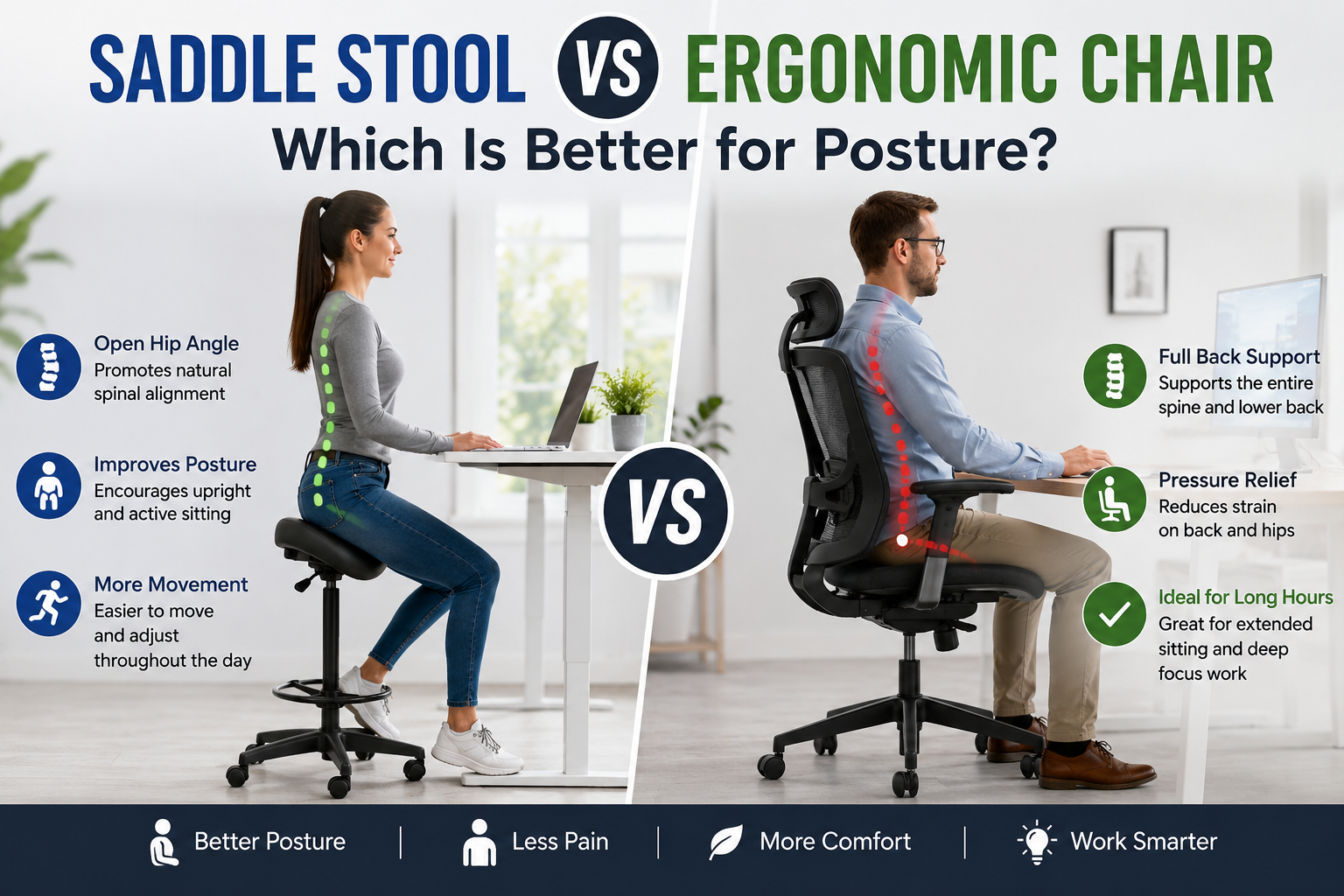
You have probably seen them: the sleek, backless saddle stool that looks like something from a futuristic dental office, and the classic ergonomic chair with its high back, adjustable armrests, and prominent lumbar support. Both claim to fix your posture. Both promise relief from back pain. But which one actually delivers?
The short answer is that they serve different masters. An ergonomic chair is designed for passive, long‑duration support when you need to stay put and focus. A saddle stool is engineered for active, upright sitting, encouraging movement and core engagement. This guide breaks down the biomechanics, reviews the research, and gives you a clear path to choosing the right tool for your body and your workflow.
Quick Comparison: Saddle Stool vs. Ergonomic Chair
| Feature | Saddle Stool | Ergonomic Chair |
|---|---|---|
| Hip Angle | Open (120–135°); thighs slope downward | Often 90°; thighs parallel to floor |
| Pelvic Tilt | Anterior (forward) — maintains natural lumbar lordosis | Posterior (backward) — can flatten lower back without support |
| Spinal Curve | Maintains S‑curve; closer to standing posture | Relies on passive backrest and lumbar support |
| Core Engagement | High — you must actively stabilize your torso | Low — chair does the work |
| Movement | Encourages micro‑movements; promotes active sitting | Static; encourages sustained, passive posture |
| Best For | Active tasks, forward‑leaning work, standing desks, healthcare (dentistry, surgery) | Long periods of stationary desk work, typing, meetings |
| Adjustability | Height, sometimes seat angle; no armrests or backrest | Height, seat depth, backrest angle, lumbar depth, 4D armrests |
Biomechanics: How Sitting Angle Affects Your Spine
To understand which chair is better for your posture, you must look at your pelvis. When you stand, your pelvis is in a neutral position, maintaining the natural S‑curve (lordosis) of your spine. When you sit on a traditional flat seat with your thighs parallel to the floor, your hips are forced into a 90‑degree angle. This rolls your pelvis backward — called a posterior pelvic tilt — which flattens your lower back into a damaging C‑curve.
Research shows that sitting in a poorly designed chair can put up to 90% more pressure on your spine than standing (source). This C‑curve slump dramatically increases anterior disc compression, stretches spinal ligaments, and leads directly to chronic back pain (source).
An open hip angle of 120–135° creates an anterior pelvic tilt, preserving the natural lordosis of your lumbar spine. This is exactly what saddle seating accomplishes: your thighs slope downward, your knees drop lower than your hips, and your pelvis stays forward, supporting the S‑curve of your back. One user described the effect vividly: after suffering a prolapsed disc, switching to a saddle stool allowed them to “sit but still keep my pelvis and spine in an upright position as if I was standing” (source).
How a Saddle Stool Promotes Active Posture
A saddle stool has no backrest. This is not a design flaw — it is the core feature. Without a backrest to lean on, your body is forced to engage its core stabilizing muscles to keep you upright. This constant, subtle activation of your deep trunk muscles is precisely what helps prevent lower back pain (source).
Key benefits for posture include:
- Open hip angle (120–135°): Thighs slope downward, tilting the pelvis forward and maintaining the lumbar curve.
- Active core engagement: Your back and abdominal muscles work continuously to keep you upright, strengthening them over time.
- Natural spinal curve: The pelvis is in a neutral position, which supports the spine’s three natural curves (source).
- Encourages micro‑movements: The lack of a backrest forces you to adjust your position constantly, preventing static loading and keeping your intervertebral discs hydrated (source).
Clinical studies have shown that saddle chairs can significantly improve the range of motion and reduce pain levels for those with lower back issues (source). Medical professionals who have adopted saddle seating report less fatigue, better posture, and a significant reduction in back and shoulder pain (source).
A properly adjusted saddle stool promotes deep diaphragmatic breathing, helps strengthen core muscles, limits forward head posture, reduces circulation issues in the back of the thigh, and helps maintain uniform intervertebral disc pressures (source). For active tasks such as dentistry, surgery, or lab work, saddle stools excel because they allow for greater freedom of movement and keep the spine aligned while leaning forward (source).
How an Ergonomic Chair Supports Passive Sitting
Standard office chairs operate on the principle of passive sitting. They assume your hips will be at 90° and use a protruding lumbar support cushion to artificially push your lower back into a lordotic curve. When you lean back to a 110° angle, the backrest effectively unloads the weight of your torso from your spine (source).
This makes traditional ergonomic chairs excellent for passive, reclined tasks such as phone calls, presentations, or casual reading. They also offer unmatched adjustability — seat depth, 4D armrests, headrest angle, and lumbar firmness — allowing you to dial in a custom fit for your body.
However, studies show that for active, forward‑leaning tasks — typing, writing, drafting, or detailed computer work — traditional chairs fail completely (source). As soon as you lean forward away from the backrest, the 90° hip angle forces your pelvis into a posterior tilt, the lumbar support becomes useless, and your spine compresses severely (source).
When properly adjusted, an ergonomic chair can still produce a 140% spinal load compared to standing (baseline 100%), which is better than the 220% of a standard office chair (source). But this is still far from the ideal open‑hip posture that a saddle stool can achieve.
Which One Is Better for Posture? The Verdict
Both chairs can be good for your posture, but they achieve it through different mechanisms. The more critical factor is whether you are matching the chair to the task.
For Active, Task‑Oriented Work (Leaning Forward): Saddle Stool Wins
If your work requires you to lean forward — typing, writing, drafting, dentistry, surgery — a saddle stool is superior. It maintains the open hip angle and your lumbar curve even when you are not touching a backrest. The absence of a backrest forces your core muscles to engage, preventing the slumping and “C‑curve” that causes pain.
For Passive, Long‑Duration Sitting (Leaning Back): Ergonomic Chair Wins
If your work involves long periods of stationary desk work — spreadsheet analysis, programming, customer support calls, or watching presentations — an ergonomic chair provides the passive support your back needs. The adjustable lumbar support and high backrest unload the weight of your torso when you recline, reducing fatigue.
Choosing the Right Seating Strategy
Instead of trying to find the one “perfect” chair, the most evidence‑backed approach is to use a system. Researchers have documented that healthy individuals, people without back pain, change their sitting posture up to 13 times per hour — roughly every 4‑5 minutes (source). Static posture, even perfect static posture, is essentially starving your intervertebral discs of nutrients.
You need movement.
An effective strategy for many people is to use a height‑adjustable standing desk and alternate between three options:
- Standing — for high‑energy, active work.
- Saddle stool — for active, upright sitting when you need to be close to your work.
- Ergonomic chair — for passive, relaxed sitting during breaks or less intensive tasks.
This movement‑rich system keeps your discs hydrated, your muscles engaged, and your spine healthy. As one ergonomics expert put it, “The ideal sitting posture is a variable one” (source).
When a Saddle Stool Might Not Work for You
Saddle stools are not without drawbacks. They can cause discomfort if not set up correctly. Common issues include:
- Initial soreness: Your body is not used to the open hip angle and active core engagement. Expect 1–2 weeks of minor soreness before you adapt.
- Pressure on the pelvis: If the saddle is too narrow or too wide for your frame, it can create pressure points. A split‑seat design (like the Salli Sway) is ideal for reducing perineal pressure (source).
- Incorrect desk height: A saddle stool raises your seated eye height. If your monitor is not also raised, you will tilt your head down, causing neck strain. Always adjust your workstation when you change your chair.
- Hip and inner thigh strain: If not properly adjusted, saddle chairs can increase strain on hip joints (source).
- Not suitable for everyone: Users with certain hip or knee conditions may find the abducted (spread) leg position uncomfortable.
- Never tilt the seat forward: An already‑tilted forward saddle seat can cause hyperlordosis (excessive lumbar curve) and low back pain (source).
Frequently Asked Questions (FAQ)
Are saddle stools better for your back than office chairs?
For active, forward‑leaning tasks, yes. Saddle stools maintain an open hip angle (120–135°) and encourage core engagement, which helps prevent the posterior pelvic tilt that causes lower back pain. For passive, reclined tasks, an ergonomic chair is better.
Can I use a saddle stool all day?
You can, but experts advise caution. Because the saddle stool requires constant core activation, some users experience fatigue over an 8‑hour day. The optimal strategy is to alternate between a saddle stool, standing, and an ergonomic chair throughout the day.
Will a saddle stool help with sciatica?
Yes. The open hip angle reduces pressure on the lumbar discs and can help alleviate sciatic nerve compression. Users have reported significant relief from sciatica using a saddle chair (source).
Do saddle stools hurt your hips?
If you choose the correct seat width for your pelvic frame, a saddle stool should not cause hip pain. A saddle that is too narrow will pinch; one that is too wide will force your legs apart awkwardly. It may take a few weeks for your hip adductors to adapt to the new position.
Can I use a saddle stool with a standing desk?
Absolutely. Saddle stools are an excellent companion to standing desks because they allow you to perch at a height that matches your standing desk, keeping you in a semi‑standing, active posture when you want a break from standing but do not want to recline.
Final Verdict: Which One Should You Buy?
👉 Choose a saddle stool if: Your work involves active, forward‑leaning tasks (writing, drafting, dentistry, lab work), you want to strengthen your core, you enjoy an upright, engaged posture, and you are willing to adjust your workstation height to match.
👉 Choose an ergonomic chair if: You need passive support for long, stationary desk work (spreadsheets, coding, customer support), you prefer to recline and have the chair support your weight, you value adjustable armrests, or you have existing hip or knee issues that make the saddle position uncomfortable.
👉 Choose both if: You can. Using a height‑adjustable standing desk, a saddle stool, and a good ergonomic chair together creates the variable, movement‑rich environment that research shows is best for spinal health.
Most important advice: No chair, no matter how expensive or well‑designed, can replace movement. Stand up, change positions, and stretch every hour. Your spine relies on compression and decompression cycles to pump nutrients in and waste products out. Static sitting — even on the perfect chair — will eventually starve your discs.