
Buying your first massage chair can be exciting — and surprisingly confusing. Product pages often use terms such as 3D rollers, 4D rollers, S-Track, L-Track, SL-Track, body scanning, zero gravity, airbags, heat, and foot rollers.
You do not need to understand every feature before you start shopping. What matters is knowing how the chair fits your body, which features match your preferences, how much space you have, what the warranty covers, and what you are actually paying for.
This beginner’s massage chair buying guide walks through the process step by step, from setting a realistic budget to checking fit, testing a chair, comparing warranties, and evaluating online purchases.
How to Choose Your First Massage Chair
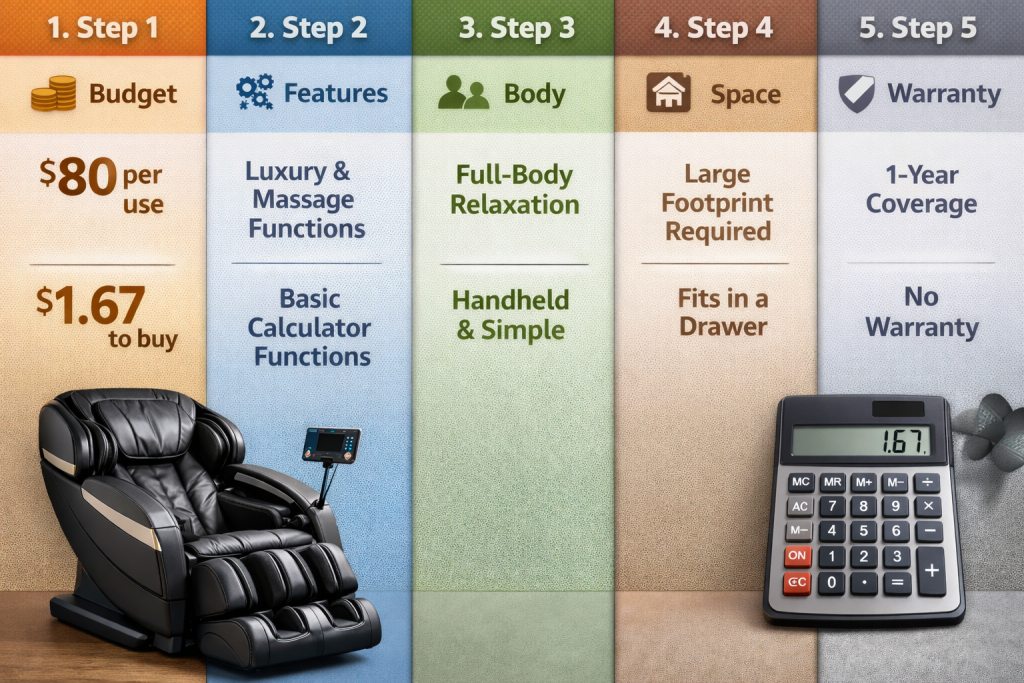
If you only have a few minutes, use this seven-step process:
Step 1: Set a realistic total budget.
Step 2: Understand roller and track technology.
Step 3: Check your height, weight, and preferred massage areas.
Step 4: Measure the room, doorway, and recline clearance.
Step 5: Test the chair when possible, or check the return policy carefully.
Step 6: Compare warranty, service, and delivery terms.
Step 7: Compare the actual features and ownership costs rather than shopping by feature count alone.
The goal is not to buy the chair with the longest feature list. The goal is to find a chair that fits your body, fits your room, matches your preferred massage style, and makes sense for your budget.
Step 1: Set Your Massage Chair Budget
Massage chairs are available across a very wide price range. Lower-priced models may offer basic massage functions, while higher-priced models can add more sophisticated roller systems, additional adjustment options, larger airbag systems, more programs, and upgraded materials.
Instead of assuming that one price range is automatically best, think about what you actually want from the chair.
| Budget Level | What You May Find | What to Check |
|---|---|---|
| Lower budget | Basic massage programs, simpler roller systems, fewer adjustment options | Fit, warranty, construction, return policy |
| Mid-range | More roller adjustment, additional massage programs, heat, airbags, or improved body-fit features | Which features you will actually use |
| Premium | More advanced roller systems, additional customization, larger feature sets, premium materials or controls | Whether the extra features justify the additional cost |
Remember the Total Cost of Ownership
The purchase price is only one part of the decision. Before ordering, check whether the advertised price includes:
- Delivery
- In-home or white-glove setup
- Taxes and other checkout charges
- Warranty service
- Return shipping or restocking fees
- Extended warranty coverage
A lower sticker price is not necessarily a lower total cost if delivery, setup, or returns are expensive.
What About Financing?
Some retailers and manufacturers offer financing promotions. If you use financing, compare the total amount paid, promotional period, interest rate after the promotion, and any fees rather than looking only at the monthly payment.
A monthly payment can make an expensive chair appear affordable while hiding the actual purchase cost.
Step 2: Understand Roller Technology
Rollers are one of the most important parts of a massage chair because they determine how the mechanical massage is delivered along the back.
2D vs. 3D vs. 4D Massage Rollers
| Roller Type | Basic Idea | What Beginners Should Know |
|---|---|---|
| 2D | Rollers move along the programmed path without the same degree of depth adjustment found in 3D systems. | Can still provide a useful massage experience, especially at a lower price. |
| 3D | Adds adjustment of roller depth toward and away from the body. | Useful if you want more control over massage intensity. |
| 4D | Generally builds on 3D-style movement with more control over roller speed, timing, or movement characteristics. | Can provide more customization, but does not automatically mean a better fit for every user. |
One important beginner mistake is treating the number in the product name as a complete measure of quality. It is not.
A well-designed 3D chair that fits your body can be a better purchase for you than a more expensive chair marketed around 4D technology that feels uncomfortable.
When comparing roller systems, pay attention to:
- Roller depth adjustment
- Massage intensity controls
- Roller path length
- Available manual controls
- Automatic programs
- Whether the chair allows you to adjust specific areas
📖 Related guide: 3D vs 4D Massage Chairs: What’s the Difference?
Step 3: Understand S-Track, L-Track, and SL-Track
The track is the path followed by the massage rollers. Track design affects how far the mechanical massage reaches and which areas of the body can be addressed by the rollers.
| Track Type | General Design | Best Question to Ask |
|---|---|---|
| S-Track | Follows the general curve of the back. | Does the roller path cover the areas I care about? |
| L-Track | Extends the roller path farther below the lower back toward the seat area. | How far does this specific model extend? |
| SL-Track | Combines the curved back path with a longer extension under the lower body. | Does the actual roller path match my preferred massage areas? |
There is no universal rule that every beginner needs an SL-Track chair. If you primarily want back and shoulder massage, an S-Track design may be sufficient. If you specifically want roller coverage extending into the seat area, an L-Track or SL-Track model may make more sense.
📖 Related guide: L-Track vs S-Track Massage Chairs: What’s the Difference?
Step 4: Check Your Height, Weight, and Body Fit
One of the most important lessons for first-time buyers is that massage chairs are not one-size-fits-all.
A chair can have excellent specifications and still feel uncomfortable if the roller path, shoulder area, footrest, or seat dimensions do not fit your body.
Height Compatibility
Do not rely on generic height ranges from a third-party article alone. Manufacturers may publish different recommended user-height ranges for different models.
Before buying, check the actual manufacturer’s specifications for:
- Recommended minimum and maximum user height
- Adjustable shoulder position
- Headrest or pillow adjustment
- Leg and footrest adjustment
- Roller reach
- Seat dimensions
For taller users: Check the manufacturer’s maximum height recommendation and make sure the leg and foot sections accommodate your body.
For couples: If two people will share the chair, compare both users’ height and body dimensions against the manufacturer’s specifications.
Weight Capacity
Weight capacity varies by model. Some chairs are designed for standard residential use, while certain heavy-duty models support higher user weights.
Always check the published weight capacity of the exact model before buying.
Do not assume that two chairs from the same brand have the same weight limit.
Seat Width and Comfort
Weight alone does not determine whether a massage chair will feel comfortable. Seat width, seat depth, shoulder width, leg length, and the position of the airbags can all affect fit.
If you have a larger frame, look for models that clearly publish seat dimensions and user-size information rather than relying only on a generic “big and tall” label.
How to Match Massage Features to Your Preferences
Instead of asking which features are universally necessary, ask which features you are most likely to use.
| Preference | Features to Consider | What to Check |
|---|---|---|
| Back and shoulder massage | Roller adjustment, shoulder airbags, adjustable intensity | Does the roller path actually reach your preferred areas? |
| Lower-body massage | Extended track, hip/seat airbags, calf and foot massage | Which parts are handled by rollers versus airbags? |
| Gentler massage | Adjustable intensity, manual controls, softer programs | Can you reduce roller and airbag intensity independently? |
| Heat | Lumbar, back, seat, or leg heat depending on the model | Where is the heat actually located? |
| Foot and calf massage | Foot rollers, calf airbags, calf rollers on selected models | Check shoe/foot size compatibility and adjustment range. |
Body Scanning: Useful, But Not Magic
Many modern massage chairs include some form of body scanning or automatic body-position detection.
The purpose is generally to help the chair identify or estimate the user’s body position so that the programmed massage can be adjusted accordingly.
However, body scanning should not be treated as a guarantee of perfect alignment.
When testing a chair, check whether:
- The shoulder detection feels accurate
- You can manually adjust the massage position
- The chair allows different user profiles
- The roller pressure can be adjusted after scanning
- The footrest and headrest can be positioned comfortably
Zero Gravity: What It Actually Does
Zero-gravity positioning is a reclined seating position inspired by a posture designed to distribute the body differently across the chair.
In massage chairs, the feature can change your body position during a massage and may make the chair feel more comfortable for some users.
But zero gravity is primarily a positioning and comfort feature. It should not be confused with a medical treatment.
If you like the feature, test the actual reclined position rather than assuming every “zero gravity” implementation will feel the same.
Heat, Airbags, and Foot Rollers: Are They Worth It?
Heat
Heat can make a massage session feel warmer and more comfortable. Different chairs place heating elements in different locations, such as the lumbar area, back, seat, or legs.
Check the actual heating zones and whether the temperature can be adjusted.
Airbags
Airbags inflate and deflate around areas such as the shoulders, arms, hips, calves, or feet.
Airbag coverage varies significantly between models. More airbags do not automatically mean a better massage.
What matters is whether the pressure feels comfortable and whether you can adjust the intensity.
Foot Rollers
Foot rollers are useful if you specifically enjoy mechanical massage around the bottoms of your feet. They are not essential for everyone.
Before buying, check the supported foot size and how the foot compartment fits your feet.
Step 5: Measure Your Space Before Ordering
A massage chair can take up considerably more space than a normal recliner, especially when fully reclined.
Measure your room before ordering.
Measurements to Take
- Doorway width: Measure the narrowest point the chair or packaging must pass through.
- Hallway width: Check turns, corners, stairways, and elevators if applicable.
- Room width and depth: Measure the actual footprint available for the chair.
- Recline clearance: Check how far the chair extends when reclined.
- Ceiling clearance: Important for certain reclined or elevated designs.
- Doorway width: ______ inches
- Hallway width: ______ inches
- Available room width: ______ inches
- Available room depth: ______ inches
- Wall clearance: ______ inches
- Ceiling height: ______ inches
Wall-Hugger and Space-Saving Designs
Some massage chairs are designed to recline while moving forward, reducing the amount of space needed behind the chair.
Do not assume that every chair marketed as “space-saving” requires the same clearance. Check the manufacturer’s installation dimensions for the exact model.
This is particularly important if the chair will be placed in a bedroom, apartment, home office, or other compact room.
Step 6: Test the Chair Before You Buy
Whenever possible, try a massage chair in person before making a major purchase.
Massage comfort is highly subjective. Roller pressure, shoulder positioning, seat shape, airbags, foot rollers, and recline position can feel very different from one model to another.
What to Test in a Showroom
- Sit in the chair with your normal posture.
- Check whether the headrest and shoulder area fit correctly.
- Try several massage programs.
- Adjust roller intensity.
- Adjust airbag intensity.
- Test the recline and zero-gravity positions.
- Check the foot and calf compartments.
- Try getting into and out of the chair.
- Make sure the controls are easy for you to understand.
Questions to Ask Before Buying
- What is the manufacturer’s warranty?
- How are warranty repairs handled?
- Is local service available?
- Who pays return shipping?
- Are there restocking fees?
- Does the advertised price include delivery?
- Is assembly included?
- How long is the return window?
Buying Online: Check the Return Policy Carefully
Buying online can give you access to a larger selection, but massage chairs are difficult to return compared with smaller products.
Before clicking Buy, read the actual return policy rather than relying on a general statement such as “30-day returns.”
Look for:
- Return eligibility
- Return shipping responsibility
- Restocking fees
- Original packaging requirements
- Pickup arrangements
- Time limits
- Damage or usage restrictions
- Whether the chair must be returned in unused condition
Step 7: Compare Warranty and After-Sales Support
A massage chair contains motors, electronics, airbags, rollers, control systems, and other moving components. Warranty coverage can therefore be an important part of the purchase decision.
Do not compare warranties using only the number of years advertised.
| Warranty Area | What to Check |
|---|---|
| Frame | How long is structural coverage? |
| Parts | Are motors, rollers, electronics, airbags, and other components covered? |
| Labor | How long is labor covered? |
| In-home service | Will technicians come to your home if a repair is required? |
| Shipping | Who pays transportation costs for warranty repairs or returns? |
Warranty Red Flags
- The warranty terms are difficult to find.
- Parts and labor have very different coverage periods.
- Repair service is only available in limited locations.
- The buyer is responsible for expensive transportation.
- The warranty becomes void under common household-use conditions.
Delivery and Installation: Plan Ahead
Massage chairs can be large and heavy. Delivery planning is especially important if your home has stairs, narrow hallways, tight turns, or limited elevator access.
Common Delivery Types
- Curbside delivery: The shipment is delivered outside or near the property, leaving you responsible for moving it inside.
- Threshold delivery: The shipment is brought closer to or inside the entrance, depending on the service.
- White-glove delivery: A delivery team handles additional placement, unpacking, assembly, or packaging removal depending on the service purchased.
Always confirm exactly what is included. “White glove” does not necessarily mean the same thing from every retailer.
Do You Need 5D, 6D, 7D, or 8D?
Marketing terminology around massage-chair generations can be confusing.
Terms such as 5D, 6D, 7D, or 8D are not standardized technical classifications across the entire industry. Different manufacturers may use these labels differently.
Instead of choosing a chair because it has the largest number, look at the actual specifications:
- How the rollers move
- Whether roller depth is adjustable
- Whether roller speed can change
- Available massage programs
- Manual adjustment options
- Track length
- Body-fit adjustments
- Warranty and service support
Common Beginner Mistakes to Avoid
Mistake #1: Shopping by Price Alone
The cheapest chair may not provide the features, fit, or service support you need. But the most expensive chair is not automatically the right choice either.
Compare the actual specifications and ownership terms of the models within your budget.
Mistake #2: Shopping by Feature Count
A chair with dozens of programs and features can look impressive on a product page. But if the chair does not fit your body or you dislike the massage intensity, the extra features have limited value.
Mistake #3: Ignoring Body Fit
Height, shoulder position, seat dimensions, leg length, and foot size can all affect comfort. Check the manufacturer’s fit information before buying.
Mistake #4: Forgetting Doorways and Recline Clearance
Measure your entrance route and installation area before ordering. A chair that cannot be moved into the room is an expensive problem.
Mistake #5: Assuming Every Warranty Is the Same
Compare frame, parts, labor, service location, and transportation coverage. Two chairs can advertise similar warranty lengths while providing very different practical coverage.
Mistake #6: Assuming a Massage Chair Treats a Medical Condition
A massage chair can provide massage and relaxation, but it should not be presented as a replacement for medical diagnosis or treatment.
If you have persistent, severe, or unexplained pain, especially pain accompanied by weakness, numbness, or other concerning symptoms, seek appropriate professional medical advice.
Beginner’s Massage Chair Shopping Checklist
📋 BEFORE YOU BUY
Budget
- □ I know my maximum purchase budget.
- □ I checked delivery and installation costs.
- □ I checked financing terms if applicable.
Body Fit
- □ I checked the manufacturer’s recommended height range.
- □ I checked the weight capacity.
- □ I checked shoulder, seat, leg, and foot fit.
Massage Features
- □ I understand the roller technology.
- □ I understand the track design.
- □ I checked massage intensity adjustment.
- □ I checked body scanning or positioning features.
- □ I checked heat zones if heat matters to me.
- □ I checked airbag coverage.
- □ I checked foot and calf massage options.
Space
- □ I measured the doorway.
- □ I measured hallways and turns.
- □ I measured the available room area.
- □ I checked recline clearance.
- □ I checked ceiling clearance if necessary.
Warranty and Returns
- □ I checked frame coverage.
- □ I checked parts coverage.
- □ I checked labor coverage.
- □ I checked warranty service availability.
- □ I read the complete return policy.
- □ I checked return shipping and restocking fees.
Before Buying
- □ I tested the chair if possible.
- □ I compared at least two or three models.
- □ I checked current manufacturer specifications.
- □ I read recent owner reviews.
Frequently Asked Questions About Buying a Massage Chair
How much should a beginner spend on a massage chair?
There is no universal price that every beginner should spend. A sensible budget depends on the features you want, how frequently you expect to use the chair, and whether the chair fits your body and room.
Instead of targeting a fixed price range, compare several models within your budget and evaluate their roller technology, track design, comfort, warranty, service, and return policy.
Should I buy a massage chair without trying it first?
If possible, testing the chair is helpful because massage comfort is subjective. If you cannot test it, pay particular attention to the manufacturer’s fit information and the retailer’s complete return policy.
Is a used massage chair a good option for a beginner?
A used chair can reduce the purchase price, but it also introduces additional questions about age, maintenance, warranty transferability, operating condition, and transportation.
If buying used, test all major functions before purchasing and verify whether any remaining warranty can be transferred.
How long does a massage chair last?
There is no single lifespan that applies to every massage chair. Durability depends on the model, construction, frequency of use, maintenance, and individual components.
Rather than relying on a specific “7–10 year” promise, check the warranty and manufacturer support for the exact model.
Can two people with different heights share one massage chair?
Often, yes, but the result depends on the chair’s adjustment range. Check the manufacturer’s recommended user-height range and test the shoulder, headrest, footrest, and roller positioning for both users.
When is the best time to buy a massage chair?
Retailers and manufacturers may run promotions around major shopping periods and holiday events, but discounts vary by brand, model, and retailer.
Rather than waiting for a particular date, compare the current price with the manufacturer’s normal pricing, warranty, delivery terms, and return policy.
What are the most important massage chair features for beginners?
There is no universal list of must-have features. For most shoppers, the most useful specifications to understand are roller technology, track design, body fit, massage intensity adjustment, recline position, airbag coverage, heat, foot and calf massage, warranty, and return policy.
The right combination depends on your body, preferences, room, and budget.
Final Thoughts: Buy for Fit, Not Just Features
Buying your first massage chair becomes much easier once you stop trying to compare every specification at once.
Start with the fundamentals:
- Set a realistic budget based on your total purchase and ownership costs.
- Understand roller and track technology before comparing models.
- Check your body fit, including height, weight, shoulder position, seat dimensions, and footrest fit.
- Measure your space before ordering.
- Test the chair when possible, especially if you are sensitive to massage pressure.
- Compare warranty and service, not just the advertised feature list.
- Read the return policy before making a large purchase.
The best first massage chair is not necessarily the cheapest, the most expensive, or the one with the longest feature list. It is the one that fits your body, fits your space, matches your preferred massage experience, and provides reasonable warranty and return protection for the price.