
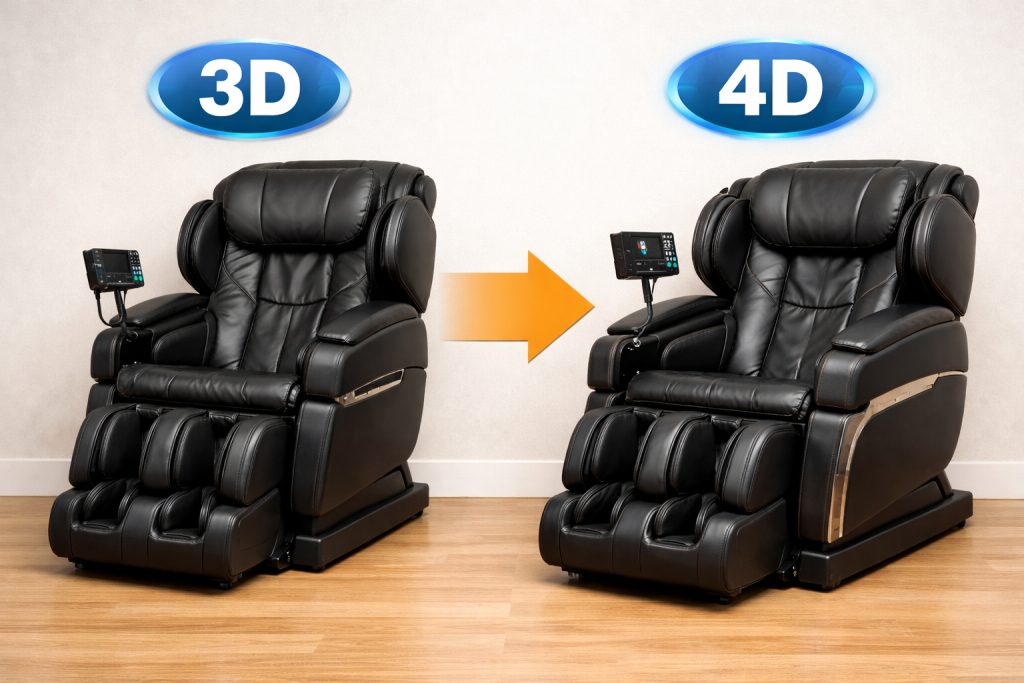
If you’re comparing 3D vs. 4D massage chairs, the biggest difference is usually how much control you have over the massage rollers’ movement, pressure, speed, and rhythm. A 3D massage chair typically adds adjustable roller depth, while a 4D model generally adds more variation in speed or timing.
However, 4D does not automatically mean a better massage. Manufacturers use these terms differently, and the quality of the roller mechanism, body fit, track design, and available adjustments can matter more than the label on the product page.
This guide explains how 3D and 4D massage chairs differ, what features to compare, when paying extra for 4D may make sense, and how to choose a chair that fits your needs and budget.
Affiliate disclosure: SitBetterLab may earn a commission from qualifying purchases made through links on this page, at no additional cost to you.
3D vs. 4D Massage Chairs: Quick Comparison
The following table describes common differences between these technologies. Features vary by manufacturer, so use the product’s technical specifications to confirm what each model actually offers.
| Feature | 3D Massage Chair | 4D Massage Chair |
|---|---|---|
| Roller depth | Usually adjustable toward and away from the body | Usually adjustable, with implementation varying by model |
| Speed and rhythm | Depends on the program and available controls | Often provides more variation in speed or timing |
| Intensity customization | Can offer adjustable depth and intensity settings | May add more ways to adjust the massage experience |
| Best reason to choose it | Adjustable pressure and value | More control over massage rhythm and movement |
| Main trade-off | May offer fewer movement adjustments than some premium models | Can cost more without providing a noticeable improvement for every user |
Important: There is no universal specification that makes every 4D chair superior to every 3D chair. Compare the actual controls, massage programs, roller mechanism, warranty, and overall comfort.
What Is a 3D Massage Chair?
A 3D massage chair typically adds a third direction of roller movement: inward and outward, toward and away from your body. This adjustment lets you change how deeply the rollers press into your back.
Like other roller systems, 3D mechanisms can move along a programmed path across the back. The additional depth control is what distinguishes a typical 3D system from a simpler fixed-depth mechanism.
Key features of 3D massage technology
- Adjustable depth: Change how far the rollers extend toward your body.
- Variable intensity: Select a gentler or firmer massage when the model supports it.
- Manual control: Some chairs allow adjustments to roller position, width, speed, or other settings.
- Multiple programs: Automatic routines may combine kneading, tapping, rolling, and other massage movements.
Advantages of 3D massage chairs
- Depth adjustment can make it easier to find a comfortable pressure level.
- Many models provide useful customization without requiring a premium-priced mechanism.
- Buyers can prioritize other features, such as body fit, track coverage, and warranty, instead of paying solely for a 4D label.
Potential limitations
Not every 3D chair offers the same range of adjustments. Some have relatively simple speed and program controls, while others provide more extensive customization. A chair can also feel too intense or poorly positioned if the roller mechanism does not fit your body well.
Best fit: Consider 3D if adjustable roller depth is your main priority and you want to compare value-focused options before moving into more expensive models.
What Is a 4D Massage Chair?
A 4D massage chair generally builds on 3D-style roller movement by adding greater variation in speed, rhythm, or timing during a massage program. The intention is to provide a more varied massage experience rather than simply maintaining one consistent movement pattern.
The exact implementation differs across manufacturers. Some models provide more manual speed settings, while others vary the roller movement through programmed routines. The term 4D alone does not establish which features are included.
Key features of 4D massage technology
- Variable speed: Some systems change roller speed during a massage routine.
- Rhythm variation: Movements may vary in timing to create a less uniform pattern.
- Depth adjustment: Many 4D models also provide adjustable roller depth.
- Program customization: Depending on the model, users may have more control over massage settings.
Advantages of 4D massage chairs
- Additional speed and rhythm controls may appeal to people who want a more varied massage.
- Some models combine these controls with advanced body scanning and multiple massage programs.
- Users who have tried both technologies may prefer the movement pattern of a particular 4D chair.
Potential limitations
- 4D models may cost more than comparable chairs with simpler mechanisms.
- The quality and usefulness of the extra controls vary by product.
- More complex features do not guarantee greater comfort or a better fit.
Best fit: Consider 4D if you enjoy experimenting with different massage rhythms and the specific model provides controls that you will actually use.
How Do 3D and 4D Massage Chairs Feel Different?
The experience depends on the chair’s design and your personal preferences, but these examples can help explain what to look for when testing a model.
The typical 3D experience
Imagine a roller moving along your back while you adjust how far it presses into your body. You can increase or reduce the depth to find a comfortable setting. The movement may feel relatively consistent within a particular program, although speed and rhythm controls vary by model.
The typical 4D experience
Imagine a similar roller system that changes its speed or timing during a routine. Some movements may feel slower and more deliberate, while others may be quicker. Whether this feels more comfortable or natural depends on the programming and your preferences.
Neither experience is universally better. If possible, test both technologies at comparable intensity levels. A chair that feels comfortable at a low setting may be a better choice than one with more features but less suitable pressure or roller positioning.
3D vs. 4D Massage Chairs: Which Features Matter Most?
When comparing two models, look beyond the technology label. These are the specifications most likely to help you make a practical buying decision.
1. Roller depth and intensity controls
Check how many depth or intensity adjustments are available and whether you can reduce the pressure easily. If you prefer gentle massage, a broad range of comfortable low-intensity settings may matter more than the maximum available depth.
2. Massage speed and rhythm
Review whether the chair lets you change speed manually or varies speed automatically during a program. A 4D label is more useful when the manufacturer clearly explains the available movement controls.
3. Track design and coverage
The track determines the path followed by the rollers. An S-track typically follows the curve of the back, while an L-track generally extends farther toward the seat. SL-track designs combine features of both configurations.
Track design and roller technology are separate considerations. A 3D chair may have an extended track, and a 4D chair may use a different track configuration. Compare both if coverage beyond the back is important to you.
4. Body scanning and fit
Some massage chairs scan or estimate body positioning before beginning a routine. The implementation and adjustment options vary. Check the manufacturer’s recommended height range, shoulder-position adjustments, and footrest dimensions.
5. Other features
- Heat settings and the body areas they cover
- Airbag placement and compression adjustments
- Foot and calf massage mechanisms
- Zero-gravity or other reclining positions
- Remote controls and program selection
- Wall clearance and fully reclined dimensions
- Warranty coverage, repairs, and return costs
Is a 4D Massage Chair Worth the Extra Cost?
It depends on how much you value the additional movement controls and whether the specific model provides a noticeably better experience for you.
Rather than assuming that every 4D chair deserves a premium, compare the actual price difference between two models with similar coverage, fit, warranty, and other features.
When a 3D chair may be the better value
- You mainly want adjustable roller depth.
- You are satisfied with the speed and rhythm options available in a particular 3D model.
- You would rather spend your budget on body fit, warranty, or other useful features.
- You have not yet tested a 4D model and are unsure whether the additional controls matter to you.
When paying more for 4D may make sense
- You have tested the chair and prefer its speed or rhythm variations.
- You expect to use the additional adjustments regularly.
- The model also offers a suitable fit, reliable support, and the features you need.
- The price difference fits your budget without forcing compromises on more important requirements.
Calculate the cost per session
You can estimate the purchase cost per use without assuming that the chair will replace professional massage or provide a particular health benefit.
Formula: Purchase price ÷ estimated number of sessions over the period you expect to own the chair.
For example, a hypothetical $4,000 chair used for 300 sessions per year over five years would have a purchase cost of approximately $2.67 per session, before electricity, maintenance, repairs, and financing costs.
Use your own expected purchase price and usage frequency to compare two models fairly. A more expensive chair is not automatically better value simply because it has more features.
What About 5D, 6D, 7D, and 8D Massage Chairs?
Some manufacturers advertise massage chairs as 5D, 6D, 7D, or 8D. These labels are not consistently standardized across the industry, and the number does not necessarily represent a universally defined additional direction of roller movement.
Some products use higher-numbered labels to describe additional programs, automated controls, or proprietary mechanisms. Others may provide limited technical detail. It is not accurate to conclude that every higher-numbered model is either superior or inferior based on its name alone.
Before buying a chair with a higher-numbered label, check:
- The manufacturer’s explanation of the roller mechanism
- Whether roller depth and speed can be adjusted independently
- What changes during an automatic massage routine
- Independent product information and available support
- Warranty coverage and return terms
If the listing relies on a large technology number but does not explain the actual mechanism, treat the claim cautiously and compare the product with better-documented alternatives.
How to Choose Between 3D and 4D Massage Chairs
Choose a 3D chair if you prioritize value
A 3D chair can be a sensible choice when adjustable roller depth is the main feature you want. Compare models based on their actual pressure controls, track coverage, fit, and warranty rather than assuming every 3D chair offers the same experience.
Choose a 4D chair if you prioritize movement customization
A 4D chair may suit you if you prefer varying speed and rhythm and have confirmed that the additional controls are meaningful. Try the chair if possible, or look for a return policy that gives you a reasonable way to evaluate it.
Do not overlook the rest of the chair
Roller technology is only one part of the buying decision. A chair that fits your body and provides comfortable pressure can be a better purchase than a model with more advanced marketing terminology but a less suitable design.
How to Test 3D vs. 4D Massage Chairs Before Buying
If you can visit a showroom, use a consistent process to compare the two technologies.
- Check fit first. Confirm that the shoulder rollers, backrest, seat, and footrest fit your body.
- Start with a gentle setting. Begin at a comfortable intensity instead of immediately choosing the strongest massage.
- Compare similar programs. Test the same general body area and similar intensity levels on each chair.
- Notice speed and rhythm. Determine whether the 4D model’s additional movement controls create a difference you actually prefer.
- Try manual adjustments. Check whether you can easily change depth, speed, or other settings.
- Review ownership terms. Confirm the warranty, delivery, installation, and return conditions before purchasing.
Do not judge a chair only by the strongest available setting. Comfort, ease of adjustment, and fit are more useful indicators of whether you will enjoy using it regularly.
Frequently Asked Questions
What is the main difference between 3D and 4D massage chairs?
3D massage chairs typically add adjustable roller depth. 4D models generally build on this with more variation in speed, rhythm, or timing. Exact features depend on the manufacturer’s implementation.
Is 4D always better than 3D?
No. A 4D chair may offer more movement customization, but that does not guarantee greater comfort or better value. Compare the actual controls, body fit, track design, warranty, and price.
Can a 3D massage chair provide deep pressure?
Many 3D chairs let you adjust roller depth and pressure, but the available range varies. Check the product specifications and, if possible, test whether the chair offers a comfortable intensity for your preferences.
Do 4D massage chairs have better massage programs?
Not necessarily. Some 4D chairs offer sophisticated programs, but program count and quality are not determined by the 4D label alone. Review the specific functions and adjustment options.
Does 4D technology mean a massage chair treats back pain better?
No. The technology label does not establish that a chair treats or prevents a medical condition. Massage may feel relaxing for some people, but responses vary. If you have persistent or severe pain or a condition that may affect safe massage use, seek advice from a qualified healthcare professional.
Are 5D and 6D massage chairs real?
These are marketing labels whose meanings vary across manufacturers. Do not assume that a higher number represents a standardized technical improvement. Check the actual roller mechanism, movement controls, and product documentation.
Should I buy a 3D or 4D massage chair for everyday use?
Choose based on your preferred massage style, fit, budget, and the features you expect to use. Both technologies may suit regular use when the chair is appropriate for you and you follow the manufacturer’s instructions.
What matters more: roller technology or track design?
They serve different purposes. Roller technology influences how the massage is delivered, while track design determines the path and coverage of the rollers. Compare both rather than treating either one as the sole measure of quality.
Final Verdict: 3D vs. 4D Massage Chairs
For many buyers, a well-designed 3D massage chair is worth considering because adjustable roller depth provides useful control without requiring a premium-priced model. A 4D chair may be worth the extra cost if its additional speed and rhythm adjustments create a massage experience you genuinely prefer.
Before deciding, compare the actual mechanism, roller controls, track coverage, body fit, warranty, and total purchase cost. If possible, test both technologies using similar settings.
The best massage chair is not necessarily the one with the highest technology number. It is the one that fits your body, matches your preferences, and offers the features and support that justify its price.