
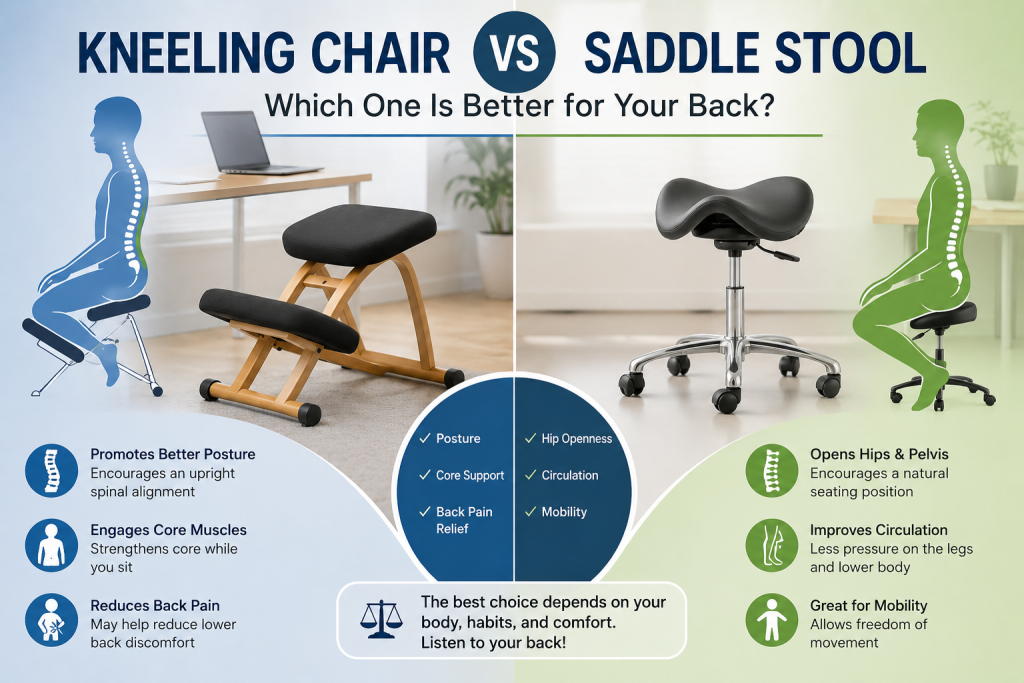
You have seen them both: the forward‑sloping kneeling chair with padded knee rests, and the horse‑saddle‑shaped stool that spreads your legs and opens your hips. Both claim to fix your posture, relieve back pain, and keep you active while sitting. But they work in fundamentally different ways — and one may be a better fit for your body and work style than the other.
This guide breaks down the biomechanics, comfort factors, pros and cons, and real‑world use cases for kneeling chairs and saddle stools. By the end, you will know exactly which one belongs in your home office.
Quick Comparison: Kneeling Chair vs Saddle Stool
| Feature | Kneeling Chair | Saddle Stool |
|---|---|---|
| Primary Support Points | Buttocks + shins | Buttocks + thighs (sit bones) |
| Hip Angle | Open (120‑135°) via forward slope | Open (120‑135°) via hip abduction |
| Pelvic Tilt | Anterior (forward) – maintains lumbar curve | Anterior (forward) – maintains lumbar curve |
| Leg Position | Knees bent, shins vertical or angled | Legs spread apart (abduction), thighs slope downward |
| Common Discomfort | Shins, knees | Hips, sit bones (ischial tuberosities) |
| Backrest Options | Rare (typically backless) | Some models have tiltable backrests |
| Mobility (Swivel / Casters) | Limited (most are stationary or rocker base) | Many have 360° swivel + casters (good mobility) |
| Best For | Forward‑leaning tasks, short to mid sessions | Prolonged active sitting, standing desk workflows, healthcare |
| Price Range (Quality) | $80–300 | $100–500 |
Biomechanics: How Each Chair Affects Your Spine
Both kneeling chairs and saddle stools are designed to tilt your pelvis forward (anterior pelvic tilt), which preserves the natural S‑curve (lordosis) of your lower back. Traditional 90° office chairs roll your pelvis backward, flattening your lumbar spine and increasing disc pressure. Both alternatives solve that problem — but through different mechanical pathways.
Kneeling Chair: The seat slopes forward, and your shins rest on padded supports. Your thighs angle downward, and your weight is shared between your buttocks and shins. The forward slope opens your hip angle to 120‑135°, tilting your pelvis forward and maintaining lumbar lordosis.
Saddle Stool: The seat is shaped like a horse saddle — wide at the back and tapering toward the front. Your legs are spread apart (hip abduction), and your thighs slope downward. Your weight rests on your sitting bones (ischial tuberosities) and inner thighs. The wide abduction naturally tilts your pelvis forward and opens your hip angle.
Both chairs engage your core muscles because there is no backrest to lean on. However, the weight distribution differs significantly: kneeling chairs put pressure on your shins; saddle stools put pressure on your sit bones and hips.
Kneeling Chair: Detailed Pros and Cons
✅ Pros
- Reduces lower back compression by opening the hip angle and preserving lumbar lordosis.
- Encourages active sitting and core engagement, strengthening back muscles over time.
- Often more affordable than quality saddle stools (quality models from $80–150).
- Rocking base models promote micro‑movements, reducing stiffness.
- Compact footprint — easy to store under a desk.
- Lightweight and portable; many models weigh under 20 lbs.
❌ Cons
- Shin discomfort is common, especially during the first 1‑2 weeks. Adequate padding is essential.
- Not suitable for users with knee problems (patellofemoral pain, runner’s knee, knee arthritis).
- No backrest; passive tasks (reading, phone calls) may feel unsupported.
- Limited mobility — most kneeling chairs do not have swivel casters.
- Requires a gradual transition period (1‑2 weeks) to avoid shin pain and back fatigue.
🎯 Best for: People with lower back pain who do not have knee issues, who work in forward‑leaning postures (typing, drawing, writing), and who are willing to adapt to a new sitting style. Ideal for compact home offices and budget‑conscious buyers.
Saddle Stool: Detailed Pros and Cons
✅ Pros
- Excellent for prolonged active sitting (8+ hour shifts in healthcare, lab work, creative studios).
- Open hip angle and wide abduction provide exceptional spinal stability and pelvic support.
- Many models feature 360° swivel and smooth‑rolling casters for easy mobility.
- Some models offer tiltable backrests for additional lumbar support.
- Split‑seat designs eliminate perineal pressure, improving circulation (essential for all‑day sitting).
- Natural micro‑movements keep core engaged and discs hydrated.
- Works seamlessly with standing desks (height‑adjustable models).
❌ Cons
- Higher cost for quality models with memory foam and adjustable backrests ($200–500).
- Initial sit‑bone soreness as your ischial tuberosities adapt to bearing weight; usually resolves within 1‑2 weeks.
- Requires proper seat width — a saddle too narrow or wide causes hip discomfort.
- Solid saddle stools can cause perineal pressure; split‑seat models are recommended (often more expensive).
- Not ideal for very small body frames (some models are designed for average to large builds).
🎯 Best for: Professionals who sit for long hours (healthcare, laboratory, creative work), standing desk users, and anyone willing to invest in a premium ergonomic seat. Excellent for those who need mobility around a workspace.
Which One Is Better for Specific Back Conditions?
For chronic lower back pain (disc compression, muscle strain): Both can help, but saddle stools may offer better long‑term comfort because they distribute weight more evenly and allow natural micro‑movements without shin pressure. However, if you have trouble spreading your legs (hip abduction), a kneeling chair may be easier to adapt to.
For sciatica: Both open the hip angle and reduce nerve compression. Saddle stools with split‑seat design may be preferred because they also reduce pelvic pressure. Some sciatica sufferers report better relief with saddle stools.
For herniated disc: Consult your doctor. Both chairs reduce intradiscal pressure compared to conventional chairs, but the forward tilt may aggravate certain disc pathologies. Start with short sessions and monitor symptoms.
For knee problems (patellofemoral pain, runner’s knee): Saddle stool is the clear winner. Kneeling chairs place weight on the shins, which can transfer load to the knee joint. Saddle stools put no pressure on the knees.
For hip problems (osteoarthritis, labral tear): Kneeling chair may be better because it does not require wide hip abduction. Saddle stools spread the legs, which can exacerbate hip impingement or arthritis.
How to Choose the Right Chair for Your Workspace
Use this decision guide based on your work style and body.
👉 Choose a KNEELING CHAIR if:
- You have no knee problems and want an affordable entry into active sitting.
- You work in a forward‑leaning posture (typing, writing, drafting).
- You have a compact workspace and need a chair that tucks under the desk.
- You are willing to go through a 1‑2 week adaptation period and may need to add extra shin padding.
- You want a lightweight, portable chair that can be moved easily.
👉 Choose a SADDLE STOOL if:
- You have knee issues or shin sensitivity.
- You sit for 6+ hours a day and want a durable, mobile seat with optional backrest.
- You use a standing desk and want a perch that adjusts to standing height.
- You need 360° mobility around your workspace (e.g., laboratory, clinic, creative studio).
- You are willing to invest in a quality model with thick memory foam and split‑seat design.
Recommended Products (Available on Amazon US)
Top Kneeling Chairs:
- NYPOT Adjustable Ergonomic Kneeling Chair — 5‑year warranty, rocking motion, height adjustable, wood frame. ~$150.
- Costway Rocking Kneeling Chair — 330 lb capacity, extra‑thick cushions, wide rocking range. ~$100–140.
- Flash Furniture Posey Kneeling Chair — Budget classic, BIFMA certified, 2″ foam padding. ~$129.
Top Saddle Stools:
- DR.LOMILOMI 510 KOA — 500 lb capacity, tiltable backrest, memory foam, aluminum base. ~$200+.
- VEVOR Saddle Stool (400 lbs) — Stainless steel base, 20–28″ height, thick PU leather. ~$100–140.
- Antlu Saddle Stool with Back Support — Tiltable backrest (80‑110°), 400 lb capacity, quick assembly. ~$110.
Frequently Asked Questions (FAQ)
Can a saddle stool replace my office chair?
Yes — many people use saddle stools as their primary desk chair, especially with a standing desk. However, some users prefer to alternate with a conventional chair for passive tasks.
Do kneeling chairs hurt your back?
If adjusted correctly, kneeling chairs should not hurt your back. In fact, they often reduce lower back pain. However, incorrect height or angle can cause new strain. Follow the manufacturer’s adjustment guide and transition gradually.
Which chair is better for standing desk users?
Saddle stools are generally better for standing desk users because many models have a wide height range (up to 28‑32 inches) and smooth casters for easy movement. Some kneeling chairs also work, but they typically have lower maximum heights and lack casters.
Do I need a backrest on a saddle stool?
If you have existing lower back pain or prefer to lean back during passive tasks, a backrest is helpful. The best backrests tilt (80‑110°) for dynamic support. For active sitting, a backless saddle stool encourages core engagement.
How long does it take to get used to a kneeling chair?
Most users need 1‑2 weeks. Initial shin soreness is common. By the end of the second week, the majority of users report comfort and improved posture.
How long does it take to get used to a saddle stool?
Similar 1‑2 week adaptation period. Initial soreness is typically in the sit bones (ischial tuberosities). Adequate cushioning and gradual use resolve this.
Final Verdict: Which One Should You Choose?
After comparing biomechanics, comfort, and real‑world use cases, here is the simple answer:
Choose a KNEELING CHAIR if: You have no knee issues, you want an affordable entry into active sitting, you work in a forward‑leaning posture, and you are willing to adapt to shin pressure for 1‑2 weeks.
Choose a SADDLE STOOL if: You have knee problems, you need mobility around your workspace, you use a standing desk, you sit for 6+ hours a day, and you are willing to invest in a quality model with proper padding and optional backrest.
Use BOTH if: Your budget and space allow. Alternating between a kneeling chair (for focused, forward work) and a saddle stool (for active perching and standing desk transitions) gives you the benefits of both active seating styles.
Most important advice: No chair, no matter how well‑designed, can replace movement. Stand up, stretch, and walk every 30‑45 minutes. Use your kneeling chair or saddle stool as one tool in a movement‑rich daily routine.
Related Articles
- Are Knee Chairs Good for Back Pain? Evidence, Benefits & Drawbacks
- How to Sit on a Kneeling Chair: Proper Posture, Common Mistakes & Adjustment Guide
- 7 Best Kneeling Desk Chairs: Ergonomic Picks for Better Posture
- Saddle Stool Benefits: Why More People Are Switching in 2026
- Saddle Stool vs Ergonomic Chair: Which Is Better for Posture?