
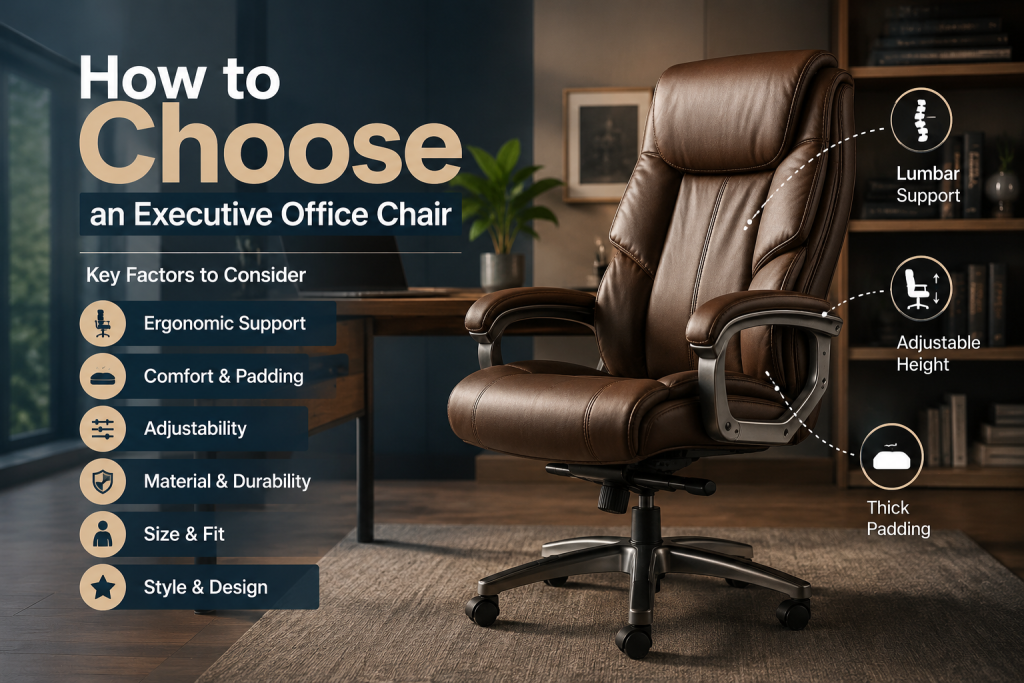
🔑 Key Factors to Consider
Before you start shopping, take a moment to assess your needs. The right chair depends on your body, your work habits, and your space.
📏 Your Body
- Height: If you’re over 6 feet, you need a chair with a taller backrest and higher seat height range
- Weight: Look for at least 300 lbs capacity — 400+ lbs if you’re over 250 lbs
- Build: Wider seats and deeper seat pans are better for larger frames
- Don’t guess — measure your height and check the chair’s specifications against your needs
💼 Your Work Style
- Sitting hours: Under 4 hours/day → executive chair is fine. 6+ hours/day → prioritize ergonomic features
- Multiple users: Look for easy adjustability (height, arms, lumbar) if the chair is shared
- Work environment: Client-facing roles may prioritize leather and polished appearance
🏠 Your Space
- Office size: Executive chairs are often larger than ergonomic chairs — measure your available space
- Desk height: Make sure the chair’s height range matches your desk
- Room aesthetic: Choose a chair that complements your office’s existing design
💰 Your Budget
- Under $200: Bonded leather, basic adjustability — look at Amazon Basics
- $200–$400: Genuine leather, better lumbar support — look at YFO or Colamy Atlas
- $400+: Premium materials, longer warranties — look at HON or Steelcase
- Tip: A $300 ergonomic chair often outlasts a $200 executive chair
💡 The most common mistake: Buying based on appearance alone. A chair that looks like a CEO’s seat but doesn’t support your back will leave you in pain within weeks. Prioritize fit and function — you can find style and ergonomics together.
🦴 Ergonomic Features That Matter
Executive chairs are often criticized for lacking ergonomic support — but it doesn’t have to be that way. Here’s what to look for:
🪑 Lumbar Support
- Adjustable lumbar is essential — fixed lumbar only works if you’re average height
- Look for height and depth adjustment — you need to position the support exactly where your spine curves
- Separate lumbar cushions (like the Colamy Atlas) outperform fixed curves
- Inflatable bladder lumbar supports often lose pressure — avoid them
💺 Seat Comfort
- Seat depth adjustment ensures your thighs are fully supported without pressing against the seat edge
- High-density foam prevents “bottoming out” after months of use
- Waterfall seat edge reduces pressure on the back of your legs
- Memory foam (like Tempur-Pedic) molds to your body for all-day comfort
🔄 Armrest Adjustability
- 3D armrests adjust height, depth, and angle
- 4D armrests add width adjustment — ideal for different body types
- Fixed armrests are the single biggest ergonomic failure in executive chairs
- Armrests should support your elbows at a 90° angle with relaxed shoulders
↕️ Adjustability Range
- Seat height: Should extend to at least 21 inches for tall users
- Backrest tilt: Synchro-tilt keeps your back supported while reclining
- Tilt tension: Allows you to adjust recline resistance based on your weight
- More adjustability = better fit for different body types and postures
📊 Ergonomic feature checklist for executive chairs:
- ✅ Adjustable lumbar support (height + depth at minimum)
- ✅ Seat depth adjustment (sliding seat pan)
- ✅ 3D or 4D armrests
- ✅ Seat height range that accommodates your height
- ✅ Tilt tension control
- ✅ Headrest with 2-way adjustment (if you want neck support)
🧵 Material Quality Guide
The materials used in an executive chair determine both its appearance and its lifespan. Here’s what to know about each option:
🟫 Leather Types
- Genuine leather: The best option — durable, breathable, and develops a patina over time. Most expensive, but worth it for long-term use.
- PU leather (faux): Synthetic leather that looks like the real thing at a fraction of the cost. More breathable than bonded leather. Good budget option.
- Bonded leather: The worst option — made from leather scraps glued together. Cracks and peels within 12-18 months, especially in hot climates. Avoid if possible.
🕸️ Mesh & Fabric
- Mesh: Breathable, cool, and flexible — ideal for warm offices or long sessions
- Fabric: Comfortable and breathable, but can stain and trap dust
- Modern executive chairs increasingly use mesh backs with padded seats for the best of both worlds
- Mesh doesn’t crack or peel like leather — often more durable long-term
🦿 Base & Frame
- Aluminum base: More durable and stable than nylon — a sign of premium build quality
- Nylon base: Common in budget chairs — lighter but less durable
- Steel frame: Heavier and more durable than plastic — check the chair’s total weight
- Heavier chairs usually = more metal and better build quality
🛡️ Durability Indicators
- BIFMA certification: Safety and durability tested — look for this on budget chairs
- Weight capacity: 300+ lbs indicates stronger build quality
- Gas lift class: Class 3 or Class 4 cylinders last longer than Class 2
- Warranty length: 5+ years indicates manufacturer confidence
💡 Material rule of thumb:
- Under $200: Expect bonded leather or PU leather
- $200–$400: You can find PU leather with some genuine leather accents
- $400+: Genuine leather becomes more common
- Mesh is often a better value — you get higher durability at the same price as cheaper leather
🎨 Style and Aesthetics: Matching Your Office
An executive chair is a visual statement. Here’s how to match your chair to your office aesthetic:
🏢 Traditional Office
- Materials: Genuine or high-quality PU leather
- Colors: Black, brown, dark burgundy
- Design: High back, tufted details, polished metal or wood accents
- Examples: YFO Home Office Desk Chair (brown leather)
💻 Modern / Minimalist Office
- Materials: Mesh, sleek fabrics, minimalist lines
- Colors: Gray, white, charcoal, black
- Design: Clean lines, low-profile back, mesh or fabric upholstery
- Examples: Colamy Atlas, Colamy Kirin
🧑💻 Home Office
- Materials: Any material — choose based on comfort and budget
- Colors: Match your home decor — neutral tones work best
- Design: Hybrid chairs like the Colamy Atlas offer both ergonomic support and professional appearance
- Tip: In home offices, ergonomics should usually win over aesthetics
🧵 Color Choices
- Black: The most versatile — works with any office
- Brown: Warm and traditional — best with wood desks
- Gray: Modern and neutral — a good alternative to black
- White: Bold and contemporary — shows dirt more easily
- Tip: Choose a color that complements your desk, not one that fights with it
💡 The best-looking chair is the one that fits your space: A traditional leather chair in a modern office will look out of place — and vice versa. Match your chair’s style to your office’s design language.
🌟 Quick Recommendations by Budget
Under $200 — Best Value
- Amazon Basics High-Back Executive — BIFMA certified, bonded leather, under $150
- Colamy Kirin — mesh, seat slider, 4-way arms at $159
$200–$300 — Best Value / Premium Hybrid
- Colamy Atlas — aluminum base, 4D arms, seat depth, ~$260
- YFO Home Office Desk Chair — genuine brown leather, spring-bag seat, ~$200
- GTPLAYER Big & Tall — 400 lbs capacity, PU leather, ~$160
$300+ — Premium Pick
- HON Ignition 2.0 Big & Tall — 450 lbs capacity, commercial-grade warranty
- Tempur-Pedic TP9000 — memory foam seat, high-back mesh, ~$299
❓ Frequently Asked Questions: Choosing an Executive Chair
🏆 Final Verdict: How to Choose the Right Executive Chair
Choosing an executive chair is about balancing appearance, comfort, and budget — but your back should always come first.
Key takeaways:
- ✅ Measure before you buy: Know your height, weight, and available space
- ✅ Prioritize adjustability: Lumbar support, armrests, and seat depth matter more than leather
- ✅ Choose materials wisely: Genuine leather > PU leather > bonded leather. Mesh is often a better value
- ✅ Match your office style: Traditional leather for classic offices, modern mesh for contemporary spaces
- ✅ Don’t buy on appearance alone: A chair that looks great but doesn’t support your body will cause pain within weeks
- ✅ Spend where it counts: If you sit 8+ hours, invest in the $200–$300 range for better ergonomics and durability
The best executive chair is one that looks professional, supports your body, and fits your budget. Take your time, check the dimensions, and choose a chair that will keep you comfortable for years to come.