SITBETTERLAB BUYING GUIDE
Best Seat Cushions for Big and Tall People
A standard seat cushion may feel comfortable at first but become less supportive during a long workday if it is too narrow, too soft, or poorly matched to your body and chair. For bigger and taller users, choosing the right cushion means looking beyond thickness and marketing claims.
This guide compares three seat cushion options from Cushion Lab, Everlasting Comfort, and ComfiLife. We also explain how to evaluate cushion width, foam density, compression resistance, and fit so you can find a heavy duty seat cushion that suits your everyday sitting routine.
Disclosure: SitBetterLab may earn a commission from qualifying purchases made through affiliate links. Product specifications and availability may vary by model.
Quick answer: Start with an extra-large cushion if your current seat feels too narrow, a supportive memory foam design if you prefer a contoured surface, or a firmer cushion if your existing one compresses too much. Check the actual dimensions and any manufacturer-published weight limit before buying. A larger cushion is not automatically rated for a higher user weight.
3 Seat Cushions to Consider for Big and Tall Users
The following products offer different approaches to seat comfort and support. They are comparison candidates rather than a laboratory-tested ranking. Because user weight limits are not consistently published for these consumer cushion models, confirm the specifications of the exact version you intend to buy.
01 · ERGONOMIC CONTOUR
Cushion Lab Pressure Relief Seat Cushion
Cushion Lab’s ergonomic seat cushion uses a contoured memory foam surface designed to support the sitting area and provide a more sculpted alternative to a flat chair pad. It is worth comparing if you want shaped support rather than simply adding more padding to your existing chair.
- Design: Contoured seat cushion with a shaped support surface.
- Material: Proprietary memory foam, according to the manufacturer’s product information.
- Best fit: Users who prefer an ergonomic contour and whose chair is compatible with the cushion’s dimensions.
- What to check: Exact width, depth, thickness, and whether the model provides enough usable seating area for your body.
- Weight capacity: Do not assume a specific maximum user weight unless it is explicitly confirmed for the selected model.
Best for comparing ergonomic contouring with wider, flatter seat cushions. Its shape may not suit every body type or chair.
02 · EXTRA-LARGE OPTION
Everlasting Comfort XL Seat Cushion
Everlasting Comfort offers an XL memory foam seat cushion designed to provide a larger seating surface. This is a useful option to investigate if a standard cushion feels too small or leaves part of your sitting area unsupported.
- Design: Extra-large seat cushion format.
- Material: Memory foam, according to the product listing.
- Best fit: Users who need more seating area than a conventional cushion provides.
- What to check: The selected XL model’s actual dimensions, thickness, cover, and return conditions.
- Weight capacity: Verify the current product documentation before relying on it for a particular body weight.
Best for shoppers prioritizing a larger surface area. XL sizing alone does not establish a higher load rating or longer foam life.
03 · WIDE SEATING SURFACE
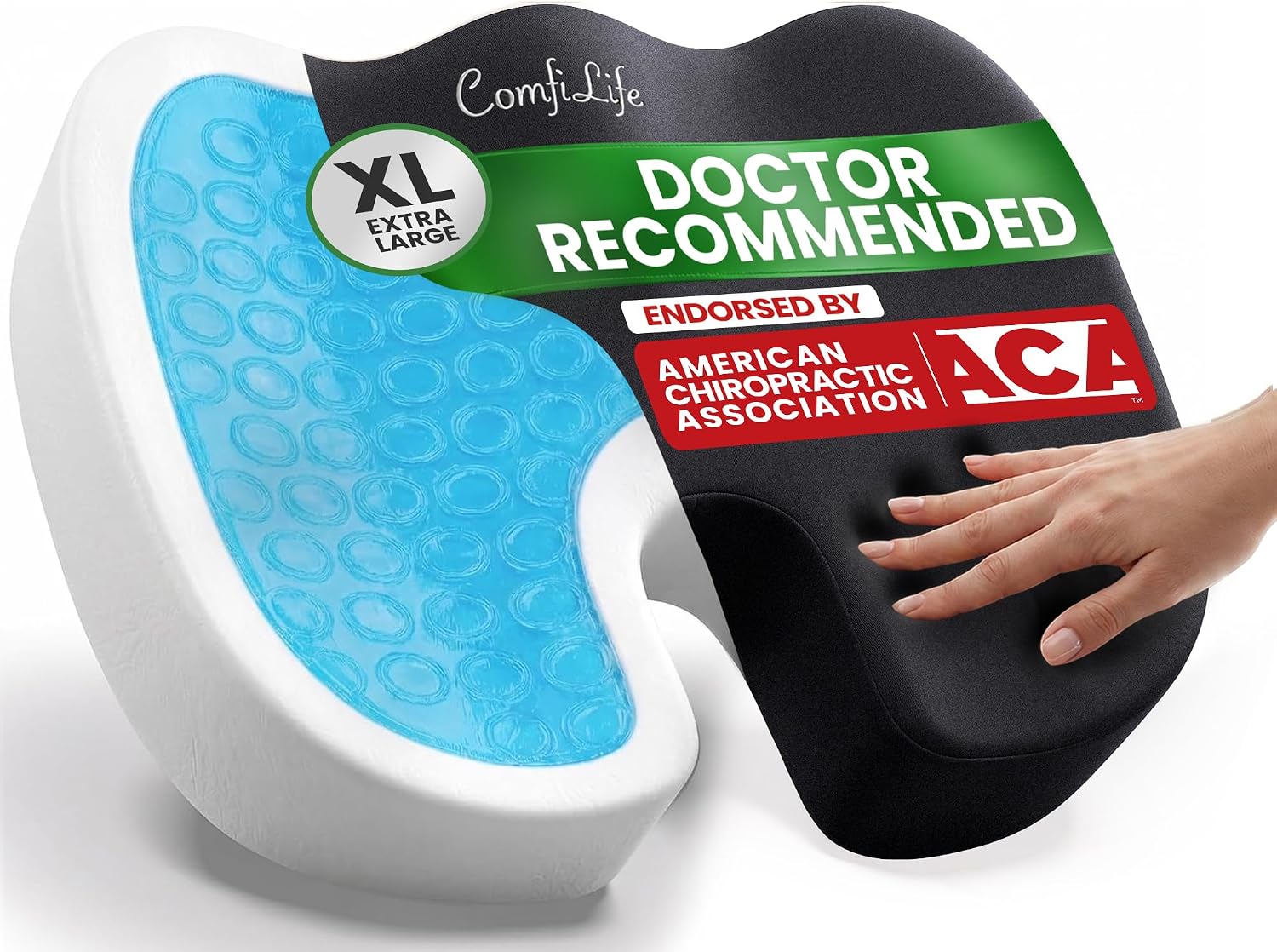
ComfiLife Extra Large Gel and Memory Foam Seat Cushion
ComfiLife’s Extra Large Gel and Memory Foam Seat Cushion is marketed as a wider option for office chairs, car seats, and larger seating areas. Its combination of memory foam and a gel layer makes it a useful alternative to an all-foam cushion.
- Design: Extra-large cushion format for a wider seating area.
- Material: Gel-enhanced memory foam, as described in the product listing.
- Best fit: Users who want additional seat coverage and prefer a gel-and-foam construction.
- What to check: Confirm the precise model and its current listed dimensions before ordering.
- Weight capacity: Do not infer a maximum supported user weight from the XL label or material description.
Best for comparing a wide cushion with a gel-enhanced foam construction. Cooling and durability depend on the full design and how it is used.
Which Cushion Should You Compare First?
- Need more seating area? Start with the Everlasting Comfort XL or ComfiLife Extra Large and compare their exact dimensions.
- Prefer an ergonomic contour? Consider Cushion Lab’s shaped seat surface.
- Want gel-enhanced foam? Compare the ComfiLife Extra Large model with conventional memory foam options.
- Need a verified higher weight rating? Look beyond brand names and request explicit documentation for the exact cushion and size.
What Makes a Seat Cushion Suitable for Big and Tall People?
A cushion for a larger user needs to fit the sitting area comfortably and retain enough support under the actual load. A cushion that is too narrow can leave the outer sitting area unsupported, while foam that compresses excessively may lose much of its useful thickness.
Four factors deserve particular attention: width, verified weight limits, foam construction, and resistance to repeated compression.
1. Choose the Right Cushion Width and Depth
Width is one of the easiest specifications to overlook. A cushion may look large in a product photo but still be too narrow for your chair or sitting area.
- Measure your chair: Record the usable width and depth of the seat, including any side bolsters or raised edges.
- Check the cushion footprint: Choose dimensions that fit the chair without excessive overhang or curling at the sides.
- Consider usable seating area: Decorative contours and deep side wings can reduce the flat or supportive surface available to sit on.
- Check seat depth: A cushion that extends too far forward can press against the backs of your thighs.
For a larger user, a wider cushion can improve fit, but only if the underlying chair also has sufficient space. A cushion cannot turn a narrow chair into a properly sized heavy-duty seat.
2. Verify the Actual Weight Capacity
Weight capacity is particularly important when shopping for a heavy duty seat cushion. However, there is a difference between a product physically tolerating a load and maintaining its intended shape and support under repeated daily use.
Before purchasing, look for a clearly stated maximum user weight or recommended operating range in the manufacturer’s documentation. Confirm that it applies to the exact model and size you are considering.
Important: A product described as “heavy duty,” “extra thick,” or “high density” does not automatically have a verified 300 lb, 400 lb, or higher weight capacity. Do not publish or rely on a numerical limit unless the manufacturer explicitly supports it.
If a product page does not state a weight limit, contact the manufacturer before buying. If you need a cushion for a wheelchair or for medically significant pressure management, consider a specialist seating product with documented sizing and load specifications.
3. Understand Foam Density and Firmness
Foam density and firmness are related to different properties. Density describes the amount of foam material within a given volume, while firmness describes how strongly the foam resists indentation under a specified test. Neither specification alone guarantees comfort or durability.
A high-density foam cushion may be a sensible option for repeated use, but its performance also depends on the foam formulation, thickness, geometry, and how much of the load is concentrated in a particular area.
- Density: Useful for comparing materials when manufacturers publish comparable specifications.
- Firmness: Helps describe the initial feel and resistance to compression.
- Thickness: Provides room for compression, but extra thickness cannot compensate for unsuitable foam.
- Construction: Layered foam, molded contours, and gel inserts change how the cushion behaves under load.
When manufacturers do not publish density or firmness data, do not guess from product photos or descriptions. Use the return policy and actual fit as part of your purchasing decision.
4. Look for Resistance to Repeated Compression
Repeated compression can gradually change the feel and shape of foam. One concern is compression set: the material may not fully recover its original thickness after being compressed for a prolonged period.
For users who sit for many hours each day, this matters because a cushion that initially feels supportive may become less comfortable as it wears. The degree of change depends on the foam formulation, load, temperature, use pattern, and overall construction.
When comparing products, look for:
- Manufacturer information about foam durability or recovery.
- A warranty that clearly explains what is covered.
- Independent testing, where available, that identifies the tested material and method.
- Reviews describing long-term use rather than only first impressions.
- A return policy that gives you time to evaluate the cushion on your actual chair.
Terms such as “premium foam” and “long-lasting support” are not substitutes for measurable test results.
5. Decide Between Memory Foam, Gel, and Firmer Cushions
Memory Foam
Can conform to the shape of your body and provide a cushioned feel. The result depends on the specific foam and its firmness, thickness, and construction.
Gel-Enhanced Foam
Combines foam with a gel layer or gel component. It may feel different from all-foam designs, but gel does not guarantee that a cushion will remain cool or resist compression better.
Firmer Support
May suit users who dislike sinking into a soft cushion. Too much firmness can also feel uncomfortable, so balance support with pressure distribution.
For a larger user, the best material is not necessarily the firmest or densest one available. It should support your weight without bottoming out, fit the chair, and remain comfortable during your normal sitting routine.
6. Check Chair Fit, Height, and Stability
An extra-large cushion can improve seat coverage but also change the relationship between your hips, knees, feet, and backrest. Review your entire sitting position after adding it.
- Make sure your feet can rest comfortably on the floor or a suitable footrest.
- Check that the cushion does not push you too far forward or reduce usable seat depth.
- Choose a stable base that does not slide around as you move.
- Confirm that the cushion does not interfere with armrests, controls, or the chair’s lumbar support.
- For vehicle use, make sure the cushion does not compromise safe visibility, pedal control, seat-belt fit, or vehicle safety systems.
7. Consider Cover Quality and Everyday Maintenance
For daily use, a removable cover can make cleaning easier. A non-slip base may help keep the cushion in position, while breathable cover materials may feel more comfortable during long sitting sessions.
Also consider how often you plan to move the cushion between chairs. A very large or heavy design may be less convenient for commuting, travel, or shared workspaces.
When a Specialist Heavy-Duty Cushion May Be Better
Most consumer seat cushions are sold primarily for everyday comfort. If you require a clearly documented high weight capacity, a much wider seat, or specialized pressure management, a bariatric or wheelchair seating cushion may be more appropriate than a general office-chair accessory.
For example, specialist seating products may be available in multiple widths and load ratings. These specifications should be checked for the exact size rather than assumed to apply to every model in a product family.
If your main requirement is a chair that supports a higher user weight—not just a replacement cushion—explore our HeavyDutyChoice weight-capacity guides for heavy-duty seating options.
If you are comparing office seating more broadly, visit the SitBetterLab Seat Cushions Hub for related buying guides.
Frequently Asked Questions
What is the best seat cushion for big people?
The best cushion depends on your sitting area, chair dimensions, preferred firmness, and how long you sit each day. Start by measuring your chair and comparing extra-large or contoured cushions. Verify the manufacturer’s weight guidance before choosing a model for a specific load.
What should I look for in a heavy duty seat cushion?
Prioritize a suitable width and depth, a clearly documented weight limit when available, supportive construction, and a stable base. If long-term durability is important, look for meaningful warranty terms and foam performance information rather than relying on the phrase “heavy duty” alone.
Does a thicker cushion support more weight?
Not necessarily. Thickness gives the cushion more material to compress, but actual performance depends on foam formulation, density, firmness, shape, and construction. A thick cushion can still compress excessively under a load it was not designed to support.
Is high-density foam better for heavier users?
High-density foam can be worth considering for regular use, but density alone does not determine firmness, comfort, or durability. Check the manufacturer’s specifications and evaluate the complete cushion design.
How do I stop a seat cushion from flattening?
Choose a product suited to your load and sitting routine, follow its care instructions, and avoid assuming that an unverified weight rating is sufficient. Foam eventually wears with use, and no material can guarantee that a cushion will never lose thickness or support.
Should I buy a larger cushion or a heavy-duty office chair?
If your current chair is too narrow, unstable, or unable to support your weight appropriately, replacing the chair may be a better long-term solution than adding a cushion. A cushion can improve fit and comfort, but it cannot increase the structural weight capacity of the chair itself.
Find a Seat Cushion That Fits Your Body and Chair
Compare dimensions, support characteristics, material specifications, and return policies before buying. The right cushion should fit your seat, remain stable, and provide comfortable support without relying on unverified weight-capacity claims.
Disclaimer: This article provides general product-selection information and is not medical advice. A seat cushion cannot guarantee pain relief or replace an appropriately rated chair or specialist seating system where one is required.