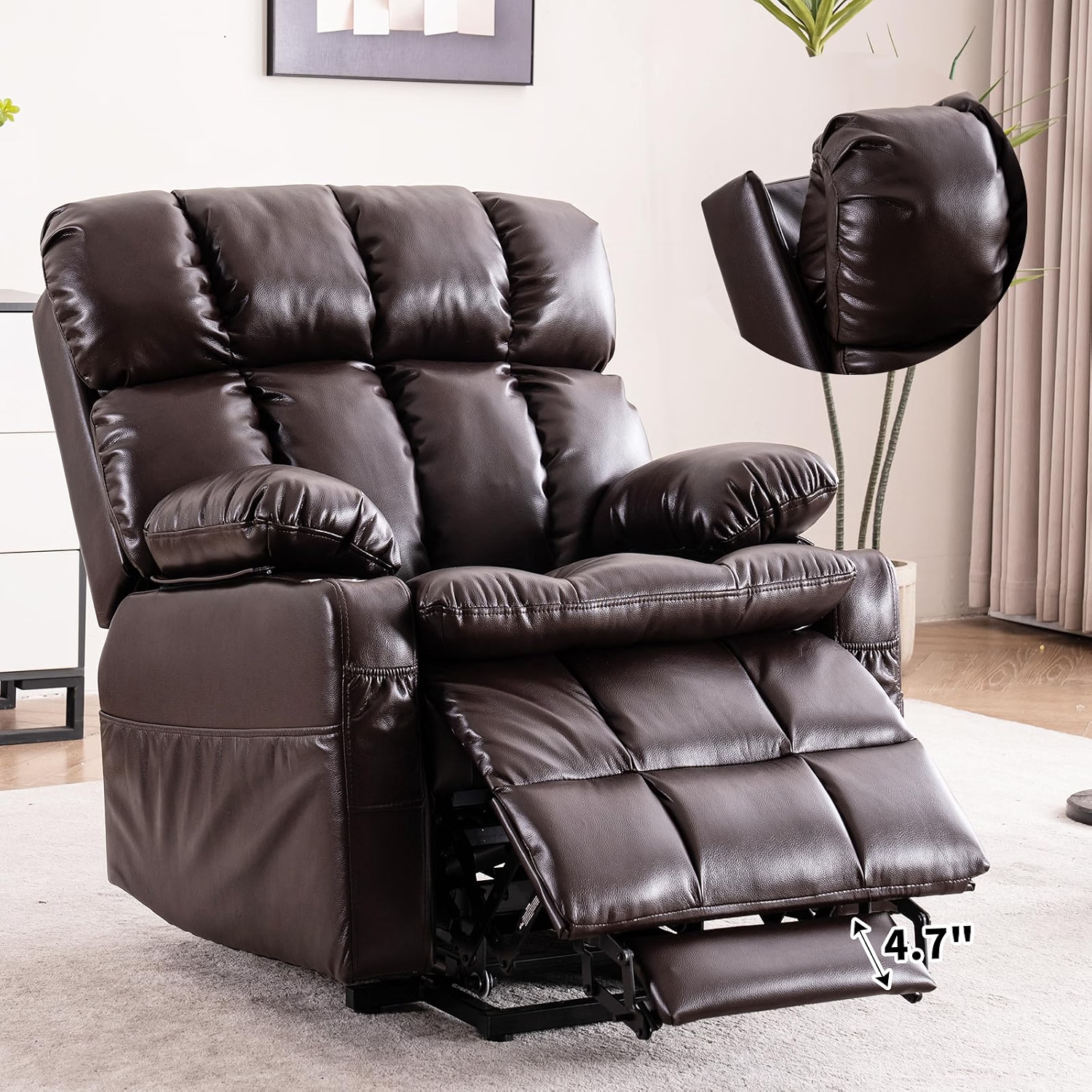
Finding the best chair after spine surgery is less about buying the most expensive office chair and more about finding a seat that fits your body, supports a comfortable sitting position, and lets you change posture without unnecessary twisting or reaching.
After a spinal procedure, your surgeon or physical therapist may give you specific instructions about sitting, bending, lifting, and how long you should remain seated. Those instructions should take priority over any general chair recommendation.
For general office use during recovery, look for an ergonomic chair with adjustable seat height, appropriate seat depth, supportive backrest, adjustable lumbar support, and controlled recline. The goal is not to force your spine into a “perfect” position, but to create a comfortable setup that makes it easier to maintain a supported posture and change positions regularly.
Important: This article provides general ergonomic and product information. Recovery instructions vary by procedure, surgical level, symptoms, and individual circumstances. If you recently had spine surgery, ask your surgeon or physical therapist how long you may sit, which positions are appropriate, and whether a particular chair or cushion is suitable for you.
Why Your Chair Matters After Spine Surgery
Sitting changes the position of the pelvis and lumbar spine, and prolonged or static sitting can be uncomfortable for many people with back problems. Research on office-chair design suggests that lumbar support and certain seat-pan adjustments can influence seated posture, although no single chair feature has been shown to eliminate sitting-related pain.
That distinction is especially important after surgery. A chair should be viewed as one part of your recovery environment—not as a medical treatment. Your surgical team determines when and how much sitting is appropriate.
A well-adjusted chair can nevertheless make everyday tasks easier. The main goals are simple: keep your feet supported, avoid excessive pressure behind the knees, support your back without forcing an uncomfortable curve, and make it easy to change positions.
What Makes a Chair More Suitable for Recovery?
- Adjustable seat height so your feet can rest comfortably on the floor.
- Appropriate seat depth so the front edge does not press into the back of your knees.
- Supportive backrest that allows you to lean back without feeling unstable.
- Adjustable lumbar support that can be positioned according to your body rather than forcing one fixed shape.
- Adjustable armrests that allow your shoulders to remain relaxed while typing.
- Controlled recline so you can change position smoothly.
6 Features to Look For in the Best Chair After Spine Surgery
1. Adjustable Lumbar Support
Lumbar support can help maintain a more supported seated posture, but more support is not automatically better. A lumbar pad that is too prominent or positioned incorrectly can become uncomfortable.
Look for a chair that allows you to adjust the lumbar support vertically and, where available, in depth or firmness. During recovery, the ability to reduce pressure can be just as useful as the ability to increase support.
2. Adjustable Seat Depth
Seat depth is easy to overlook. If a seat is too deep, you may have difficulty sitting fully against the backrest while keeping comfortable clearance behind your knees.
A sliding seat pan is therefore useful for people with different leg lengths. Rather than choosing a chair based only on its overall height rating, check the actual seat dimensions and compare them with your body measurements.
3. Controlled Recline
A chair that allows controlled reclining gives you another way to change position during the workday. The important feature is control—not a specific recline number that is supposedly appropriate for every surgical patient.
If your surgeon has given you a specific sitting or reclining restriction, follow that restriction instead of relying on a chair manufacturer’s recommended angle.
4. Supportive Seat Cushion
The ideal cushion is highly individual. Very soft foam can allow you to sink into the chair, while an overly firm surface can create pressure points.
Medium-firm cushioning is a reasonable starting point for many office users, but incision location, tailbone sensitivity, hip comfort, and the type of surgery can change what feels appropriate.
5. Adjustable Armrests
Armrests can reduce the need to support your arms entirely from the shoulders while working at a desk. Ideally, they should allow your forearms to rest comfortably without forcing your shoulders upward.
6. Easy-to-Use Adjustments
After surgery, you may not want to repeatedly reach underneath a chair or twist your body to change an adjustment. Controls that are easy to reach from a seated position can make everyday use more convenient.
Best Chairs to Consider After Spine Surgery
There is no universally correct chair for every spine-surgery patient. The models below represent different approaches to ergonomic seating, so use the feature comparison rather than treating any model as a medical device or guaranteed recovery solution.
| Chair | Useful Feature | Potential Limitation | Best For |
|---|---|---|---|
| Steelcase Leap | Extensive adjustment options | Higher price; used/refurbished versions vary | Users prioritizing adjustability |
| Herman Miller Aeron | Pellicle suspension and multiple sizes | Mesh feel is not comfortable for everyone | Users who prefer breathable seating |
| SIHOO Doro C300 | Dynamic lumbar and recline features | Fit depends strongly on body size | Mid-range ergonomic setups |
| Branch Ergonomic Chair | Straightforward ergonomic adjustments | Fewer adjustment options than premium chairs | Home-office users |
Before buying: Verify the current manufacturer’s specifications, dimensions, warranty terms, return policy, and seller information. Product specifications and Amazon listings can change.
Steelcase Leap: For Extensive Adjustability
The Steelcase Leap is worth considering if adjustability is your primary concern. Its seat, backrest, lumbar, armrests, and recline settings give you multiple ways to customize the chair to your body.
That flexibility can be useful during recovery because the position that feels comfortable on one day may not feel the same a week later. However, a highly adjustable chair still needs to be correctly fitted.
Herman Miller Aeron: For Size Options and Breathable Support
The Aeron takes a different approach. Its suspension seat and back are designed to distribute contact across the body rather than relying on a thick upholstered cushion. It is also available in multiple sizes, which makes fit an important part of the buying decision.
For someone who dislikes hot foam cushions, the breathable material may be appealing. On the other hand, some people prefer the softer feel of a traditional padded seat, so the Aeron is a chair you should try before committing if possible.
SIHOO Doro C300: A Mid-Range Alternative
The SIHOO Doro C300 offers a different balance of price and adjustability. Its dynamic lumbar system and reclining mechanism may appeal to users who prefer a chair that moves with them rather than remaining completely fixed.
Because chair fit varies substantially with body proportions, check the manufacturer’s current seat dimensions before purchasing. A feature-rich chair is not automatically a good fit if the seat is too deep, too narrow, or otherwise mismatched to your body.
How to Set Up Your Chair After Spine Surgery
Buying an ergonomic chair is only the first step. The way you adjust it matters just as much. Research suggests that chair features can influence seated posture, but individual fit and comfort remain important.
Step 1: Set the Seat Height
Start with your feet supported on the floor or an appropriate footrest. Your knees should not be forced into an uncomfortable position, and you should not need to slide forward in the seat to reach the floor.
Step 2: Adjust Seat Depth
Sit fully against the backrest and check the space between the seat edge and the back of your knees. A small clearance is generally preferable to having the seat press directly behind your knees.
Step 3: Adjust Lumbar Support
Use enough lumbar support to feel supported without creating a concentrated pressure point. If the support causes pain, numbness, incision discomfort, or increased symptoms, stop using that setting and ask your care team whether a different setup is appropriate.
Step 4: Adjust the Armrests
Relax your shoulders and position the armrests so your forearms are supported while using the keyboard and mouse. Avoid settings that cause your shoulders to shrug.
Step 5: Position the Monitor
Bring the monitor and keyboard toward you instead of repeatedly leaning forward to see the screen. Your chair cannot compensate for a workstation that forces you into an awkward position.
How Long Should You Sit After Spine Surgery?
There is no universal sitting schedule for every spine procedure. Your surgeon’s instructions should determine your limits.
For example, postoperative instructions from Massachusetts General Hospital for lumbar fusion advise limiting sitting to 20–30 minute intervals to avoid muscular discomfort. That is a procedure-specific clinical instruction, not a universal rule for everyone recovering from spine surgery.
A practical principle is to avoid treating the chair as a place where you must remain still for hours. If your care team permits it, changing positions and taking short walking or standing breaks can be more useful than searching for a chair that promises to solve every sitting problem.
Chairs and Seating Options to Use With Caution
Very Soft Lounge Chairs
Deep, soft seating can make standing up more difficult and may make it harder to maintain a consistent supported position. If you have recently had surgery, a chair that is easy to enter and exit may be more practical than a deep lounge chair.
Exercise Balls
An exercise ball provides very different support from an ergonomic office chair. It does not provide a stable backrest and should not be treated as a default recovery chair. Ask your physical therapist before using one as part of rehabilitation.
Kneeling Chairs
Kneeling chairs change pelvic and lumbar positioning, and research has examined their effect on lumbar curvature. That does not mean they are appropriate after spine surgery. Because postoperative restrictions vary, discuss unusual seating positions with your care team first.
Questions to Ask Your Surgeon Before Buying
- How long can I sit continuously at this stage of recovery?
- Should I use an upright position or a slight recline?
- Is there a specific movement or sitting position I should avoid?
- Would a lumbar cushion be appropriate for my procedure?
- Do I need a headrest or additional upper-back support?
- When can I gradually increase my desk or computer time?
FAQ: Best Chair After Spine Surgery
What is the best chair after spine surgery?
The best chair depends on your procedure, body dimensions, symptoms, and your surgeon’s restrictions. For general office use, prioritize adjustable seat height, suitable seat depth, supportive lumbar adjustment, comfortable cushioning, adjustable armrests, and controlled recline.
Is a firm or soft chair better after back surgery?
A medium-firm surface is a reasonable starting point for many people, but there is no single cushion firmness that works for every postoperative patient. Comfort, pressure distribution, and your specific surgical restrictions matter more than choosing an arbitrary firmness level.
Is an ergonomic chair good after spinal fusion?
An ergonomic chair may make desk sitting more comfortable, but it does not replace postoperative care. After spinal fusion, follow the sitting, lifting, bending, walking, and rehabilitation instructions provided by your medical team. Mayo Clinic notes that recovery after fusion can take months and that physical therapy may help patients learn how to move, sit, stand, and walk appropriately.
Do I need a headrest after spine surgery?
Not necessarily. A headrest is primarily useful when the chair’s reclined position and headrest fit your body comfortably. If you had cervical surgery or have specific neck restrictions, ask your surgeon or physical therapist before choosing a headrest-based setup.
Can I use a lumbar pillow instead of buying a new chair?
Possibly. If your existing chair already has an appropriate height, seat depth, and backrest, a properly positioned lumbar cushion may improve comfort. Research has found that lumbar support can alter seated lumbar posture, although the clinical benefits are not necessarily the same for every person.
When should I replace my office chair after spine surgery?
Consider replacing or modifying your chair if it forces you to slouch, causes persistent pressure, lacks the adjustments needed for your body, or makes it difficult to follow your clinician’s recommended sitting position.
Final Takeaway
The best chair after spine surgery is not necessarily the chair with the most features or the highest price. Look for a model that fits your body, provides comfortable back support, allows useful adjustments, and makes it easy to change positions.
Most importantly, treat the chair as part of your recovery environment rather than as a treatment. Your surgeon and physical therapist should determine when you can sit, how long you can sit, and which positions are appropriate for your procedure.
If you are shopping for a chair, compare seat depth, lumbar adjustability, recline control, cushion feel, armrest adjustment, size options, return policy, and warranty before making a decision.