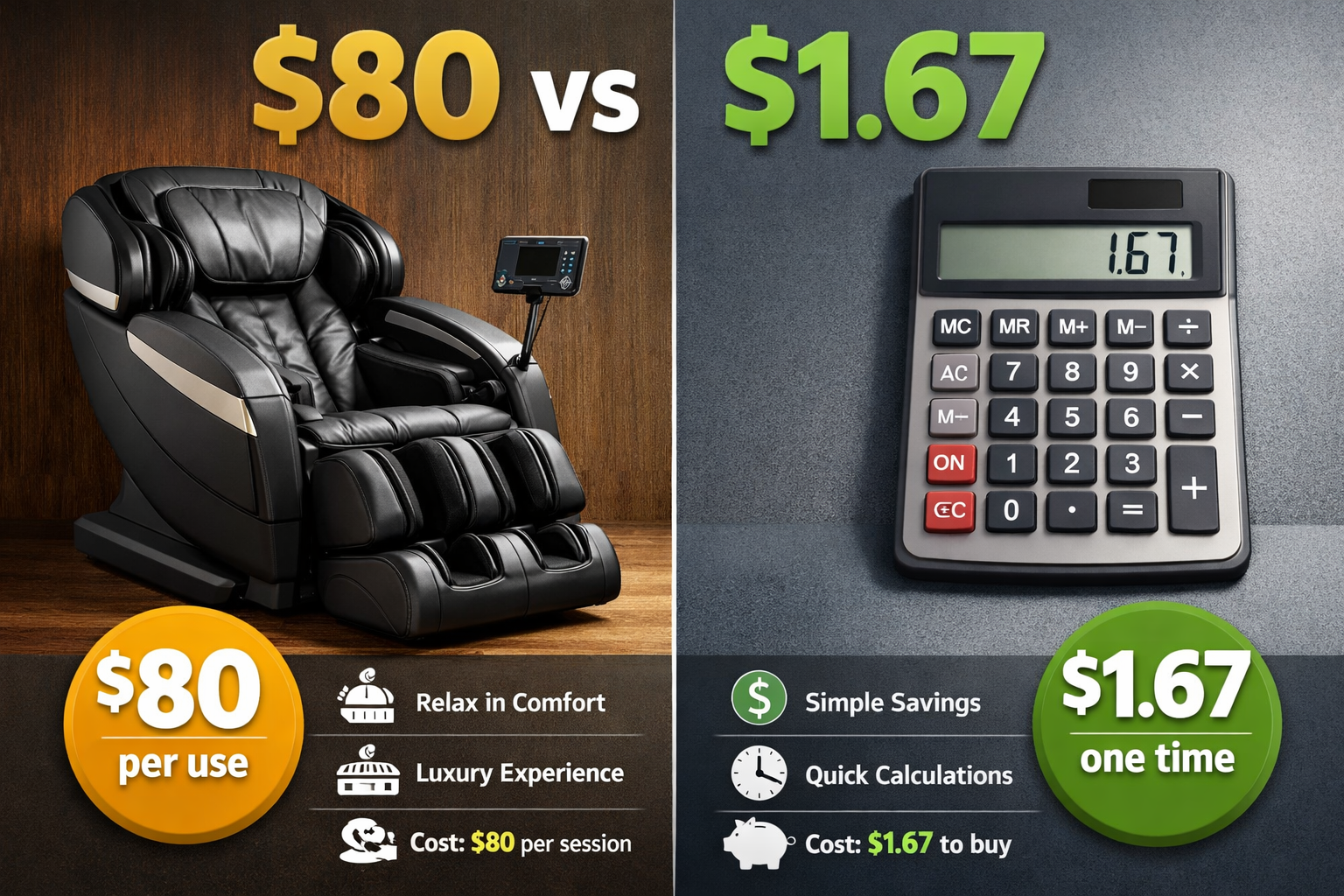
Massage chairs can cost anywhere from hundreds to several thousand dollars. Whether one is worth buying depends less on the chair itself and more on how often you will use it, what you currently spend on massage, and what you expect the chair to do.
Are massage chairs worth it? For some people, they can be a practical long-term purchase. For others, a professional massage, a smaller massage device, or simply occasional use may make more financial sense.
The key is to compare the upfront cost, expected usage, maintenance, space requirements, and alternatives rather than assuming that a massage chair will automatically “pay for itself.”
Are Massage Chairs Worth It? The 5 Questions to Ask First
Before comparing models, answer these five questions:
- How often will you realistically use it?
- How much do you currently spend on professional massage?
- Are you looking for relaxation or treatment for a medical condition?
- Do you have enough room for a full-size massage chair?
- Would you still use the chair six months after buying it?
The last question is particularly important. A $4,000 chair used four times a week can have a very different value proposition from a $4,000 chair that becomes unused furniture.
Massage Chair Cost vs. Professional Massage
The simplest way to evaluate a massage chair financially is to compare its purchase price with the amount you would otherwise spend on professional massage.
For illustration, suppose a professional massage costs $80 per session. That is an example assumption, not a universal U.S. price. Actual prices vary significantly by location, therapist, session length, and type of massage.
| Massage Frequency | Example Cost | Annual Cost | 5-Year Cost |
|---|---|---|---|
| Weekly | $80/session | $4,160 | $20,800 |
| Every 2 weeks | $80/session | $2,080 | $10,400 |
| Monthly | $80/session | $960 | $4,800 |
At this hypothetical $80 session price, someone receiving weekly massages would spend more than $20,000 over five years before considering travel, scheduling, tips, or price increases. Someone getting one massage per month would spend much less.
How Long Does It Take for a Massage Chair to Break Even?
A simple break-even calculation is:
Using $80 as an example professional massage cost:
| Chair Price | $80 Massage Sessions to Match Purchase Price | Weekly Use | Every-2-Week Use |
|---|---|---|---|
| $1,500 | 19 sessions | About 4–5 months | About 9 months |
| $3,000 | 38 sessions | About 9 months | About 1.5 years |
| $4,000 | 50 sessions | About 1 year | About 2 years |
| $6,000 | 75 sessions | About 1.4 years | About 2.9 years |
| $8,000 | 100 sessions | About 1.9 years | About 3.8 years |
This is a simple purchase-price comparison. It does not account for electricity, maintenance, repairs, financing costs, delivery, warranties, or the fact that professional massage and massage-chair sessions are not identical services.
What Does a Massage Chair Cost Per Use?
Another useful calculation is cost per use. Consider a hypothetical $4,000 chair used four times per week for five years.
Four sessions per week × 52 weeks × 5 years = 1,040 sessions.
$4,000 ÷ 1,040 sessions = approximately $3.85 per session.
For example:
| $4,000 Chair | 5-Year Sessions | Purchase Cost Per Use |
|---|---|---|
| 1× per week | 260 | $15.38 |
| 2× per week | 520 | $7.69 |
| 4× per week | 1,040 | $3.85 |
| Daily | 1,825 | $2.19 |
These figures are not a guarantee of chair lifespan. They simply illustrate why expected usage matters when evaluating the purchase.
What Are You Actually Paying For?
A massage chair’s price is not determined by one feature. Depending on the model, you may be paying for a combination of:
- Roller mechanism and track design
- Body scanning or body-position detection
- Air compression systems
- Foot and calf massage
- Heat functions
- Recline mechanisms
- Massage intensity and programming options
- Materials and upholstery
- Warranty and service support
- Brand and distribution costs
Features also vary substantially between models. A higher purchase price does not automatically mean every user will experience a proportionally better massage.
3D vs. 4D, S-Track vs. L-Track: Do Expensive Features Matter?
Terms such as 3D, 4D, S-Track and L-Track are useful when comparing chairs, but they should not be treated as automatic indicators of quality.
For example, 3D and 4D mechanisms generally refer to how the rollers move and how their movement can be adjusted. Track design describes the path followed by the massage mechanism.
Your body size, preferred massage intensity, target areas, chair fit, and programming options may matter just as much as the headline technology.
If you are comparing these technologies, see:
- 3D vs 4D Massage Chairs: What’s the Difference?
- L-Track vs S-Track Massage Chairs
- Massage Chair Features Checklist
Massage Chair vs. Professional Massage
| Factor | Massage Chair | Professional Massage |
|---|---|---|
| Availability | At home | Requires appointment |
| Personalization | Depends on chair | Hands-on adjustment |
| Upfront Cost | High | Low per visit |
| Recurring Cost | Usually maintenance/electricity | Every session |
| Human Assessment | No | Yes |
| Best Use Case | Convenient recurring home use | Individualized hands-on massage |
These are different services rather than direct substitutes. A massage chair can provide convenience and repeatable mechanical massage, while a professional can adjust techniques based on the individual session.
What Does the Research Say About Massage Chairs?
The research base is more limited than many marketing pages suggest.
A 2023 rapid scoping review examined research specifically involving massage chairs. It identified 59 articles and included 18 studies in its final analysis. The review reported potential benefits involving stress, mental fatigue, muscle stiffness, pain and quality of life, while also noting that two case reports described complications associated with massage-chair use.
Research on massage therapy more broadly is also mixed. A 2024 systematic review mapping evidence from 2018–2023 found that most conclusions about massage for painful adult conditions had low or very low certainty; only a minority reached moderate certainty, and no conclusions were rated high certainty.
There is also at least one randomized controlled trial directly comparing home massage-chair therapy with basic physiotherapy for lower-back-pain patients. Both groups improved, but physiotherapy produced greater improvements in pain and functional outcomes in that study, while the massage-chair intervention had a lower treatment cost.
When Is a Massage Chair More Likely to Be Worth It?
1. You Use It Several Times a Week
Frequent use spreads the purchase price across many sessions. If you already enjoy massage and expect to use the chair regularly, the cost-per-use calculation becomes more favorable.
2. You Currently Pay for Regular Massage
If you already spend hundreds or thousands of dollars each year on professional massage, a chair can be compared directly with that recurring expense.
3. Convenience Matters to You
You do not need to schedule an appointment, drive to a clinic or massage studio, or leave home. That convenience can have real value even when the chair does not produce the same experience as a human therapist.
4. Multiple People Will Use It
If several household members use the same chair, the purchase cost can be distributed across more users. However, make sure the chair accommodates the different users’ height, weight and body proportions.
5. You Have Enough Space
Massage chairs are large pieces of furniture. Check the chair’s dimensions, recline clearance and delivery path before buying.
When Is a Massage Chair Less Likely to Be Worth It?
1. You Only Want Occasional Massage
If you expect to use a chair once a month or less, the upfront cost can be difficult to justify compared with paying for occasional professional sessions.
2. You Are Buying Mainly Because of Advertising Claims
Claims about “healing,” “curing,” or guaranteed pain relief should be treated cautiously. A consumer massage device should not be viewed as a medical treatment simply because it uses terms such as therapeutic, AI, 4D or body scan.
3. You Have Not Tested the Chair’s Fit
A chair can have impressive specifications and still feel uncomfortable if the roller path, seat dimensions, shoulder position, foot section or intensity does not suit your body.
4. You Are Stretching Your Budget to Buy One
A massage chair is a discretionary purchase for many households. Financing can make a monthly payment look manageable while increasing the total cost or creating financial pressure.
5. You Expect It to Replace Medical Care
If you have significant or unexplained pain, neurological symptoms, a recent injury, or another medical concern, buying a massage chair should not replace professional evaluation.
Massage Chair Safety: Who Should Be Careful?
Massage is not risk-free, and a massage chair should not automatically be considered safe for every person or condition.
Mayo Clinic advises people with certain conditions to discuss massage with a healthcare professional first. Examples include recent heart attack, bleeding disorders, blood-thinning medication use, recent blood clots, severe osteoporosis, recent surgery, fractures, open wounds and certain other medical conditions.
Research on massage-related adverse events also shows that serious complications are uncommon but possible.
How Much Should You Spend on a Massage Chair?
There is no universal “correct” price. Instead, match the budget to the features and usage pattern you actually need.
| Budget Level | What to Evaluate | Who It May Suit |
|---|---|---|
| Lower-priced | Basic massage programs, fit, warranty and mechanism | Occasional users with modest expectations |
| Mid-range | Track, roller movement, body fit, airbags, heat and programming | Frequent home users |
| Premium | Advanced mechanisms, customization, materials, warranty and service | Users who value extensive customization |
Rather than choosing a price bracket first, identify the features and body fit you need, then compare chairs within that range.
For a more detailed budgeting guide, see:
How Much Should You Spend on a Massage Chair?
Massage Chair Financing: What to Check
Some retailers offer financing through third-party providers. The monthly payment alone should not determine whether the purchase makes sense.
Before financing, check:
- Total amount paid over the financing period
- Interest rate and promotional period
- What happens when a promotional rate expires
- Late-payment terms
- Return and cancellation policies
- Warranty coverage
- Delivery and installation costs
Massage Chair vs. Massage Gun vs. Foam Roller
A massage chair is not necessarily the best choice for every type of self-care.
| Option | Main Advantage | Main Limitation |
|---|---|---|
| Massage Chair | Hands-free, convenient, broad-body massage | High upfront cost and large footprint |
| Massage Gun | Portable and targeted | Requires manual positioning |
| Foam Roller | Very low purchase cost | Requires active participation |
| Professional Massage | Individualized hands-on treatment | Recurring cost and appointment required |
Common Mistakes When Buying a Massage Chair
Mistake 1: Buying Based Only on the Number of Features
A long feature list does not guarantee that the chair will feel comfortable or suit your body.
Mistake 2: Ignoring Chair Fit
Height ranges, shoulder position, seat dimensions, foot length and roller reach can affect the experience.
Mistake 3: Ignoring Warranty and Service
A complex mechanical product can require service. Warranty length, parts availability and local support deserve attention alongside the massage functions.
Mistake 4: Assuming More Expensive Means Better for You
Premium mechanisms may provide additional customization, but not every user needs every available feature.
Mistake 5: Treating a Massage Chair as Medical Treatment
Massage may help some people manage discomfort or relax, but a chair should not be presented as a cure for a medical condition.
Frequently Asked Questions
Is a massage chair a good investment?
It can be a worthwhile purchase if you use it regularly and value having massage available at home. The financial case is strongest when you would otherwise pay for frequent professional massage. It is less compelling for occasional users.
How often should you use a massage chair?
Follow the manufacturer’s instructions for session length and frequency. More use is not automatically better, and people with medical conditions should ask a healthcare professional whether massage is appropriate.
Can a massage chair replace a massage therapist?
Not completely. A chair can provide repeatable mechanical massage at home, but a professional massage therapist can adjust techniques based on the individual’s needs and provide hands-on assessment.
Can a massage chair replace physical therapy?
No. A massage chair should not be treated as a replacement for physical therapy when physical therapy has been recommended. In one randomized trial involving lower-back-pain patients, both massage-chair therapy and physiotherapy improved outcomes, but physiotherapy produced greater improvements in pain and function.
Do massage chairs help with back pain?
They may help some people manage pain or muscle tension, but results vary and the evidence base remains limited. Massage-chair use should not replace medical evaluation when back pain is severe, persistent or accompanied by concerning symptoms.
Are expensive massage chairs worth it?
Not automatically. Higher-priced models may offer more advanced mechanisms and customization, but value depends on whether those features matter to you and whether you will use them regularly.
Are cheap massage chairs worth it?
There is no reliable price cutoff at which every chair becomes good or bad. Instead, compare the mechanism, body fit, warranty, service support, return policy and actual features. Avoid assuming that a low price automatically means poor quality—or that a high price guarantees a better experience.
Can massage chairs make pain worse?
They can cause discomfort or aggravate symptoms if the intensity or positioning is inappropriate. Stop using the chair if it causes significant pain and seek professional advice when appropriate.
So, Are Massage Chairs Worth It?
A massage chair may be worth the money when:
- You expect to use it several times per week.
- You already spend significant money on recurring massage.
- You value having massage available at home.
- You have enough space for a full-size chair.
- You have realistic expectations about what the chair can and cannot do.
A massage chair may be harder to justify when:
- You expect to use it only occasionally.
- The purchase would put pressure on your household budget.
- You mainly want treatment for a medical condition.
- You have not checked whether the chair fits your body.
- You do not have sufficient space for the chair and its recline clearance.
Final Cost-Benefit Takeaway
The answer to “Are massage chairs worth it?” is ultimately a personal cost-benefit calculation.
For a frequent user, the convenience of having massage at home can make a high upfront price easier to justify. If you currently pay for regular professional massage, the simple break-even calculation can also provide a useful reference point.
But a massage chair should not be viewed as a guaranteed medical treatment or as a universal replacement for professional care. Research suggests potential benefits, while also showing that the evidence remains limited and that massage-chair therapy does not necessarily outperform clinical approaches such as physiotherapy.
The best buying decision is therefore not simply to find the most expensive chair you can afford. It is to find a chair that fits your body, matches your intended usage, provides the features you actually want, and fits comfortably within your budget.
📌 Related Massage Chair Guides
Ready to Compare Massage Chairs?
Before buying, compare the massage mechanism, track design, body fit, features, warranty and total cost—not just the advertised number of programs.
2 thoughts on “Are Massage Chairs Worth It? Cost, Benefits & Value”