
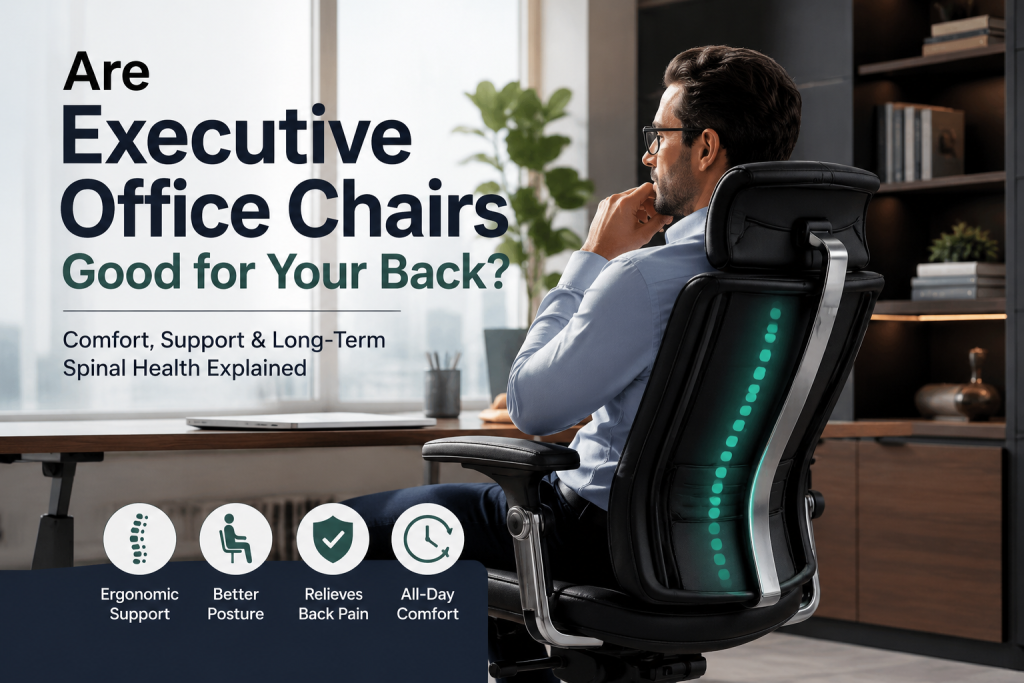
🪑 The Promise of Executive Chairs
Executive chairs are designed to project authority. The high back, the thick padding, the imposing silhouette — all of it sends a signal. But does it actually support your back?
What traditional executive chairs get right:
- ✅ Tall backrests that cover your entire upper back
- ✅ Premium materials that look and feel expensive
- ✅ Plush padding that feels great for the first 30 minutes
- ✅ A commanding presence that elevates your office aesthetic
What they get wrong:
- ❌ Fixed lumbar that doesn’t adjust to your spine
- ❌ Overstuffed cushions that lack structural support
- ❌ Non-adjustable armrests that strain your shoulders
- ❌ Shallow seat pans that don’t support your thighs
- ❌ A design philosophy that prioritizes appearance over anatomy
⚠️ The Problems with Traditional Executive Chairs
If you’ve ever felt back pain after a long day in an executive chair, you’re not alone. Here’s what’s actually happening:
1. Fixed Lumbar = Fixed Pain
Most executive chairs have a built-in lumbar curve that doesn’t move. If you’re not exactly average height — and almost nobody is — the support hits the wrong spot. Too high, and it pushes into your ribs. Too low, and it misses your lumbar spine entirely. A fixed curve only works for about 20% of the population.
2. Overstuffed Padding = Sinking Pelvis
That thick, plush cushion feels amazing when you first sit down. But as the day wears on, the soft foam compresses unevenly. Your pelvis sinks backward, your hips tilt, and your lower back flattens into a C-curve. The very thing that makes the chair feel comfortable initially is what causes pain hours later.
3. Fixed Armrests = Rounded Shoulders
When armrests don’t adjust, your shoulders are forced into unnatural positions. If they’re too low, you hunch. If they’re too high, you shrug. Either way, tension builds in your trapezius muscles and travels down your spine.
4. Shallow Seat Pan = Thigh Pressure
When your seat is too short for your legs, the front edge cuts into the back of your thighs. Your pelvis rotates backward to relieve the pressure, flattening your lumbar curve. This single design flaw is responsible for more lower back pain than almost any other chair feature.
✅ What Makes an Executive Chair Good for Your Back?
Not all executive chairs are bad. In fact, a new wave of ergonomic executive chairs combines the best of both worlds: professional aesthetics and genuine spinal support. Here’s what to look for:
🦴 Adjustable Lumbar Support
- Height adjustment — positions the support where your spine actually curves
- Depth adjustment — controls how aggressively the support presses into your back
- Separate lumbar cushions (like Colamy Atlas) outperform fixed curves
- Dynamic lumbar systems (like Sihoo Doro C300) move with your body
🔄 Seat Depth Adjustment
- Allows you to slide the seat forward or backward
- Ensures your thighs are fully supported without pressing against the seat edge
- Critical for maintaining proper pelvic tilt
- Rare under $300, but essential for back health
🔄 4D Armrests
- Height, depth, angle, and width — full adjustability
- Prevents shoulder and neck strain
- Allows you to maintain a neutral upper body posture
🧠 High-Density Foam
- Firm enough to support your pelvis without sinking
- Resists compression and maintains shape over time
- Prevents “bottoming out” after months of use
- Different from the soft, overstuffed padding of traditional executive chairs
💡 The bottom line: An executive chair is good for your back if it has adjustable lumbar support, seat depth adjustment, and 4D armrests. If it lacks even one of these, it’s not protecting your spine — it’s just a stylish seat.
🧪 How to Tell if an Executive Chair Is Hurting Your Back
Take this 5-minute self-test:
- Sit in the chair with your feet flat. Can you feel the lumbar support? If not, it’s hitting the wrong spot.
- Slide your hand between the lumbar support and your back. You should feel a gentle curve, not a gap or a hard push.
- Place your hand under your thigh, near your knee. You should be able to slide it in easily. If there’s pressure, your seat depth is too shallow.
- Rest your arms on the armrests. Your shoulders should be relaxed and down, not hunched or raised.
- Stand up and sit down again after 10 minutes. If you feel relief when you stand, the chair is putting excessive pressure on your back.
If you fail any of these tests, the chair is not good for your back — no matter how expensive or how good it looks.
❓ Frequently Asked Questions: Executive Chairs and Back Health
🏆 Final Verdict: Are Executive Office Chairs Good for Your Back?
The short answer: It depends entirely on the chair.
Traditional executive chairs — with fixed lumbar, overstuffed padding, and fixed armrests — are actively bad for your back. They prioritize appearance over anatomy and will leave you in pain within weeks.
But a new generation of ergonomic executive chairs has emerged in 2026 that finally gets it right. These chairs combine the polished, professional look you want with the adjustable lumbar support, seat depth adjustment, and 4D armrests your spine needs.
Key takeaways:
- ✅ A chair is only as good as its adjustability. Fixed lumbar = fixed pain.
- ✅ Seat depth adjustment is non-negotiable. Shallow seats cause pelvic tilt.
- ✅ 4D armrests prevent shoulder strain. Fixed armrests create tension.
- ✅ High-density foam supports; soft foam compresses. Overstuffed cushions feel good for 10 minutes but hurt for hours.
- ✅ Spend on the right features, not just the right brand. A $260 Colamy Atlas outperforms a $500 traditional executive chair.
The best executive chair for your back is the one that adapts to your body, not the one that forces your body to adapt to it. Choose wisely, and your spine will thank you.
📚 You May Also Like
- Best Executive Office Chair Under $300: 7 Picks That Look and Feel Premium (2026)
- Executive Office Chair vs Ergonomic Chair: Which One Is Right for You?
- How to Choose an Executive Office Chair: 2026 Buyer’s Guide
- Executive Office Chair for Back Pain: 7 Picks That Prioritize Your Spine
- Best Ergonomic Chair Under $300: 5 Picks That Punch Above Their Weight