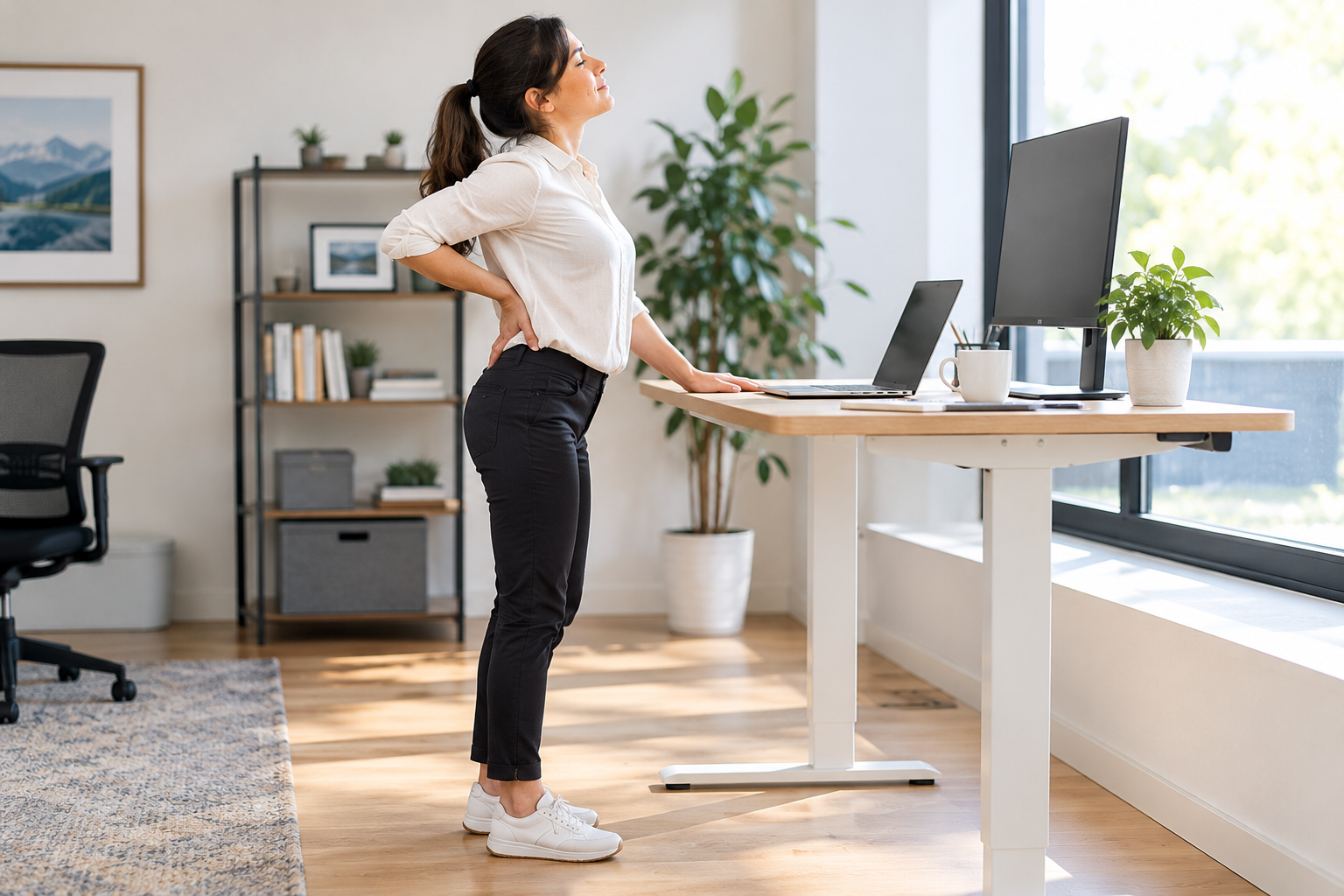
Back pain from standing too long is a common concern for people who work on their feet, stand at a standing desk, or spend hours cooking, cleaning, and doing other daily tasks. Remaining in one position for an extended period can contribute to discomfort and muscle fatigue, especially when you have few opportunities to move or change your posture.
The solution is not necessarily to sit all day. Instead, try varying your position, taking short movement breaks, reviewing your footwear, and adjusting your workstation. This guide explains common reasons your back may hurt after prolonged standing and seven practical ways to improve comfort.
Why Does Your Back Hurt from Standing Too Long?
Standing is a normal part of daily life, but holding nearly the same position for a long time can be tiring. Several factors may contribute to back discomfort.
1. Staying in One Position for Too Long
Your body is designed to move between different positions. Standing still for a prolonged period may increase discomfort or fatigue in some people, even when their posture appears normal.
People who work at checkout counters, assembly stations, kitchen counters, reception desks, and standing desks may be especially likely to notice symptoms when they cannot take regular movement breaks.
2. Muscle Fatigue
Your trunk and hip muscles help maintain balance while you stand. Remaining upright for extended periods can feel tiring, particularly if you are not accustomed to standing for that long or if your work involves repetitive movements.
Muscle fatigue does not automatically mean that your back is injured. However, persistent or severe pain should not be dismissed as simple fatigue.
3. Repeated Bending, Reaching, or Twisting
Standing work often involves more than simply standing. Reaching across a counter, leaning forward to use equipment, repeatedly bending, or twisting while carrying objects may contribute to discomfort.
Consider the entire task, not just how long you remain on your feet. Small changes to the placement of tools, supplies, and frequently used objects may reduce unnecessary reaching.
4. Footwear and Standing Surfaces
Uncomfortable shoes, inadequate cushioning, and hard standing surfaces may contribute to foot, leg, or general discomfort. Their relationship with back pain varies from person to person, so changing shoes is not a guaranteed solution.
Footwear that fits well and feels comfortable during your normal activities is a reasonable starting point. If your workplace permits it, a suitable anti-fatigue mat may also make prolonged standing more comfortable.
5. An Existing Back or Hip Problem
Sometimes standing reveals symptoms associated with an underlying back, hip, or nerve condition. Pain that repeatedly appears after a similar amount of standing, travels down a leg, or improves only when sitting may deserve professional assessment.
Do not assume that prolonged standing is the only cause simply because it triggers your symptoms.
7 Ways to Relieve Back Pain from Standing Too Long
1. Change Positions Regularly
One of the simplest adjustments is to avoid remaining in the same position for too long. You do not need to maintain a perfectly rigid posture throughout the day.
- Shift your weight naturally between your feet.
- Take a few steps when your task allows.
- Alternate between sitting, standing, and walking when possible.
- Use brief breaks before discomfort becomes difficult to manage.
There is no universal break schedule that works for everyone. Start by noticing when discomfort usually begins and adjust your routine accordingly.
2. Take Short Walking or Sitting Breaks
If your back starts to ache while standing, a short break may help. Depending on your work and symptoms, you might sit briefly, walk at a comfortable pace, or move to a different task.
Try these practical ideas:
- Take a short walk between tasks.
- Sit down during a suitable work break instead of remaining on your feet.
- Alternate standing tasks with seated tasks when possible.
- Break longer jobs into smaller sections.
Do not force yourself to keep standing simply to build endurance. If symptoms consistently worsen, reduce the aggravating activity and consider professional advice.
3. Review Your Shoes and Standing Surface
Footwear should fit properly, feel comfortable, and suit the demands of your activity. Shoes that are worn out, too tight, or uncomfortable may make long periods on your feet harder to tolerate.
Consider the following:
- Choose shoes that fit securely without squeezing your toes.
- Look for cushioning and support that feel comfortable to you.
- Replace footwear that is visibly worn or no longer comfortable.
- If you stand in one workplace location, ask whether an appropriate anti-fatigue mat is permitted.
A cushioned mat should be stable and designed for the environment. Avoid mats that slide, curl at the edges, or create a tripping hazard.
Neither special shoes nor anti-fatigue mats are guaranteed to resolve back pain. If changing footwear does not help, consider other contributors to your symptoms.
4. Adjust Your Standing Desk or Workstation
If you use a standing desk, the height and layout of your workstation can influence how comfortably you work. A desk that is too high or too low may encourage you to shrug your shoulders, lean forward, or repeatedly bend your back.
Use these basic setup principles:
- Desk height: Aim for a height that lets your shoulders relax and your elbows remain comfortably near your sides while working.
- Screen position: Place your monitor directly in front of you so you do not need to twist or repeatedly look sideways.
- Keyboard and mouse: Keep them within easy reach to reduce prolonged forward leaning.
- Frequently used items: Place them where you can reach them without repeated bending or twisting.
- Movement options: Alternate between sitting and standing rather than treating standing as the only healthy position.
A standing desk is a tool for changing positions, not a requirement to stand for hours continuously. If you are new to standing work, increase standing time gradually and adjust based on comfort.
For more detailed workspace guidance, see our standing desk guide and our article on lumbar support for desk chairs.
5. Try Gentle Movement After Standing
Gentle movement may help some people feel less stiff after a long period on their feet. Choose a movement that feels comfortable rather than trying to force a deep stretch.
Possible options include:
- Easy walking: Walk slowly for a short distance on a level surface.
- Gentle pelvic tilts: If lying down is comfortable, make small, controlled pelvic movements with your knees bent.
- Comfortable hip movement: Slowly move your hips through a pain-free range without bouncing or forcing the stretch.
- Relaxed breathing: Take a few slow, comfortable breaths and allow your shoulders to relax.
Not every exercise is suitable for every cause of back pain. Stop if a movement increases your symptoms, produces sharp pain, or causes pain to spread farther down a leg.
For more step-by-step ideas, read Back Pain Relief Exercises at Home. Confirm that this article is published and that the URL is correct before adding the link.
6. Improve How You Perform Standing Tasks
When working on your feet, the way you organize and perform a task may matter as much as the standing duration.
- Keep frequently used tools and supplies close to your normal working area.
- Avoid repeatedly twisting your trunk while carrying objects.
- When lifting something, keep it close to your body and avoid lifting loads that exceed your ability.
- Use a stable step or other appropriate equipment when you need to reach high shelves instead of overreaching.
- Where possible, alternate repetitive tasks that use different movements.
If your job requires prolonged standing without sufficient breaks, consider discussing task rotation, workstation adjustments, or reasonable break options with your supervisor.
7. Pay Attention to Recovery and Persistent Symptoms
After a long day on your feet, you may find it helpful to change into comfortable clothing, take a short walk if tolerated, or rest in a position that reduces discomfort.
Some people prefer lying on their side with a pillow between their knees. Others find lying on their back with a pillow under their knees more comfortable. These are optional comfort measures, not treatments for every cause of back pain.
If your back pain keeps returning, limits normal activities, or does not improve with reasonable adjustments, arrange a medical assessment rather than relying on home care indefinitely.
Standing Desk vs. Sitting: Which Is Better for Your Back?
Neither sitting nor standing is automatically best for every person. Remaining in one position for too long can be uncomfortable, and a standing desk does not eliminate the need for movement.
| Work position | Potential benefit | What to watch for |
|---|---|---|
| Sitting | Provides a chance to rest your legs during standing tasks. | Prolonged sitting or an awkward workstation may increase discomfort. |
| Standing | Allows position changes and may suit some tasks. | Long periods of static standing can cause fatigue or discomfort. |
| Alternating positions | Creates opportunities to vary posture and movement. | Adjust the timing and duration to your symptoms and work needs. |
The practical goal is to find a comfortable combination of sitting, standing, and movement that suits your body and your job.
When Is Back Pain from Standing a Warning Sign?
Back pain after standing is not always caused by muscle fatigue or posture. Seek urgent medical care if you experience:
- New loss of bladder or bowel control, or difficulty urinating.
- Numbness around the groin, genitals, or saddle area.
- Rapidly worsening leg weakness or significant new neurological symptoms.
- Severe pain after a major fall, collision, or other significant injury.
Arrange prompt medical assessment if back pain is accompanied by fever, unexplained weight loss, a history of cancer, or other concerning symptoms. Persistent or progressively worsening pain also deserves evaluation.
If standing reliably brings on back pain and sitting provides relief, especially when symptoms travel into your buttock or leg, a healthcare professional can help assess possible causes. This pattern alone does not establish a diagnosis.
Frequently Asked Questions
Why does my lower back hurt when I stand for a long time?
Prolonged static standing, muscle fatigue, repetitive bending, workstation setup, and other factors may contribute. However, lower back pain can have several causes. If it is severe, persistent, worsening, or accompanied by neurological symptoms, seek medical advice.
How long is too long to stand without a break?
There is no universal time limit that applies to everyone. Your comfort, health, task, and tolerance all matter. Try changing positions before discomfort becomes pronounced and build your routine around regular opportunities to move.
Are standing desks bad for your back?
Not necessarily. A standing desk can help you vary your working position, but standing continuously for long periods may still cause discomfort. Adjust the desk properly and alternate between sitting, standing, and movement.
Do anti-fatigue mats help with back pain?
Some people find anti-fatigue mats more comfortable than hard floors during prolonged standing. Their benefits vary, and they are not a guaranteed treatment for back pain. Choose a stable mat that suits the workplace and does not create a tripping risk.
What shoes are best for standing all day?
Look for shoes that fit well and feel comfortable and stable during your usual activities. Cushioning and support preferences vary, so there is no single shoe that is best for everyone with back pain.
Should I sit down when my back starts hurting from standing?
If sitting reduces your discomfort, a short sitting break may be reasonable. You can also try gentle walking or another comfortable position. Avoid forcing yourself to remain standing through increasing pain, and seek assessment if symptoms recur or worsen.
Final Thoughts
Back pain from standing too long may be influenced by static posture, muscle fatigue, footwear, repetitive tasks, and workstation setup. Small practical changes—such as alternating positions, taking movement breaks, reviewing your shoes, and adjusting your work area—may improve comfort for some people.
You do not need to stand perfectly or avoid sitting altogether. Focus on varying your position, moving within a comfortable range, and responding to your symptoms. If pain persists, worsens, or comes with warning signs, seek appropriate medical care.
Health disclaimer: This article is for general educational purposes only and is not a substitute for individualized medical advice, diagnosis, or treatment.