📖 What Does “5D” Mean in Massage Chairs?
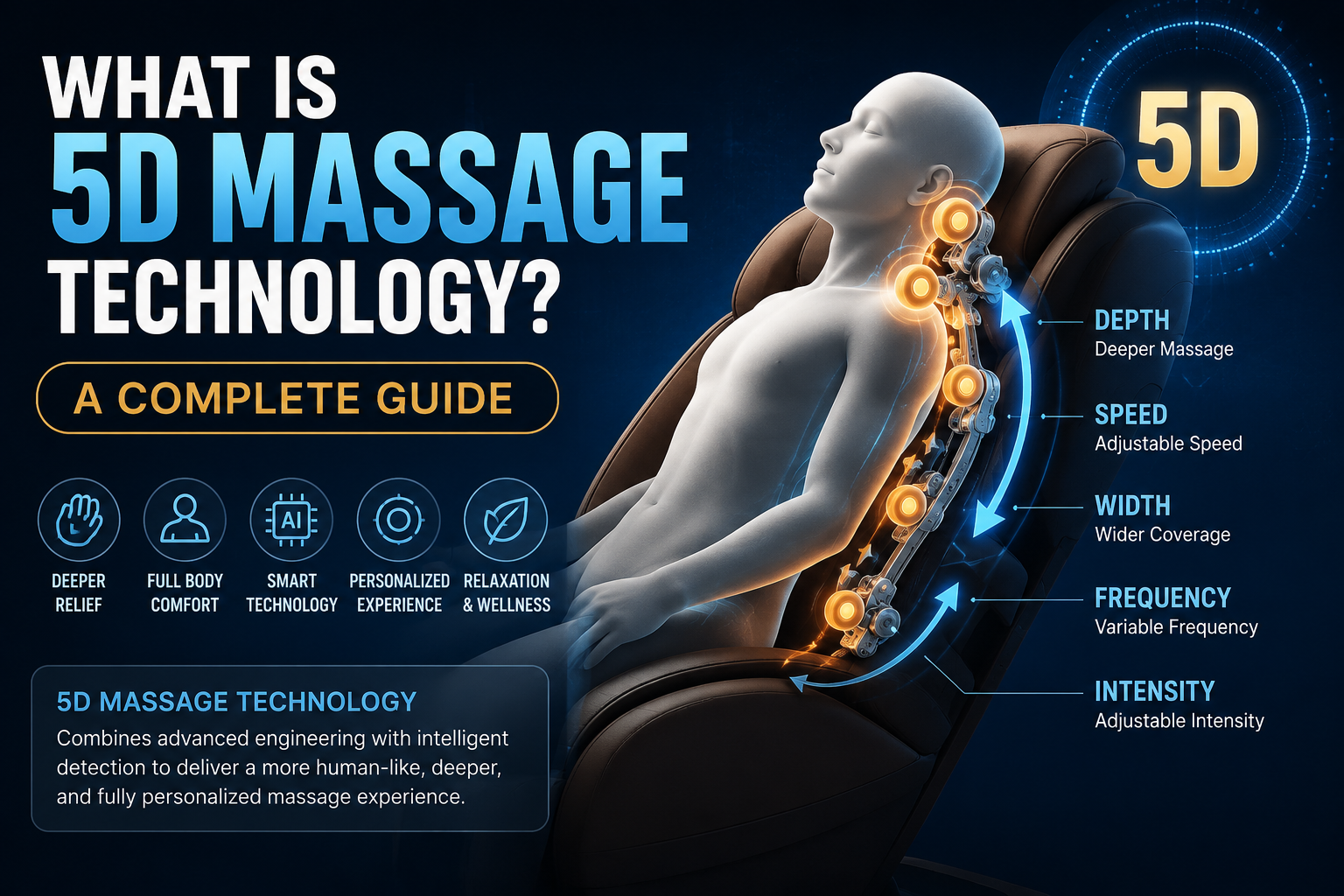
To understand 5D, it helps to first understand what the “D” stands for. In the massage chair industry, the “D” refers to dimensions of movement — the axes and directions in which the massage rollers can move.
Here’s a quick breakdown of how massage technology has evolved:
| Technology | Movement Dimensions | What It Does |
|---|---|---|
| 1D | Rotation only | Rollers spin in place — basic vibration |
| 2D | Up/down + left/right (X + Y axes) | Surface-level massage; can’t “dig” into muscles |
| 3D | Up/down + left/right + in/out (X + Y + Z axes) | Adjusts intensity by pushing rollers deeper into your back |
| 4D | 3D + variable speed/rhythm | Mimics a human therapist’s cadence — slowing down at knots, speeding up during long strokes |
| 5D | 4D + AI real-time adaptation | Sensors measure muscle stiffness and automatically adjust depth, speed, and pressure without you touching the remote |
💡 Important note: According to the current national standard GB/T 26182-2022, 4D is the highest officially recognized classification for massage chair mechanisms. The term “5D” is not a formal industry standard — it’s a technical extension built on 4D technology, with the core innovation being real-time force feedback and adaptive adjustment.
🧠 How Does 5D Massage Technology Work?
The fundamental breakthrough of 5D technology is sensing + adaptation. Here’s how it works:
1. Pressure Sensing
5D massage mechanisms are equipped with high-precision force sensors built directly into the massage roller mechanism. These sensors capture contact pressure data between the massage heads and your body — sometimes hundreds of data points per second.
As one industry expert put it: “5D is not a marketing gimmick; it’s a technical solution to the problem of ‘machines lacking perception’ during massage.”
2. Real-Time Feedback Loop
When the sensors detect that you’re tensing up, flinching, or experiencing discomfort, the system instantly adjusts. This creates a closed-loop control system — the chair “feels” your response and adapts in real time.
“The difference between 4D and 5D is like the difference between driving a manual transmission and an automatic.” — Zhang Yunlong, OGAWA Group
3. AI-Driven Adjustment
The collected sensor data is processed through AI algorithms that determine the optimal massage intensity, trajectory, and rhythm for your specific body. Some systems can detect your muscle fatigue level in real time and adjust accordingly.
4. Body Mapping
Many 5D chairs also feature advanced body scanning. For example, Fujiiryoki’s “AI Double Sensing+” system measures 8 different points along your spine to map your unique back curve, allowing the 5D-AI Mecha Plus to personalize pressure along your contours.
🔍 5D vs 4D: What’s the Real Difference?
| Aspect | 4D Massage | 5D Massage |
|---|---|---|
| Movement | 3D + variable speed/rhythm | 4D + real-time force feedback |
| Intelligence | Follows pre-programmed routines | Adapts dynamically to your body’s response |
| Sensors | Limited or none | High-precision pressure sensors |
| Interaction | One-way (chair → you) | Two-way (chair senses you → adjusts) |
| Personalization | Program-based | Real-time, body-specific |
| Price | Generally 30–50% lower than 5D | Premium pricing |
In simple terms: 4D is programmed intelligence; 5D is adaptive intelligence.
✨ Key Benefits of 5D Massage Technology
The most frequently cited benefit of 5D technology is its ability to sense your comfort level in real time. If you flinch or tense up from pain, the sensors detect it and automatically reduce pressure. If your muscles are particularly tight, the chair can increase intensity to work out the knots.
In testing, 5D-equipped chairs maintained 98.7% force stability after 30 minutes of continuous use, compared to just 82.4% for traditional 4D models. This means the massage doesn’t gradually become too strong or too weak over time.
5D chairs can apply different pressures to different body parts. For example, your lower back might receive deep tissue pressure while your more sensitive upper back gets a gentler touch — all in the same session.
Some 5D systems can detect when you’ve fallen asleep during a massage and automatically switch to a gentler mode, preventing muscle strain from prolonged high-intensity massage.
🏆 Which Brands Offer 5D Massage Technology?
Several premium brands have developed their own 5D systems:
| Brand | 5D Technology Name | Key Feature |
|---|---|---|
| Fujiiryoki | 5D-AI Mecha PLUS / 5D-AI PLUS | Dual-ball mechanism, 8-point spine mapping, made in Japan |
| OGAWA | 5D Smart Positioning Mechanism | 31 sensors, 102mm force adjustment, 37% larger massage area |
| Osaki | AI Health Detection | Robo Walking technology, real-time body composition adaptation |
| Kahuna | 8D Dual Air Tech Touch Rollers | AI Brain Relaxation Program, 54″ SL-track |
| Synca | 5D-AI with Body Scan | Japanese engineering, 38 courses |
Fujiiryoki’s 5D-AI Mecha Plus, for example, uses brushless motors and AI to achieve high torque and precision, transforming mechanical movements into a smooth, hand-like massage. The system provides real-time feedback control up to 200 times per second.
💰 Is 5D Worth the Investment?
- You have chronic muscle tension or specific pain points that require precise, adaptive pressure
- You want a chair that adapts to your body in real time rather than following fixed programs
- Multiple people in your household have different body types and sensitivities
- You value the “interactive” massage experience — a chair that “knows” when to adjust
- Your budget allows for premium pricing (typically $5,000+)
- You’re on a tight budget — 4D chairs offer excellent value at 30–50% lower cost
- You prefer a predictable, consistent massage every time — 4D’s fixed programs may actually suit you better
- You’re a casual user who doesn’t need AI-driven personalization
- You’re unsure whether the extra cost will translate to a noticeably better experience for your specific needs
“For most users, a 3D or 4D massage chair offers the best balance of price and performance. However, if you have chronic tension, the 5D’s ability to ‘find’ your knots is worth the investment.”
⚠️ Watch Out for Marketing Hype
Not everything labeled “5D” is genuine 5D technology. Here are some red flags to watch for:
- “6D,” “8D,” “10D,” or higher numbers — These have no technical standard support and are purely marketing gimmicks
- No mention of pressure sensors or adaptive adjustment — Genuine 5D requires force sensors and closed-loop control
- Vague claims without technical explanation — Ask specifically about sensor types, feedback mechanisms, and AI capabilities
“The ‘5D’ terminology is not a national standard term, but rather a technical extension built on 4D by some manufacturers, with the core being ‘real-time force feedback’ and ‘adaptive adjustment’.”
📝 Summary
| Question | Answer |
|---|---|
| What is 5D massage? | 4D massage + real-time force sensors + AI adaptive control |
| How does it work? | Sensors detect muscle tension; AI adjusts force and trajectory instantly |
| Is it a real technology? | Yes — but not an official industry standard; it’s a premium extension of 4D |
| How much does it cost? | Typically $5,000+ for 5D-equipped chairs |
| Is it worth it? | Yes for chronic pain sufferers and those wanting adaptive massage; 4D offers better value for most users |
3 thoughts on “What Is 5D Massage Technology? A Complete Guide”