
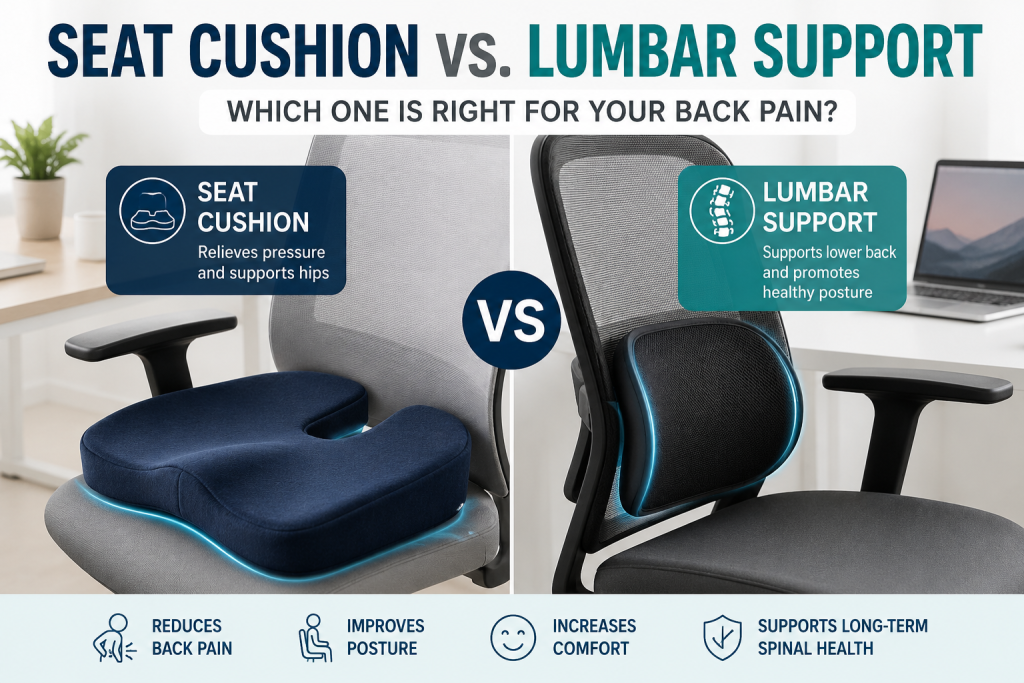
We’ve all been there: sitting at your desk, the afternoon drags on, and your lower back starts its familiar, dull ache. You adjust your posture, shift in your seat, and maybe even lean on one arm to take the pressure off. It’s exhausting. Then you start browsing online for a solution, and you’re hit with two options: plush, contoured seat cushions or curved, firm lumbar support pillows. The marketing makes both sound like miracle cures, but which one is actually right for you?
The short answer is that they solve different problems. A seat cushion primarily targets pressure and pain in your pelvis, tailbone, and hips. A lumbar support pillow is designed to fill the gap in your lower back and support your spine’s natural curve. Understanding this difference is the key to finding real relief[reference:0]. This guide will help you diagnose the source of your discomfort and pick the right tool for the job.
The Core Difference: Pelvis vs. Spine
To understand which support you need, you first need to understand where your pain is coming from.
Seat Cushions (Coccyx Cushions)
Primary Function: Relieve direct pressure on your tailbone (coccyx) and sitting bones (ischial tuberosities). They distribute your body weight more evenly across a larger surface area, reducing painful pressure points in your pelvis.
Key Feature: Many feature a U‑shaped or V‑shaped cutout in the back. This “coccyx cutout” creates a space where your tailbone sits with no direct contact with the seat, offloading pressure and allowing it to float[reference:1].
Best For: Tailbone pain (coccydynia), general soreness in the buttocks, or when you feel like you’re sitting directly on a hard surface. Some dynamic seat cushions are even designed to encourage micro-movements, which help with circulation and core engagement[reference:2].
Lumbar Support Pillows (Back Cushions)
Primary Function: Fill the natural gap between your lower back and the chair. This maintains the healthy inward curve (lordosis) of your lumbar spine, promoting an upright posture.
Key Feature: A firm, often contoured shape that’s placed horizontally across your lower back. It prevents you from slouching and reduces the load on your spinal discs. Some studies have shown that using a lumbar roll can significantly reduce both back and leg pain[reference:3].
Best For: Lower back pain related to posture, muscle fatigue from slouching, and general lumbar strain during long periods of sitting. Chiropractors note that these pillows help maintain the spine’s natural C-curve, ensuring proper weight distribution on your sitting bones[reference:4].
When to Choose a Seat Cushion
You are likely a good candidate for a seat cushion if your discomfort is centered in your lower buttocks or pelvis and feels worse the longer you sit.
- Symptom: A sharp, aching, or burning pain right at the very bottom of your spine, especially when you’re sitting on a hard surface. This is a classic sign of tailbone pain (coccydynia). A cushion with a cutout is the primary non-invasive treatment for this.
- Symptom: A general feeling of “soreness” in your buttocks or sitting bones after sitting for a few hours. A seat cushion adds a layer of pressure relief.
- Forget a New Chair: If you have a desk chair you otherwise like but the seat has gone flat, you don’t need to replace the whole chair. A good seat cushion can transform a hard, unsupportive seat. Studies have found that dynamic seat cushions can reduce spinal discomfort compared to sitting on a standard chair[reference:5].
When to Choose a Lumbar Support Pillow
You will benefit more from a lumbar support pillow if your pain is concentrated in your lower back muscles and feels like a dull ache or a feeling of stiffness.
- Symptom: A dull ache in your lower back that gets worse as the day goes on and feels better when you stand up or lie down. This is a sign that your back muscles are fatigued from trying to hold you upright.
- Symptom: You find yourself slouching in your chair without realizing it. After a while, sitting up straight takes conscious effort and is uncomfortable. A lumbar pillow props you up, making good posture effortless.
- During a Task: You work at a desk or drive for long periods and notice your lower back feels stiff and tight. Clinical studies have shown that sitting with a lumbar roll (a lordotic posture) can significantly reduce back and leg pain compared to slouching[reference:6].
Can You Use Both? The Dynamic Duo of Ergonomic Comfort
For many people, the best solution isn’t choosing one over the other—it’s using both. Since the seat cushion and lumbar pillow address two different areas (pelvis and spine), they work incredibly well in tandem, especially if your pain is widespread.
Think of it this way: the seat cushion provides a stable, pressure-relieving foundation for your pelvis, and the lumbar pillow ensures your spine stacks properly on top of that foundation.
If you suffer from tailbone pain and lower back pain, or if you just want the ultimate in long-term sitting comfort for 8+ hour workdays, a combined system is often the most effective solution. A dynamic duo can help support your natural spinal curves while taking pressure off your sensitive lower sitting bones.
What Science and Experts Say
While marketing claims can be misleading, scientific studies and medical experts offer clear guidance on what these tools can and cannot do.
On Lumbar Support: Research on the McKenzie method shows that sitting with a lumbar roll can centralize pain, moving it from the leg back toward the spine[reference:7]. However, orthopedic experts warn that back support cushions are not a cure for serious conditions like herniated discs. They are supportive tools, not medical devices[reference:8].
On Seat Cushions: A 2024 study in Applied Ergonomics found that dynamic seat cushions that encourage postural shifts can help reduce spinal discomfort[reference:9]. However, many experts note that the comfort provided by cushions may lull users into sitting longer and moving less, which can be counterproductive[reference:10].
The Common Thread: Every expert agrees that no cushion is a substitute for movement. The pressure on your lumbar spine when sitting is double that when standing[reference:11]. The single best thing you can do for your back is to get up and walk around every 30 minutes. No ergonomic tool can replace that.
Frequently Asked Questions (FAQ)
Will a seat cushion help with my lower back pain?
If your lower back pain is caused by poor pelvic positioning due to a hard, flat seat, then yes. By improving the angle of your pelvis, a seat cushion can indirectly help. However, if your primary pain is in the lumbar muscles, a lumbar support pillow is a more direct solution.
Can a lumbar support pillow hurt my back?
Yes, if used incorrectly. It needs to be positioned in the curve of your lower back, not pushing on your tailbone. If you have certain conditions like spinal stenosis, a lumbar roll may actually aggravate your symptoms[reference:12].
Will a cushion fix my slouching?
It can help a lot. A lumbar pillow makes it easier to sit up straight, and a seat cushion can help you sit in a better position. But if you have chronic slouching, you may also need to strengthen your back and core muscles through exercise. Think of cushions as tools that enable, not enforce, good posture.
Is a seat cushion or lumbar pillow better for sciatica?
This depends on the cause of your sciatica. The main difference is that seat cushions help with pain radiating from the pelvis/tailbone area, while lumbar rolls address nerve tension originating in the lower back. A chiropractor can help you determine the root cause.
Why do I sometimes feel worse after using a lumbar pillow?
It could be that the pillow is too thick, pushing your spine into too much of an arch. Or you may have a condition where forced extension is harmful (e.g., spondylolisthesis). Start with a thin pillow and only increase firmness and size gradually[reference:13].
Final Verdict: Which One Should You Try First?
If you are suffering from lower back pain, the choice between a seat cushion and a lumbar support pillow comes down to a simple self-assessment of where your pain is located.
- Start with a lumbar support pillow if your pain is a dull ache or stiffness located in your lower back muscles, you feel the urge to slouch, and you need help maintaining an upright posture.
- Start with a seat cushion (coccyx cushion) if your pain is a sharp ache in your tailbone or soreness in your buttocks, and the pain intensifies the longer you sit, especially on hard surfaces.
- Use both if you have widespread discomfort that affects both your lower back and your pelvis, or if you sit for more than 8 hours a day and want the ultimate in full-body ergonomic support.
Ultimately, the best support is the one you actually use consistently and one that truly fits your specific needs. Listen to your body—it will tell you what it needs. And remember, the most important health advice is to stand up, stretch, and move around as often as you can. No cushion can replace a good habit.
This information is for educational purposes only and does not constitute medical advice. For specific medical concerns, please consult a qualified healthcare professional.