
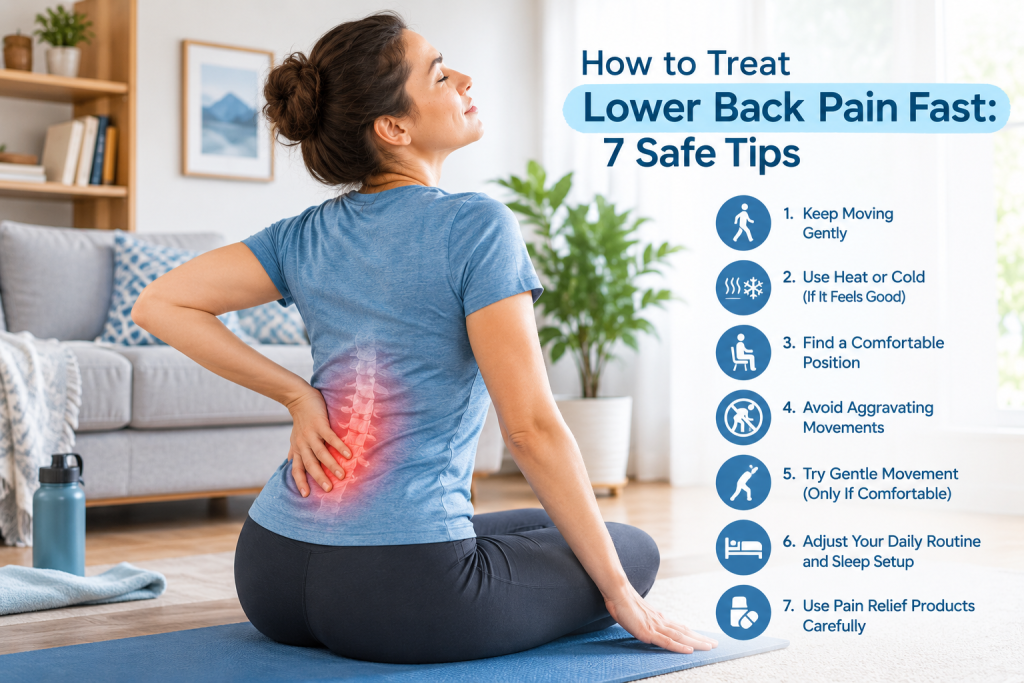
If you’re searching for how to treat lower back pain fast, the first step is to avoid making the discomfort worse. Mild lower back pain can sometimes improve with gentle movement, temporary heat or cold, and changes to daily activities. However, the best approach depends on what is causing the pain, and no home remedy can guarantee immediate relief.
This guide explains seven practical steps you can consider at home, what to avoid, and when lower back pain needs medical attention. These suggestions are intended for general educational purposes and are not a substitute for a professional assessment.
1. Keep Moving Gently Instead of Staying in Bed
When your lower back hurts, resting briefly in a comfortable position may help. However, prolonged bed rest can make it harder to return to normal activity. For many cases of uncomplicated back pain, gentle movement is a better starting point than staying in bed for long periods.
- Walk around your home at a comfortable pace.
- Change positions regularly rather than sitting or lying in one position for hours.
- Break household tasks into smaller steps.
- Temporarily reduce activities that involve heavy lifting, forceful twisting, or repeated bending.
Start with a short walk rather than a demanding workout. If walking increases your pain, causes symptoms to spread down your leg, or produces new weakness or numbness, stop and seek appropriate advice.
2. Try Heat or Cold for Temporary Comfort
Heat and cold are common home-care options for lower back discomfort. Neither is guaranteed to work for everyone, so choose the option that feels better and use it safely.
When to try heat
A warm pack or heating pad may feel soothing when your back feels stiff or tense. Use a comfortable temperature and place a layer of fabric between the heat source and your skin.
When to try cold
A cold pack wrapped in a towel may feel helpful after a recent strain or when the area feels irritated. Never apply ice directly to your skin.
Safety tips:
- Follow the device manufacturer’s instructions and use short applications.
- Do not fall asleep with an electric heating pad switched on.
- Avoid heat or cold on areas with reduced sensation or poor circulation unless a healthcare professional has advised you how to use it safely.
- Stop if your skin becomes painful, excessively red, or irritated.
Heat and cold may provide temporary comfort, but they do not establish or treat every possible cause of back pain.
3. Find a Comfortable Sitting or Resting Position
There is no single posture that is perfect for everyone with lower back pain. Instead, look for a position that reduces discomfort and allows you to relax without forcing your spine into an uncomfortable shape.
When sitting, try the following adjustments:
- Use a chair that supports your body comfortably.
- Keep both feet supported by the floor or a footrest.
- Place your hips and knees in a comfortable position.
- Use a small cushion or lumbar support only if it improves comfort.
- Stand up and move periodically rather than trying to maintain one rigid posture all day.
If desk work tends to aggravate your back, read our guide to lumbar support for desk chairs. You can also explore our guide to the best office chairs for a bad lower back for workspace-specific considerations.
4. Avoid Movements That Make the Pain Worse
When trying to feel better quickly, it can be tempting to stretch aggressively or repeat an exercise until the discomfort disappears. That approach may backfire, particularly when the cause of the pain is unclear.
For now, consider limiting activities that clearly aggravate your symptoms, such as:
- Lifting heavy objects from the floor.
- Twisting your torso while carrying something.
- Deep forward bends that increase your pain.
- Forceful back extensions or intense stretching.
- High-impact exercise that produces worsening symptoms.
You do not necessarily need to avoid all bending or lifting indefinitely. The goal is to reduce aggravating activities while symptoms are acute, then return to normal tasks gradually as tolerated.
5. Try Gentle Movement Only If It Feels Comfortable
Some people find that a small amount of gentle movement helps them feel less stiff. The right choice depends on your symptoms. You do not need to complete a full exercise routine when your back is hurting.
Possible options include:
- Short walks: Walk at an easy pace on a level surface.
- Small pelvic tilts: Lie on your back with your knees bent and gently move your pelvis through a comfortable range.
- Gentle cat-cow movements: If kneeling is comfortable, slowly round your back and return toward neutral without forcing the movement.
Stop any movement that causes sharp pain, increases symptoms, or produces pain that travels farther down your leg. If you are unsure which movements are suitable, ask a qualified healthcare professional or physical therapist.
For step-by-step instructions, see our related guide: Back Pain Relief Exercises at Home. Confirm that this URL is live after publishing the related article.
6. Review Your Daily Routine and Sleeping Setup
Lower back discomfort may be affected by repeated daily activities, including prolonged sitting, standing in one position, and uncomfortable sleeping arrangements. Changing these habits may improve comfort, although it will not resolve every underlying condition.
During desk work
- Keep frequently used items within easy reach.
- Adjust your chair and desk so you are not repeatedly reaching or twisting.
- Take brief movement breaks throughout the day.
During standing tasks
- Shift your weight and change your stance periodically.
- Use a stable footrest if alternating one foot at a time feels comfortable.
- Take short sitting or walking breaks when possible.
When sleeping
Try a position that feels comfortable and does not increase your symptoms. Some people prefer sleeping on their side with a pillow between their knees; others find lying on their back with a pillow beneath their knees more comfortable. These are options to experiment with, not rules that everyone must follow.
If your mattress or sleeping position consistently leaves you uncomfortable, review your sleep setup rather than assuming that buying a new mattress will cure back pain.
7. Be Careful With Pain-Relief Medicines and Products
Over-the-counter medicines and topical products may help some people, but they are not suitable for everyone. Your age, medical history, other medicines, pregnancy status, and the cause of your pain can affect which options are safe.
- Read the product label and follow the recommended dose.
- Ask a pharmacist or healthcare professional before using an anti-inflammatory medicine if you have kidney disease, a history of stomach ulcers or bleeding, cardiovascular conditions, take blood thinners, or are pregnant.
- Do not combine medicines with overlapping active ingredients unless a healthcare professional says it is appropriate.
- Use topical products only as directed. Some should not be combined with external heat sources.
- Do not use a back brace, massage device, or other product as a substitute for evaluation when symptoms are severe or worsening.
There is no universal best pain-relief product for lower back pain. If you need medication to function or the pain is not improving, a pharmacist or healthcare professional can help you decide what is appropriate.
What Not to Do When You Want Fast Lower Back Pain Relief
Some common responses may prolong discomfort or delay appropriate care.
- Do not force a stretch: More intensity does not mean faster recovery.
- Do not stay in bed all day: Brief rest may be useful, but prolonged inactivity is often unhelpful for uncomplicated back pain.
- Do not resume heavy exercise immediately: Return gradually as symptoms allow.
- Do not assume posture is the only cause: Back pain can have many causes, and posture alone cannot explain every case.
- Do not ignore warning signs: Some symptoms require urgent assessment rather than home treatment.
When Should You Seek Medical Attention?
Not all lower back pain should be treated at home. Seek urgent medical care if you develop any of the following:
- New loss of bladder or bowel control, or difficulty urinating.
- Numbness around the groin, genitals, or saddle area.
- Rapidly worsening leg weakness or significant new neurological symptoms.
- Severe back pain after a major fall, collision, or other significant injury.
Arrange prompt medical assessment if you have back pain with fever, unexplained weight loss, a history of cancer, a weakened immune system, or pain that is severe, worsening, or persistent. These features do not always indicate a serious condition, but they should not be ignored.
If your pain is interfering with normal activities or repeatedly returning, a healthcare professional can assess possible causes and recommend an appropriate treatment plan.
Frequently Asked Questions
How can I relieve lower back pain quickly at home?
For mild discomfort without warning signs, try a comfortable position, gentle walking, and a wrapped heat or cold pack if helpful. Avoid heavy lifting and movements that worsen your symptoms. Improvement is not guaranteed, and severe or unusual symptoms need medical assessment.
Is heat or ice better for lower back pain?
Either may provide temporary comfort. Heat may feel better for stiffness, while cold may feel soothing after a recent strain. There is no universally best option; use either safely and stop if it irritates your skin or worsens your discomfort.
Should I walk when my lower back hurts?
Gentle walking can be helpful for many people with uncomplicated back pain. Start with a short, easy walk and adjust based on how you feel. Do not push through increasing pain, new weakness, or numbness.
Should I stretch immediately after my back starts hurting?
Not necessarily. Gentle movement may help some people, but forceful stretching can aggravate symptoms. Start with comfortable movements and stop if the pain increases or spreads.
How long should lower back pain last?
Recovery time depends on the cause and severity. Many uncomplicated episodes improve over time, but persistent, recurrent, severe, or worsening pain deserves medical assessment. Do not rely on home remedies alone if you are concerned about your symptoms.
Final Thoughts
When looking for how to treat lower back pain fast, focus on safe, practical steps rather than a guaranteed quick fix. Gentle movement, comfortable positioning, temporary heat or cold, and reducing aggravating activities may help with some types of mild back discomfort.
Choose options that feel comfortable, return to activity gradually, and seek medical advice when symptoms are severe, persistent, or accompanied by warning signs. The right treatment depends on the cause of your pain.
Health disclaimer: This article is for general educational purposes only. It does not provide a diagnosis or replace individualized medical advice, diagnosis, or treatment.