
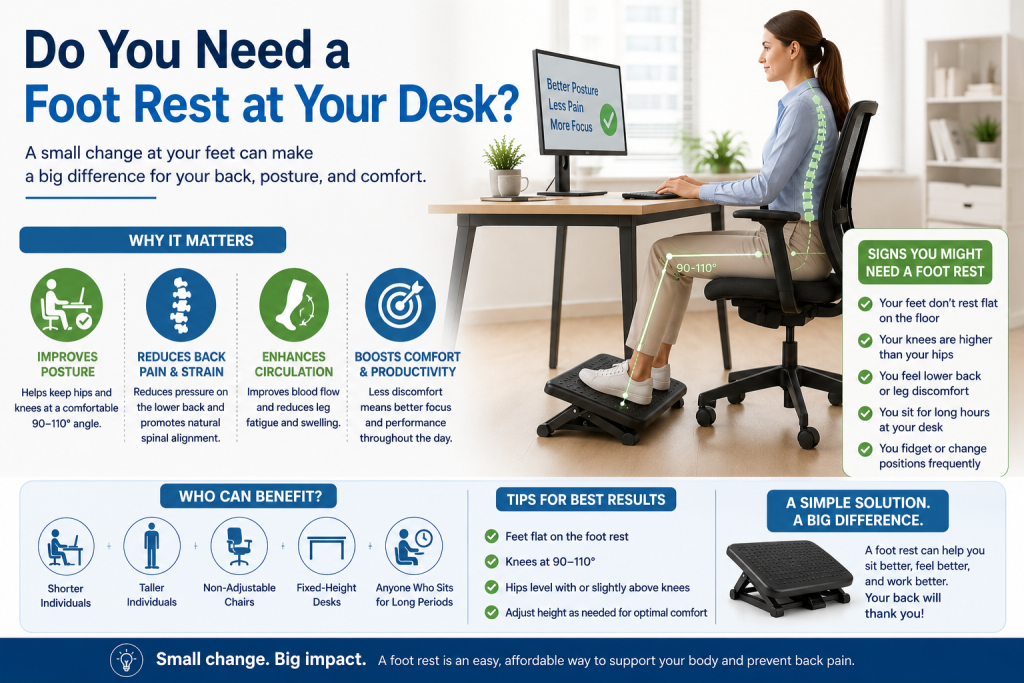
✅ 5 Signs You Need a Foot Rest at Your Desk
If your chair is too high and your feet dangle, your thighs press against the seat edge, cutting off circulation and pulling your pelvis backward. A foot rest bridges the gap.
That’s your body trying to raise your feet. A foot rest gives you a stable place to put them, reducing hip imbalance and back strain.
Constant movement often means you can’t find a comfortable foot position. A foot rest creates a stable base, allowing your upper body to relax.
Saddle stools, kneeling chairs, and ball chairs assume your feet are supported. Without a foot rest, you’ll slide forward or strain your lower back.
Standard desks are made for average heights. Shorter users need elevation; taller users may need a lower foot rest to avoid knee impingement. Either way, adjustability helps.
🔬 Science: How a Foot Rest Changes Your Sitting Posture
Research shows that proper foot support is not optional — it’s foundational. A 2025 study in the International Journal of Industrial Ergonomics found that using a foot rest significantly reduced lumbar flexion and erector spinae muscle activity, meaning your back works less to stay upright. Here’s what happens when you add a foot rest:
- Pelvis rotates forward → restores natural S-curve of the spine (lumbar lordosis).
- Hip angle opens to 100-110° → reduces pressure on the sciatic nerve and lumbar discs.
- Thigh pressure drops by up to 30% → improves circulation and prevents “dead leg” syndrome.
- Shoulders naturally align over hips → reduces neck and upper back tension.
The takeaway: If any of the five signs apply to you, a foot rest isn’t a luxury — it’s an ergonomic necessity.
🪑 When You Might NOT Need a Foot Rest
You may be fine without a foot rest if:
- Your feet rest flat on the floor with your knees at 90° and your chair height is correct.
- You use a standing desk exclusively (though foot rests can still help while standing).
- You already have an ergonomic chair with an integrated footrest (rare, but some high-end chairs have them).
- You work from a recliner or lounge chair where feet naturally elevate.
If you’re unsure, try a low-cost adjustable foot rest (like the Amazon Basics or Mind Reader) for a week. The improvement in comfort will tell you everything.
📏 How to Test If You Need a Foot Rest Right Now
Try this 30-second self-assessment:
- Sit in your office chair as you normally would.
- Look down at your feet. Are they flat on the floor? If not, proceed to step 3.
- Stack a few thick books (2-4 inches) under your feet.
- Notice how your lower back feels. Does the ache decrease? Do your shoulders relax?
If stacking books improves your comfort, you need a foot rest. A proper foot rest will be more stable and adjustable than books, but the test confirms the benefit.
❓ Frequently Asked Questions: Do You Need a Foot Rest?
🏆 Final Verdict: Should You Get a Foot Rest for Your Desk?
For the vast majority of desk workers, the answer is yes. If any of these apply to you — feet dangling, crossing legs, lower back pain, or sitting more than 4 hours a day — a foot rest will measurably improve your comfort and posture. Start with an adjustable model to find your ideal height, then enjoy the difference.