
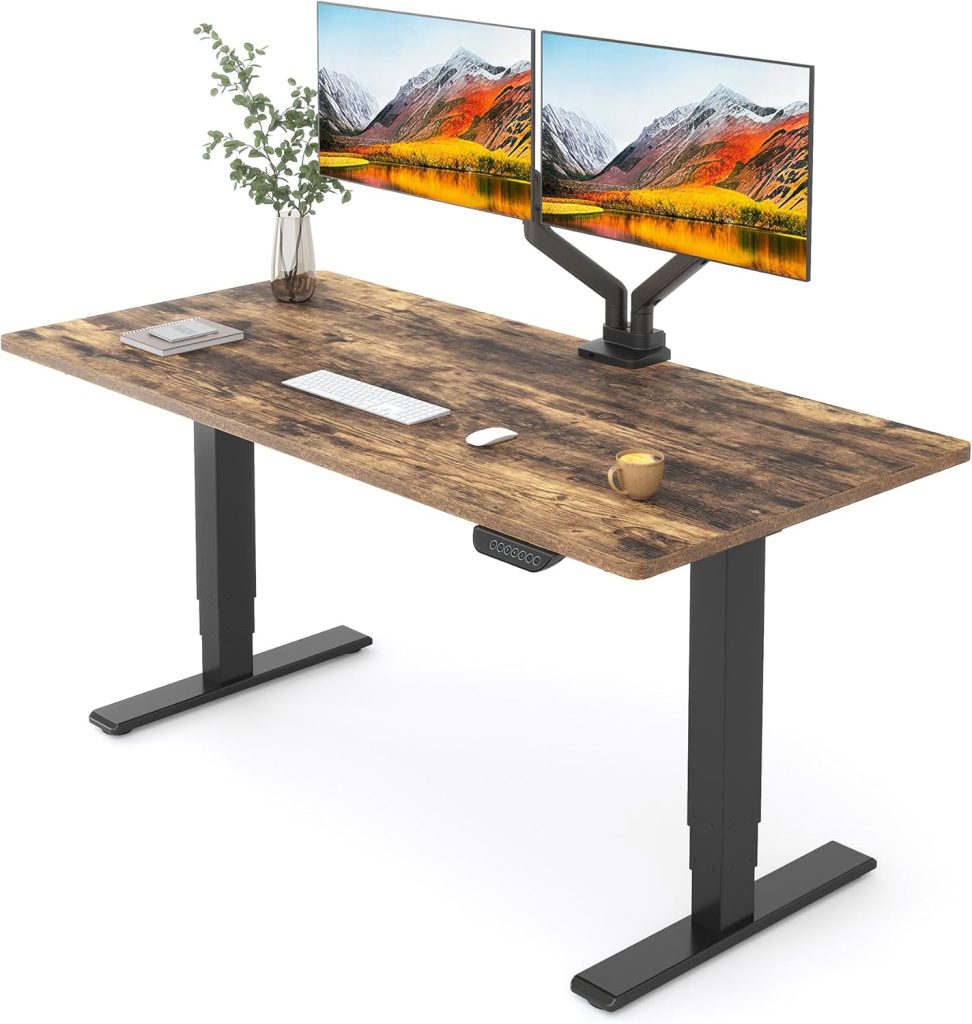
Standard desks are built for average-height people. If you’re 5’4″ or shorter, that usually means your desk is too tall, forcing your shoulders up and your wrists into awkward angles. The right desk height for short person isn’t a single number — it depends on your chair height, elbow position, and how you work.
Most fixed desks sit around 29–30 inches high. For shorter users, that’s often 2–4 inches too tall. Your feet might dangle, your forearms tilt upward, and your neck compensates. The result? Tight shoulders, wrist strain, and lower back fatigue. This guide shows you how to measure, adjust, and fix your setup without guessing.
📌 Why Standard Desk Heights Often Fail Short People
Most fixed desks are built at 29 to 30 inches tall, a standard designed around an average-height user of roughly 5’9″. If you’re 5’4″ or below, that top surface can sit several inches above your natural elbow height, and your body has to work around the mismatch.
Here’s what often happens when the desk is too high:
- Raised shoulders: You lift your shoulders to rest your forearms on the desk, which can create constant tension in your neck and upper back.
- Wrist extension: Your wrists bend upward to type or use a mouse, which may strain the tendons over long work sessions.
- Neck strain: You may tilt your head forward or downward to see your screen clearly, adding extra load to the cervical muscles.
That one-size-fits-all standard ignores shorter body proportions. A person under 5’0″ often needs a surface around 22 to 24 inches, while someone 5’2″ to 5’4″ usually does better at 24 to 26 inches. Most standard desks don’t go that low without modification.
🔑 How to Calculate Your Ideal Desk Height at Home
The most reliable starting point for a short person isn’t your overall height — it’s your floor-to-elbow measurement. That number tells you where your desktop should sit so your forearms stay parallel to the floor without shrugging or reaching.
Here’s a simple method you can do at home with a chair and a tape measure:
- Sit in your normal chair with your feet flat on the floor and your knees bent at about 90 degrees.
- Relax your shoulders and let your upper arms hang straight down.
- Bend your elbows to roughly 90–100 degrees.
- Have someone measure from the floor to the underside of your forearm, just below the elbow crease.
- If you usually wear shoes with a thicker sole, add 0.5 to 1 inch to that measurement.
For most people under 5’4″, a seated desk height between 22 and 25 inches works better than the standard 29–30 inch desk. Standing desk heights typically range from 35 to 40 inches for shorter users.
| Your Height | Seated Desk Height | Standing Desk Height |
|---|---|---|
| 5’0″ | 22–23 in | 35–36 in |
| 5’1″ | 22–23.5 in | 36–37 in |
| 5’2″ | 23–24 in | 37–38 in |
| 5’3″ | 23.5–24.5 in | 38–39 in |
| 5’4″ | 24–25 in | 39–40 in |
Remember to test the measurement with your actual keyboard and mouse. Your wrists should stay straight, not angled upward, when your elbows are at that 90–100 degree bend.
🔍 Best Adjustable Desks for Short Users in 2026
The single most important spec for shorter users is minimum desk height. If you’re under about 5’4″, look for a desk that goes to 24 inches or lower from the floor to the top of the desktop. Many standard electric desks bottom out around 28–30 inches, which forces shorter people to raise their chair too high or shrug their shoulders.
Top adjustable desks in 2026 now include models with true low ranges between 22 and 24 inches. A few standouts:
| Model | Min Height | Height Range | Stability Note | Price Range | Check Price |
|---|---|---|---|---|---|
| Uplift V2 Commercial | 22.6″ | 22.6″–48.7″ | Optional crossbar improves low-height stability | $600–$900 | Check Price → |
| Flexispot E7 | 22.8″ | 22.8″–48.4″ | Dual-motor design; stable at minimum height | $400–$600 | Check Price → |
| Fully Jarvis | 24.5″ | 24.5″–50″ | Reliable, but not as low as others | $500–$750 | Check Price → |
For seated use, you’ll want an electric sit-stand desk with programmable presets. Set one button for your seated height — often 22–25 inches — and another for standing, typically 35–40 inches depending on your height and elbow angle. That removes daily fine-tuning.
Stability at low settings matters more than you’d expect. Look for wide leg bases or a crossbar, which reduce side-to-side wobble when the desk is compressed to 22–24 inches. Also check the control box placement. A bulky motor housing under the desktop can hit your knees or reduce leg clearance when the desk is low.
If you don’t need electric adjustment, a crank desk with a low minimum range works too. But memory presets are worth the extra cost if you switch between sitting and standing regularly.
📌 Accessories to Fix a Too-High Desk
If your desk is fixed too high, you don’t have to replace it right away. A few well-chosen accessories can bring the work surface down to you.
- Keyboard trays with negative tilt. A clamp-on or under-desk tray drops the typing height by 2–4 inches. Look for one that tilts down slightly so your wrists stay neutral instead of bending upward.
- Adjustable chairs with short-stroke cylinders. A chair that drops below 16 inches from floor to seat helps smaller frames. Pair it with a backrest that supports your lumbar curve without pushing your shoulders forward.
- Footrests. If your chair must sit higher to reach the desk, a footrest keeps your feet flat and knees close to 90 degrees. Choose a model with adjustable height and angle.
- Monitor arms or laptop stands. Raising the screen to eye level stops you from hunching. A gas-spring monitor arm gives the most flexibility, while a simple laptop stand or stack of books works in a pinch.
Start with the keyboard tray if you only buy one thing. It fixes the most damaging part of a too-high desk: typing with raised shoulders and overextended wrists.
📌 Common Posture Mistakes Short People Make at Desks
If you’re under about 5’4″, it’s easy to slip into habits that feel like small compensations but add up to real strain by mid-afternoon. These are the most common desk posture mistakes I see in shorter users.
- Perching on the edge of the chair. This might seem like it gives your feet more floor contact, but it removes thigh support and forces your lower back to do all the stabilizing work.
- Sitting too far back in a deep seat. When the seat pan is too deep, your knees can’t bend comfortably at the front edge. You end up either sliding forward or losing contact with the backrest, which undermines lumbar support.
- Dangling feet without support. When your feet don’t rest flat on the floor or a footrest, your pelvis tilts backward and flattens the natural curve in your lower back. That increases pressure on the discs and can leave you feeling achy after an hour.
- Shrugging shoulders to reach a high desk. A fixed desk around 29–30 inches often forces short users to lift their elbows and shoulders just to type. That creates constant tension in the upper traps and neck.
- Craning the neck up to see a monitor. If the screen is too high, you’ll tilt your head back to focus. Over time, that compresses the cervical spine and can contribute to headaches or neck stiffness.
Each of these mistakes usually stems from one root problem: the desk or chair doesn’t fit your shorter proportions. Fix the height and support first, and the posture correction often follows naturally.
❓ FAQ
What is the standard desk height and why is it too tall for short people?
Most fixed desks sit 29–30 inches tall, built for people around 5’8″ to 5’10”. If you’re shorter, your elbows end up below the surface, so you shrug or reach upward. That can strain your neck and shoulders over time.
What desk height should a 5’2″ person use?
A 5’2″ person usually needs a seated desk height around 24–26 inches. Sit with shoulders relaxed and elbows bent about 90 degrees, then measure from the floor to your forearms. That measurement is your target.
Can a short person use a standing desk?
Yes, but only if it lowers far enough. Many standing desks stop around 28–29 inches, which is still too tall for shorter users. Look for a minimum height near 23–25 inches. A keyboard tray can drop even lower if needed.
How do I make a too-high desk comfortable without replacing it?
Raise your chair until your elbows clear the desk, then add a footrest so your feet aren’t dangling. Keep your knees near 90 degrees. A clamp-on keyboard tray can also lower your typing surface a few inches.
Are there desks designed specifically for short people?
Few desks are marketed specifically for shorter people, but adjustable-height desks with low minimums work well. Some brands drop to 22–24 inches. Petite or child-size desks exist, though they may lack depth or stability for a full work setup.
What chair features matter most for short desk users?
Prioritize a seat height low enough for your feet to rest flat, often around 15–17 inches for shorter adults. A shorter seat depth, adjustable lumbar support, and armrests that lower out of the way also help. If the chair can’t go low enough, add a footrest.