
Lumbar Support Buying Guide
Best Mesh Lumbar Support Pillows for Office Chairs
Want additional lower-back support without the enclosed feel of a thick foam cushion? A mesh lumbar support pillow may be worth considering. Learn how mesh tension, frame design, attachment stability, and cleaning requirements affect your choice.
Support Tension
Secure Attachment
Easy Maintenance
If your lower back feels warm or sweaty during a long workday, a thick lumbar pillow may not be your preferred solution. A mesh lumbar support pillow offers a different approach: a tensioned fabric surface supported by a frame or flexible structure, rather than relying entirely on a thick layer of foam.
However, mesh does not automatically mean better ventilation or better back support. The fabric’s openness, tension, frame shape, and distance from your back all influence how a cushion feels. Some products sold as mesh back supports are also rigid frame-mounted accessories rather than standalone pillows.
This guide focuses on choosing a breathable lumbar support for an office chair, with particular attention to airflow, support feel, attachment stability, compatibility, and cleaning. The goal is to help you decide whether a mesh design suits your chair and working environment before you spend money on another back-support accessory.
Quick buying advice
Choose a mesh design if you prefer a lighter, less foam-heavy support surface. Prioritize a stable frame, comfortable tension, and a secure attachment system. If you need substantial cushioning or a softer contact surface, a contoured foam pillow may be a better fit.
Best Mesh Lumbar Support Options to Compare
Mesh lumbar supports vary considerably in design. The following options are useful starting points for comparing mesh backrest attachments and breathable support products. They are not a hands-on-tested ranking, and not every option is a standalone mesh pillow.
Option 1
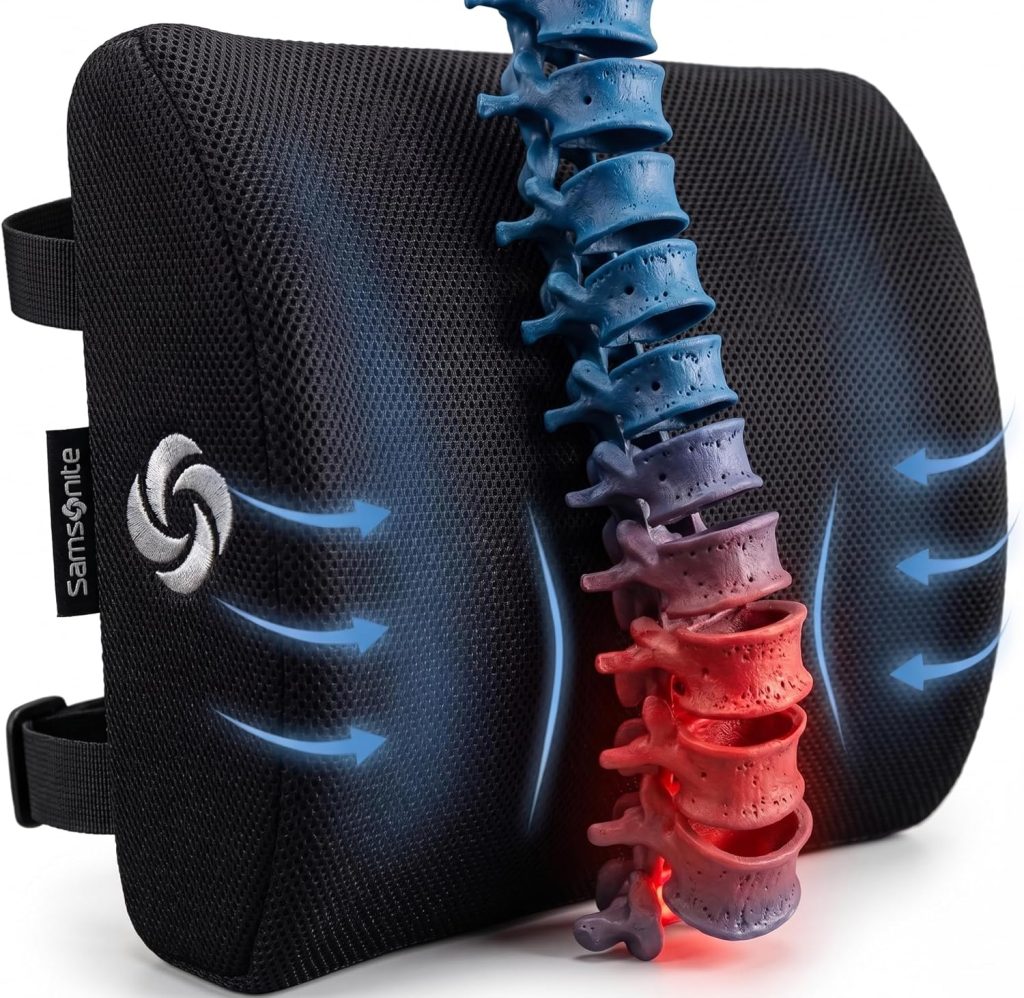
Samsonite Mesh Back Support
A mesh-style back support worth investigating if you want a lightweight accessory for an existing chair. Verify the current model’s frame, attachment method, dimensions, and whether it is designed specifically for lumbar placement.
Best for: Shoppers comparing mesh back-support accessories.
Option 2
Fellowes Mesh Back Support
A candidate for shoppers comparing frame-supported mesh back accessories. Check the exact product version to determine how it attaches, where it contacts the back, and whether it fits your chair’s backrest.
Best for: Buyers comparing structured mesh support designs.
Option 3
Ergonomic Mesh Lumbar Support Cushion
Compare current mesh lumbar cushions from multiple sellers if you need a standalone accessory rather than a rigid frame-mounted support. Examine the fabric, tensioning system, edge construction, and included straps carefully.
Best for: Buyers specifically seeking a mesh cushion with chair attachment straps.
Alternative
Contoured Foam Lumbar Support Pillow
If mesh feels too firm or does not provide enough cushioning, compare contoured foam designs. These use a different support mechanism and may provide a softer contact surface, although they can feel warmer depending on the foam and cover.
Best for: Shoppers who prioritize cushioning over a tensioned mesh surface.
Product verification note: These are shopping candidates and search links, not verified recommendations based on product testing. Product names, availability, construction, and specifications can change. Confirm that the exact item is a mesh lumbar support and that its attachment system suits your chair before purchasing.
How Does a Mesh Lumbar Support Pillow Work?
A mesh support uses a fabric surface held in position by a frame, flexible structure, or attachment system. When you lean back, the fabric deforms under load and provides resistance against your back.
Unlike a solid foam cushion, a mesh design may leave more open space around the support surface. However, its comfort depends on how the fabric is tensioned and how the frame distributes pressure. A tightly tensioned mesh panel can feel firm, while a more flexible surface may allow greater movement.
Airflow and heat management
Open-weave mesh can allow air to pass through the material more readily than some dense, solid cushion covers. This can be appealing if you work in a warm room or prefer less enclosed cushioning against your back.
Actual ventilation depends on the entire construction. A mesh surface backed by foam or placed close against an upholstered chair may not provide the same airflow as a more open design. Room temperature, clothing, and individual heat sensitivity also affect comfort.
Support through fabric tension
Mesh support relies partly on the tension of the fabric and the geometry of the supporting frame. The surface needs to resist your back without creating uncomfortable pressure points or excessive sagging.
If the mesh is too loose, you may feel that it provides little useful support. If it is too rigid or tightly tensioned, the contact may feel harsh. Look for a shape and tension level that feel comfortable in your normal working position.
Less bulky construction
Many mesh supports use a relatively thin fabric surface rather than a thick foam block. This may help preserve more of the chair’s usable depth, but it is not guaranteed: frame thickness, mounting hardware, and the distance between the support and backrest also matter.
Measure the full assembly rather than the fabric alone, especially if your office chair already has a shallow seat or a pronounced built-in lumbar curve.
Mesh vs. Foam Lumbar Support: Which Is Better?
The choice between mesh and foam is not simply a question of which material is more ergonomic. They provide support in different ways, and the better option depends on your comfort preferences, chair design, and environment.
| Feature | Mesh support | Foam cushion |
|---|---|---|
| Airflow | Open mesh may allow more airflow | Depends on foam, cover, and construction |
| Support feel | Tensioned and potentially springy | Cushioned, with feel varying by foam density and shape |
| Thickness | May have a slimmer profile, depending on the frame | Often adds more depth to the backrest |
| Attachment | May use a rigid frame, hooks, or straps | Often uses elastic straps or a fitted shape |
| Cleaning | Mesh can collect dust and debris in the weave | Removable covers can simplify cleaning |
| Potential drawback | May feel too firm or expose pressure points | May feel warm or push the body forward |
Choose mesh if you prefer a tensioned support surface and want to investigate more breathable designs. Choose foam if you want a padded contact area or need a particular contoured shape. Neither material is automatically better for every user.
If you are also choosing a new chair, our office chair guide for lower-back comfort can help you evaluate built-in lumbar adjustment rather than relying entirely on an add-on accessory.
Five Features to Check Before Buying Mesh Back Support
1. Mesh tension and flexibility
The fabric should provide comfortable resistance without sagging excessively or feeling like a rigid board. Product photographs rarely reveal the actual tension, so look for descriptions of the frame, fabric construction, and support design.
When available, review user feedback that specifically discusses tension, sagging, or long-term fabric durability. General comments about comfort may not tell you whether the mesh holds its shape over time.
2. Frame strength and edge construction
The frame determines how the mesh is held in place and how pressure is distributed. Check the visible frame design, the connection points, and whether the edges may press into your back when you lean or move.
Do not assume a rigid frame is more comfortable simply because it looks sturdy. The frame needs to remain stable while keeping hard edges away from sensitive contact areas.
3. Attachment stability
A mesh support that shifts during normal movement can become distracting. Depending on the design, it may attach with elastic straps, adjustable straps, hooks, or a frame-mounted system.
Confirm the attachment method before purchasing. A rigid accessory may not fit every chair, and straps designed for a narrow backrest may not secure properly around a wide or heavily contoured chair.
4. Height and contact area
The support should contact your lower back rather than forcing pressure into the middle back or pelvis. Check the dimensions and whether the entire accessory can be repositioned vertically.
Do not assume that a mesh support has adjustable height just because it attaches to a chair. Some products have a fixed support shape and only limited mounting flexibility.
5. Cleaning and maintenance
Mesh can accumulate dust, skin oils, and debris between its fibers. A surface that looks easy to wipe may still need occasional brushing or vacuuming, depending on the weave and frame design.
Check the manufacturer’s cleaning instructions before using detergent or soaking the fabric. Avoid harsh chemicals unless the manufacturer explicitly permits them, and allow the material to dry fully before use.
How to Install and Position a Mesh Lumbar Support
- Read the installation instructions. Identify the intended mounting points and confirm that the accessory is compatible with your chair’s backrest.
- Center the support. Position the mesh surface around the inward curve of your lower back, using your normal seated position as the reference.
- Secure the attachment system. Tighten straps or fasteners enough to prevent unwanted movement without distorting the chair or damaging its fabric.
- Check the frame and edges. Make sure hard components do not create pressure points when you lean back or shift position.
- Assess the support feel. The surface should provide comfortable contact without excessive sagging, concentrated pressure, or an uncomfortable forward push.
- Recheck after use. If the accessory slips, loosens, or changes position, review the installation and inspect the attachment points before continuing to use it.
For more guidance on positioning and choosing lumbar support, visit our lumbar support resource. If you find that the mesh feels too firm or uncomfortable, compare it with a contoured foam option rather than assuming all mesh designs will feel the same.
Can You Attach Mesh Lumbar Support to a Mesh Office Chair?
Sometimes, but compatibility depends on the accessory and chair construction. A mesh-backed chair may have a flexible fabric surface, a rigid outer frame, or a combination of the two. An add-on support that works on an upholstered chair may not attach securely to every mesh backrest.
Before buying, check the following:
- Whether the accessory is designed for a mesh backrest or only a solid chair back.
- Whether straps can pass around the frame without pressing excessively against the mesh.
- Whether the chair manufacturer permits attaching accessories to the backrest.
- Whether the accessory can remain centered without distorting the chair’s existing lumbar mechanism.
- Whether the added frame or support surface interferes with reclining or normal movement.
Avoid stretching straps tightly across unsupported mesh or modifying the chair frame unless the manufacturer specifically allows it. If the chair already has adjustable lumbar support, test its built-in mechanism before adding a second support surface.
Common Mistakes When Buying a Mesh Lumbar Support Pillow
Assuming every mesh design is cooler
Open fabric can improve airflow, but the frame, backing materials, and distance from the chair also matter. Look at the complete construction rather than the word mesh alone.
Choosing maximum tension
A very firm surface is not necessarily more supportive. Excessive tension may create concentrated pressure or make the accessory uncomfortable during long sitting sessions. Comfort and fit should take priority over a rigid feel.
Ignoring the mounting hardware
A support may have an attractive mesh surface but an attachment system that does not suit your chair. Confirm the frame dimensions, strap arrangement, and mounting instructions before ordering.
Expecting mesh to correct a poor chair fit
A lumbar accessory cannot fix every problem with seat depth, seat height, or backrest geometry. If the chair is fundamentally the wrong size, adjusting or replacing it may be more useful than adding another component.
Frequently Asked Questions
Is a mesh lumbar support pillow more breathable than memory foam?
An open mesh surface can allow more air to pass through than some solid foam cushions. However, actual comfort depends on the weave, frame, backing materials, room temperature, and how the support sits against your back.
Does mesh lumbar support provide enough support for long hours?
It can provide comfortable support for some users, but performance depends on the shape, tension, frame, and fit. Check that the accessory remains stable and does not create pressure points during your normal sitting routine.
Can a mesh lumbar support pillow be washed?
Cleaning methods vary by product. Some mesh surfaces can be wiped or gently brushed, while others require specific care. Follow the manufacturer’s instructions and avoid soaking or using harsh cleaners unless permitted.
Will mesh lumbar support work with a gaming chair?
It may, but compatibility depends on the chair’s backrest width, side bolsters, frame, and attachment system. Check the mounting instructions and ensure that the accessory does not interfere with the chair’s existing lumbar support.
Is a mesh support better than a foam lumbar pillow?
Neither is universally better. Mesh may appeal to users who prefer a tensioned surface and more open construction, while foam provides a padded contact area. Choose according to comfort, chair compatibility, support shape, and the amount of additional depth you can accommodate.
How do I prevent a mesh lumbar support from slipping?
Use the intended attachment points, verify that the accessory fits the backrest, and follow the installation instructions. If the frame or straps cannot remain stable without excessive tension, choose a different mounting design that is compatible with your chair.
Final Verdict: Choose Mesh for Its Construction, Not Just Its Label
A mesh lumbar support pillow can be a useful alternative to a thick foam cushion if you prefer an open, tensioned surface. The most important factors are comfortable mesh tension, a stable frame, a suitable contact area, and an attachment system that works with your chair.
If airflow is your main concern, compare the full construction rather than assuming every mesh product is equally breathable. If you need soft cushioning or a specific contour, a foam pillow may be more suitable. If your chair already has effective built-in lumbar adjustment, you may not need an add-on at all.
Before buying: verify the exact product type, dimensions, frame design, mounting compatibility, cleaning instructions, and return policy.
Disclosure: SitBetterLab may earn a commission from qualifying purchases made through affiliate links, at no additional cost to the buyer. Product availability and specifications may change. This article provides general information and is not a substitute for individualized medical advice.