
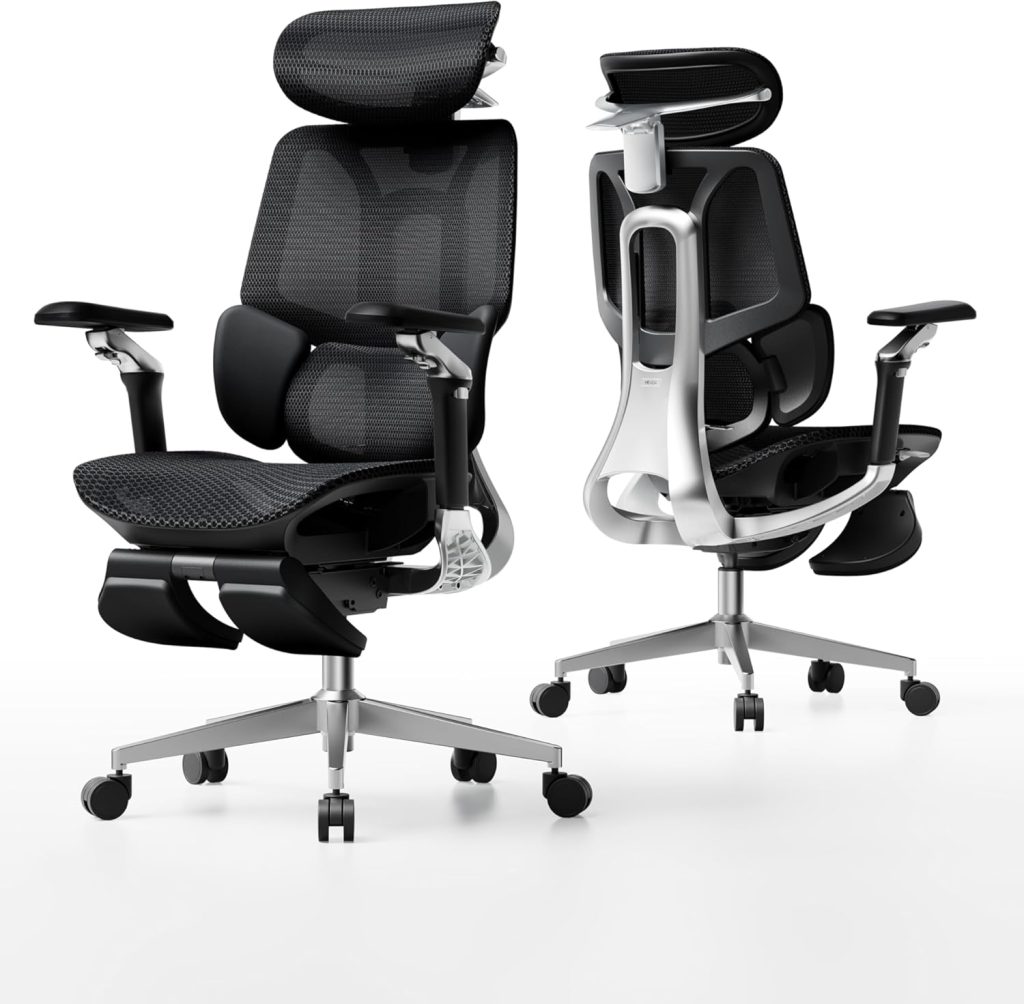
EXECUTIVE OFFICE CHAIRS
The best executive office chair for short people should fit your body rather than simply look large and luxurious. This guide focuses on seat height, seat depth, lumbar positioning, armrest fit, recline, and overall adjustability.
If you are shorter than average, prioritize a chair with a sufficiently low minimum seat height and a seat depth that does not force your knees away from the seat edge. Adjustable armrests and lumbar support are also important because a chair that is too large can make it difficult to maintain a comfortable working position.
Finding the best executive office chair for short people can be surprisingly difficult. Many executive-style chairs are designed with a tall back, deep seat, thick padding, and a relatively large overall frame. Those features can look impressive, but they do not automatically make a chair a good fit for a shorter user.
For shorter users, the most important measurements are often the ones that are easy to overlook: minimum seat height, usable seat depth, armrest range, and lumbar position. If the seat is too high, your feet may not rest comfortably on the floor. If the seat is too deep, the front edge can press behind your knees or encourage you to slide forward. If the armrests are too high, your shoulders may stay elevated while you work.
This guide therefore focuses on fit and adjustability rather than appearance alone. Some of the chairs below are traditional executive-style chairs, while others are premium ergonomic office chairs with a high-back profile. That distinction matters because the most adjustable chair is not always the chair with the most traditional executive appearance.
Best Executive Office Chairs for Short People at a Glance
| Chair | Why It Fits Shorter Users | Key Fit Features | Best For |
|---|---|---|---|
| HBADA E3 Pro 2026 | Low-end seat-height range and adjustable seat depth | 18.1–20.4″ seat height; 17.7–19.7″ seat depth | Adjustability and modern executive style |
| Branch Ergonomic Chair Pro | Designed for users starting around 5’2″ | Adjustable seat height, seat depth, 5D arms, two-way lumbar | Short-to-average users wanting maximum adjustment |
| Steelcase Leap | Extensive ergonomic adjustment and seat-depth control | Adjustable seat depth, seat height, arms, lumbar and recline | Long workdays and precise fit |
| Steelcase Series 2 | Adjustable seat depth with a relatively compact profile | Adjustable seat depth, 4D arms, adjustable lumbar on applicable versions | Professional executive-style workspace |
| HON Ignition 2.0 | Multiple configurations provide different seat-height and seat-depth ranges | Adjustable seat height, usable seat-depth options, adjustable arms | Office users looking for a practical alternative |
1. HBADA E3 Pro 2026
HBADA E3 Pro 2026
The HBADA E3 Pro is one of the more interesting choices for shorter users because its published specifications include a relatively low minimum seat height and adjustable seat depth.
| Seat height | 18.1–20.4 inches |
| Seat depth | 17.7–19.7 inches |
| Recommended height | 5’1″–6’5″ |
| Weight capacity | 330 lb |
| Recline | Up to 140° |
The combination of seat-depth adjustment, seat-height adjustment, backrest-height adjustment, and adjustable lumbar support makes this model worth considering if you are around 5’1″ to 5’4″. Its high-back design also gives it more of the visual presence associated with an executive office chair.
2. Branch Ergonomic Chair Pro
Branch Ergonomic Chair Pro
Branch lists the Ergonomic Chair Pro as suitable for users from 5’2″ to 6’2″. It provides seat-height and seat-depth adjustment, 5D armrests, and two-way adjustable lumbar support.
The important feature is not simply the chair’s overall height. The Pro lets users adjust seat height and depth independently, while the 5D arms provide more control over where the arm pads sit relative to the desk.
- Designed for users starting around 5’2″.
- Adjustable seat height and seat depth.
- Two-way adjustable lumbar support.
- 5D adjustable armrests.
- Optional headrest.
- 275 lb published support capacity.
One important distinction is that the Branch Ergonomic Chair Pro is an ergonomic office chair rather than a traditional padded executive chair. If your priority is body fit over a conventional executive aesthetic, that trade-off may be worthwhile.
3. Steelcase Leap
Steelcase Leap
The Steelcase Leap is not a traditional executive chair, but its extensive adjustment range makes it relevant to shorter users who want a premium office chair with a more substantial professional appearance.
Steelcase’s current Leap specifications include adjustable seat depth, fully adjustable arms, height-adjustable lumbar support, lower-back firmness control, pneumatic seat-height adjustment, and multiple recline settings.
For a shorter user, the adjustable seat depth is particularly important. Start with the seat positioned so your back can remain against the backrest without the front edge pressing into the area behind your knees.
If you spend most of the day at a desk, the Leap is worth considering even though it does not have the classic oversized executive-chair silhouette.
4. Steelcase Series 2
Steelcase Series 2
Series 2 has a slimmer profile than many traditional executive chairs while retaining a professional appearance. Its adjustable seat depth and 4D arms are useful when a shorter user needs to bring the working position closer to the desk.
- Adjustable seat depth.
- 4D adjustable arm support.
- Weight-activated recline response.
- Flexible back designed to support movement.
- Height-adjustable lumbar on applicable configurations.
Series 2 is particularly interesting if you want something that looks appropriate in a professional office but do not want an oversized executive chair that may be difficult to fit to a shorter body.
5. HON Ignition 2.0
HON Ignition 2.0
The HON Ignition 2.0 is another ergonomic office chair worth considering if you want to avoid the oversized proportions of many traditional executive chairs. HON offers multiple configurations with different seat-height and seat-depth specifications.
The key here is to check the exact configuration before ordering. HON’s published specifications show different seat-height and usable-seat-depth ranges across Ignition 2.0 configurations, so the model code and configuration matter.
Do not assume that every Ignition 2.0 configuration has the same dimensions. Verify the exact seat height and seat depth for the version you are purchasing.
What Makes an Executive Office Chair Good for Short People?
A shorter user does not necessarily need a small chair. What matters more is whether the chair can be adjusted so the seat, backrest, armrests, and lumbar support line up with your body.
1. A Low Enough Minimum Seat Height
The first measurement to check is the minimum seat height, not the maximum. Your goal is to sit with your feet supported and your knees in a comfortable position while maintaining contact with the backrest.
A chair that only works when the seat is raised may be a poor fit for someone with shorter legs. This is one reason a chair with a broad adjustment range can be more useful than a visually smaller chair with limited adjustment.
2. Adjustable Seat Depth
Seat depth is especially important for shorter users. A seat that is too deep can leave excessive space between your back and the backrest when you try to keep your feet positioned comfortably.
Ideally, you should be able to sit against the backrest while leaving some clearance between the front edge of the seat and the backs of your knees. The exact amount varies with body proportions, so use this as a fit check rather than a rigid measurement rule.
3. Adjustable Armrests
Executive chairs often have large fixed armrests. That can be a problem if the armrests are too high or too far apart for your shoulders.
Look for armrests that adjust vertically. Width, depth, and pivot adjustments can provide even more flexibility.
4. Lumbar Support That Can Move With You
A large backrest does not automatically provide good lumbar support. For shorter users, a lumbar pad positioned too high can miss the lower back entirely.
Height-adjustable lumbar support is therefore particularly useful. Depth adjustment can be valuable as well because it lets you control how prominently the support contacts your back.
5. A Backrest That Does Not Force an Awkward Posture
High-back executive chairs can provide a sense of support, but a very large backrest can also overwhelm a smaller frame. Look for a backrest that supports your upper back without forcing your shoulders or head into an unnatural position.
Executive Chair Fit Checklist for Short People
| Feature | Why It Matters | What to Check |
|---|---|---|
| Minimum seat height | Helps you keep your feet supported | Measure from the floor to the compressed seat surface |
| Seat depth | Prevents excessive pressure behind the knees | Prefer adjustable depth when possible |
| Armrest height | Helps keep shoulders relaxed | Check minimum and maximum arm height |
| Lumbar height | Allows support to align with your lower back | Height adjustment is preferable |
| Seat width | Affects how close you sit to the armrests | Check usable seat and armrest spacing |
| Recline | Provides posture changes during long work sessions | Look for controlled recline and tension adjustment |
What Chair Height Is Best for Someone 5’0″, 5’2″, or 5’4″?
There is no single seat-height setting that works for every person at a particular height because leg length, torso length, footwear, and desk height all affect chair fit.
5’0″–5’2″
Prioritize a low minimum seat height and short or adjustable seat depth. A footrest may help if the desk requires a higher chair position.
5’3″–5’4″
Seat-depth adjustment becomes particularly useful. Check armrest height and lumbar position rather than focusing only on overall chair height.
5’5″+
More standard office-chair dimensions may work, but individual proportions still matter. Adjustable depth remains useful for fine-tuning.
Traditional Executive Chair vs. Ergonomic Chair for Short People
| Feature | Traditional Executive Chair | Ergonomic Office Chair |
|---|---|---|
| Appearance | Usually large, padded, high-back | Usually lighter and more technical |
| Seat adjustment | Varies significantly by model | Usually more extensive |
| Seat depth | Often fixed | Often adjustable |
| Lumbar adjustment | Often limited | More likely to include height/depth adjustment |
| Short-user fit | Depends heavily on model | Often easier to fine-tune |
If appearance is your top priority, a traditional executive chair may still be the right choice. But if you are short and spend eight or more hours at your desk, a highly adjustable ergonomic chair can make it easier to achieve a proper fit.
How to Set Up an Executive Office Chair for a Short Person
- Lower the seat until your feet are comfortably supported. Avoid raising the chair simply because the desk feels high.
- Adjust seat depth. Sit fully back and check whether the front edge puts pressure behind your knees.
- Position the lumbar support. Move it vertically until it contacts the area where you need support.
- Set the armrests. Your shoulders should remain relaxed rather than elevated toward your ears.
- Adjust the desk if necessary. A chair cannot completely solve a desk that is too high for your seated position.
- Use a footrest when appropriate. If your feet cannot remain supported after achieving a comfortable desk height, a footrest can help bridge the difference.
Related Executive Office Chair Guides
Best Executive Office Chairs
Explore the complete Executive Chairs Hub.
Executive Chairs for Long Hours
Compare chairs designed for extended desk work.
Executive Chairs with Adjustable Lumbar
See different lumbar-support adjustment systems.
Executive Chairs for Tall People
Compare fit considerations for taller users.
Office Chairs for Lower Back Pain
Explore the lower-back support cluster.
Frequently Asked Questions
What is the best executive office chair for short people?
There is no single best chair for every shorter user. Models with adjustable seat height, adjustable seat depth, adjustable armrests, and movable lumbar support generally provide more opportunities to achieve a proper fit. Among the models covered here, HBADA E3 Pro, Branch Ergonomic Chair Pro, and Steelcase Leap offer particularly useful adjustment features.
What is the most important chair measurement for a short person?
Minimum seat height and seat depth are two of the most important measurements. A chair that is too high can make it difficult to keep your feet supported, while a seat that is too deep can place pressure behind your knees or encourage you to slide forward.
Is a high-back executive chair good for a short person?
It can be, but the height of the backrest alone does not determine fit. Check seat height, seat depth, lumbar position, armrest range, and headrest adjustment. A large chair with limited adjustment may fit a shorter user poorly.
Is a 17-inch seat depth good for a short person?
It can work for some users, but there is no universal ideal seat depth. Your leg length and the relationship between your back and knees matter more than a single number. Adjustable seat depth is generally more useful than choosing a chair solely by a published fixed measurement.
Should short people use a footrest with an office chair?
A footrest can be useful when the desk requires a chair height that leaves your feet unsupported. The goal is to maintain comfortable lower-body support without compromising your desk and arm position.
Are ergonomic chairs better than executive chairs for short people?
Not automatically. The important difference is adjustability. Many modern ergonomic chairs offer more seat-depth, armrest, and lumbar adjustments, while some executive chairs prioritize appearance and cushioning. Compare the actual fit specifications rather than the chair category alone.
Find the Right Executive Chair for Your Height
If you are short, do not choose an executive office chair based only on its appearance. Start with minimum seat height, seat depth, armrest range, and lumbar adjustment, then compare the chair with your own body measurements.
SitBetterLab may earn a commission when you purchase through qualifying links, including Amazon links. Product specifications can vary by model, configuration, and market. Always confirm the current manufacturer’s specifications before purchasing.