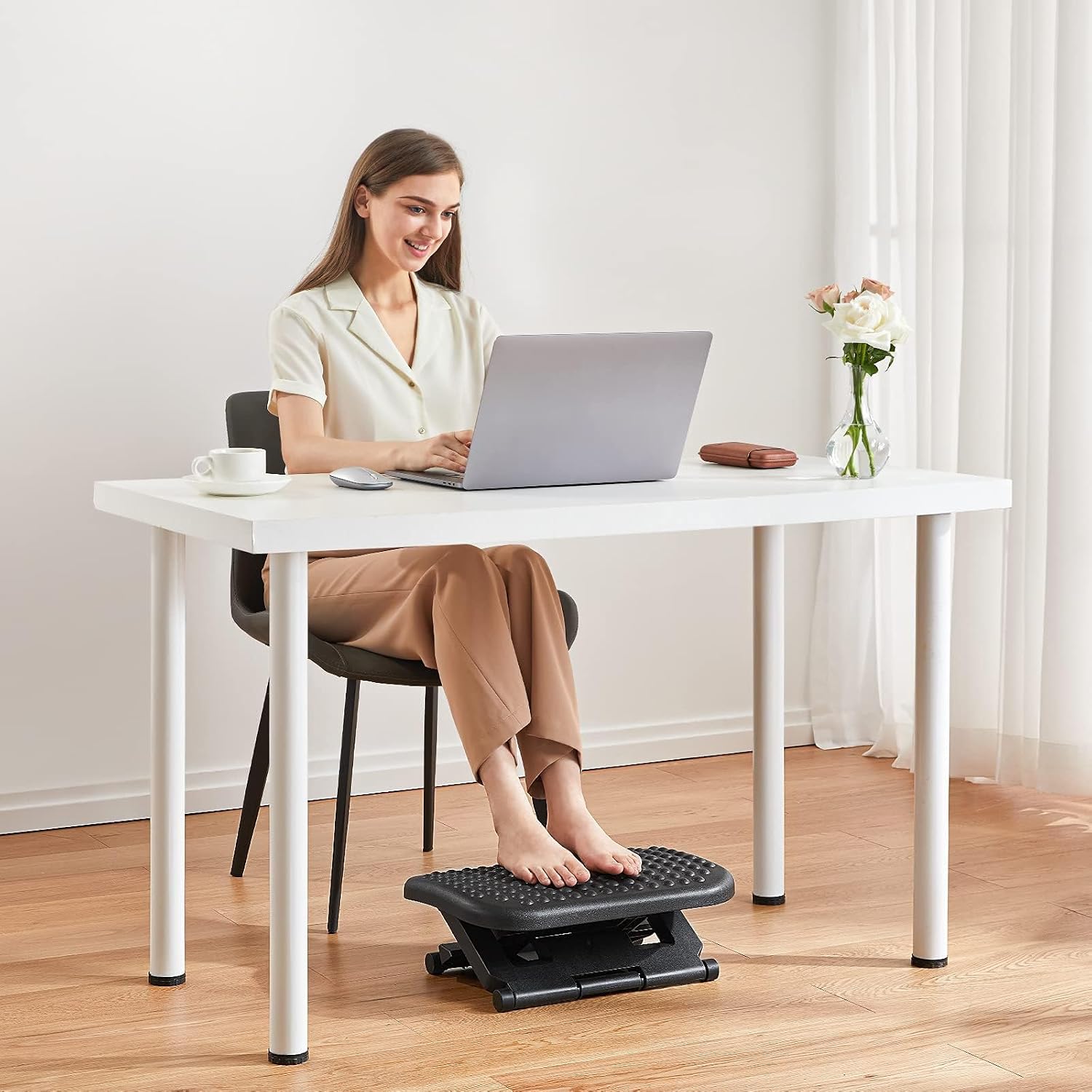
If you’re under about 5’4″, a standard desk setup often leaves your feet dangling or forces you to perch on the edge of your chair. That’s where the best footrest for short people makes a real difference. It’s not just a comfort accessory — it stops your thighs from pressing into the seat edge and helps your lower back stay relaxed.
Most generic footrests are built for average-height users, so their minimum height is still too tall for shorter legs. I’ve tested adjustable, rocking, and angled options to find what actually works when you need a lower platform and a more compact footprint.
📌 Why Short People Need a Specialized Footrest
Most generic footrests are designed around average-height desks and average-length legs. If you’re 5’3” or shorter — or simply have a shorter inseam — a standard footrest often places your feet too high. Many popular models start around 3.5 to 5 inches tall, but under a typical desk, shorter users usually need 2 to 4 inches of lift, depending on their chair height and seat depth.
When a footrest is too tall or too deep, a few things happen quickly:
- Dangling feet or ankles that hover above the support
- Thigh pressure from the seat edge digging into your hamstrings
- Lower back strain as your pelvis tilts and your spine loses its neutral curve
- Poor circulation in the legs, especially after long sitting sessions
The real goal is simple: both feet flat, knees close to 90 degrees, and thighs parallel to the floor. For short legs, that usually means a lower-profile footrest that sits closer to the chair base.
Once you hit that position, your lower back stops bracing and your hips can relax. That’s why I recommend angle-adjustable or low minimum-height footrests for petite users — not the tallest, thickest cushion you can find.
📌 Key Features to Look for in a Footrest for Short Stature
When you’re shopping for a footrest for a shorter frame, a few specific specs matter more than brand names or cloud-like padding. The goal is to let your feet rest flat at the right height, so your knees bend at roughly 90 degrees and your hips stay planted against the chair back. If the platform sits too tall or forces your legs forward, it actually defeats the purpose.
Here’s what I prioritize when evaluating footrests for shorter inseams:
- Low height range. Many standard footrests start around 4–5 inches off the floor, which is already too tall for some shorter users. Look for a minimum height of 2–3 inches, with adjustable positions up to about 6 inches. That range gives you room to dial in knee and hip alignment without overextending.
- Adjustable tilt angle. A fixed platform locks your ankles into one position. Tilt adjustment—typically 0 to 20 or 30 degrees—lets you rock the surface to match how you naturally sit. That gentle movement can reduce calf tightness on long desk days.
- Compact depth and width. Depth is the big one. A footrest that’s 15–18 inches deep pushes your feet away from the chair, which forces short legs to reach. I look for a depth around 10–14 inches. Width in the 15–18 inch range still gives you room to shift your stance without sprawling.
- Non-slip surface and stable base. A slick top surface means constant micro-adjustments with your feet. A textured or rubberized deck keeps shoes and socks from sliding. Underneath, a weighted base with rubber grips should stay put on both hard floors and low-pile carpet.
- Durable materials. Hollow, cheap plastic flexes and eventually cracks. Reinforced ABS plastic, powder-coated steel, or high-density foam all hold up well. Foam models feel softer underfoot, while plastic and metal platforms offer firmer, more predictable support over time.
🔍 Top 5 Best Footrests for Short People in 2026
I picked these five after checking the lowest height setting, how firmly the angle locks, and whether the base stays put on wood and carpet. short users benefit most from a footrest that starts low — ideally under 4.5 inches — so your knees don’t get pushed upward.
| Product | Height Range | Angle Adjustability | Stability | Price Range | Check Price |
|---|---|---|---|---|---|
| HUANUO Adjustable Footrest | 3.9″–5.5″ | 0°–20° locking | Wide, non-slip base | $25–$35 | Check Price → |
| Everlasting Comfort Memory Foam Footrest | Fixed ~4.7″ | No angle adjustment | Non-slip bottom | $30–$40 | Check Price → |
| ComfiLife Foot Rest | Fixed 3.9″ | No angle adjustment | Non-slip bottom | $20–$30 | Check Price → |
| Kensington SoleMate Footrest | 3.5″–5.5″ | 0°–12° locking | Stable locking base | $45–$60 | Check Price → |
| Humanscale FR300 Foot Rocker | Fixed ~4.5″ | Rocking 0°–10° | Non-skid strips | $100–$130 | Check Price → |
1. HUANUO Adjustable Footrest – Best Budget Adjustable Pick
The HUANUO Adjustable Footrest lowers to about 3.9 inches, short enough for most 5’0”–5’4” users to plant both feet flat. A knob locks the tilt angle anywhere from 0° to 20°, and the textured surface grips shoes. The wide base stays stable on both carpet and hard floors.
- Low 3.9″ minimum height
- Locking angle adjustment
- Stable, non-slip base
- Plastic platform feels less cushioned
- Adjustment knob can be stiff at first
2. Everlasting Comfort Memory Foam Footrest – Best Soft Foam Option
This memory foam footrest has a fixed height of roughly 4.7 inches and a contoured top that cradles your feet. It works well if your chair seat is around 16–18 inches high. The non-slip bottom keeps it from sliding, but there’s no angle adjustment.
- Plush memory foam comfort
- Machine washable cover
- Stays put on hard floors
- Fixed height may be too tall for very petite frames
- No angle adjustment
3. ComfiLife Foot Rest – Best Under $25 Foam Pick
The ComfiLife Foot Rest sits at a fixed 3.9-inch height, which is lower than many foam footrests and better suited to short legs. The dense memory foam resists flattening over time. A non-slip bottom keeps it stable, though it doesn’t adjust or rock.
- Low fixed height fits petite frames better
- Budget-friendly
- Dense foam holds its shape
- No height or angle adjustment
- Cover may show wear after heavy use
4. Kensington SoleMate Footrest – Best Locking Ergonomic Pick
The Kensington SoleMate adjusts from 3.5 to 5.5 inches, so shorter users can start quite low. The tilt angle locks at 0°, 6°, 9°, or 12°, giving a stable platform without wobble. The textured surface and locking base make it a solid mid-range choice.
- Lowest setting fits short legs well
- Multiple locked tilt positions
- Very stable base
- Plastic texture can feel hard under bare feet
- Price higher than basic foam options
5. Humanscale FR300 Foot Rocker – Best Premium Rocking Footrest
The Humanscale FR300 has a fixed height around 4.5 inches and a smooth rocking motion through about 10°. It’s built with non-skid strips for stability. However, the fixed height means it’s better for short users with chairs lowered enough to keep knees at a comfortable angle.
- Premium build quality
- Gentle rocking encourages movement
- Non-skid strips prevent sliding
- Expensive for a footrest
- No height adjustment; may not fit very low seating
⚡ Adjustable Height vs. Rocking Footrests: Which Is Better for Short Legs?
Rocking footrests feel great, but most are fixed at 3–5 inches tall. For a shorter frame, that height may not be enough to get your thighs parallel to the floor if your chair is raised to match a standard desk. You end up perching or tucking your feet, which defeats the purpose.
Adjustable-height platforms usually range from 4 to 14 inches. You can lock in the exact height that lets your feet rest flat and your knees bend at about 90 degrees. Many also add a tilt angle for gentle ankle movement without losing support.
Here’s a quick comparison to help you decide:
| Type | Height Range | Movement | Best For | Price Range |
|---|---|---|---|---|
| Fixed-height rocker | 3–5 in | Rocking/tilting | Low chairs, active sitting | $30–$50 |
| Adjustable-height platform | 4–14 in | Lockable tilt or static | Standard desks, short legs needing exact height | $40–$90 |
If you’re under about 5’3″, an adjustable-height footrest is the more versatile pick. A rocker can be a nice secondary option for low chairs or when you like to fidget, but it won’t fix a height mismatch between your chair and desk.
🔑 How to Choose the Right Footrest Height and Angle for Your Desk Setup
Sit in your chair with hips against the backrest and measure from the crease behind your knee to the floor. That number tells you where your knees should be supported. If your chair seat sits higher than that measurement, subtract: seat height minus knee-to-floor distance equals the footrest height you need. For example, a 19-inch seat and a 16-inch knee height mean you need a 3-inch footrest.
Then aim for the 90-degree knee and hip angle rule. Your knees should bend at roughly 90 degrees, with thighs parallel to the floor and feet fully supported. Your hips should also sit around 90 degrees. This keeps your spine neutral and takes pressure off the backs of your thighs. If your knees sit higher than your hips, lower the footrest or raise the chair slightly.
Angle comes next. Start with a flat platform, then tilt it 5 to 15 degrees toward you if your heels feel pinched or your Achilles tightens. The goal is to shift contact to the midfoot while keeping heels lightly planted. Avoid steep angles that force your toes upward — that can increase calf and Achilles strain.
Pairing tips for different chair seat heights:
- Standard desk chairs (17–20 inches): Most short users need 2–5 inches of lift. An adjustable-height rocker works well.
- Low-profile chairs (15–16 inches): A flat memory foam mat or 1–2 inch wedge may be enough.
- Drafting or bar-height chairs: Look for tall footrests with at least 8–12 inches of height range.
🔑 How to Set Up Your Footrest for Correct Ergonomics
Start by placing the footrest directly in front of your chair, centered with your hips. You shouldn’t have to twist or lean sideways to reach it. Slide it close enough that your knees stay bent around 90 degrees, but far enough that your calves don’t press hard against the edge.
- Set the height first. Adjust the footrest until your thighs are parallel to the floor and your feet rest fully on the surface — no dangling heels, no tiptoe pressure.
- Check the distance. Your feet should sit slightly forward of your knees, not tucked underneath the chair. This keeps blood flow normal and avoids cramping.
- Angle for movement. If the footrest rocks or tilts, set a gentle angle that lets you shift your feet without sliding forward. A slight recline can reduce calf fatigue.
For shorter legs, start with the minimum height and raise it gradually until your thighs feel supported — not lifted.
Then avoid these common mistakes:
- Too high: This pushes your knees above hip level and can increase pressure on the back of your thighs.
- Too far back: If the footrest sits under the chair, you’ll unconsciously perch on the edge of your seat.
- Unstable placement: Wobbly footrests force constant micro-adjustments. Choose one with non-slip feet or a weighted base.
You’ll know it’s set correctly when your lower back feels neutral and you’re not gripping the floor with your toes.
🔍 FAQ: Best Footrest for Short People
What is the ideal height for a footrest for a short person?
For most short users (5’0″ to 5’3″), a footrest that adjusts between 3 and 6 inches high works best. You want knees at roughly 90 degrees with feet resting flat. Start around 3-4 inches, then fine-tune up or down based on your chair height.
Can a footrest help reduce lower back pain for petite users?
It can. When feet dangle, the pelvis tilts forward, which increases lumbar curve pressure. A properly set footrest encourages neutral pelvis alignment, which may help reduce lower back strain during long sitting sessions. Many short users report less back fatigue within a week.
Are rocking footrests good for short legs?
They can work if the resting height sits under 5 inches. Look for gentle-arc rockers rather than tall units that force knees upward. A wide platform with a modest tilt range usually feels best for shorter legs.
What is the best material for a footrest for short users?
High-density memory foam wins for comfort and light pressure relief. Hard plastic or metal options are more durable and easier to clean. For petite users, a foam core with a non-slip base offers the best balance. Removable, washable covers are a practical bonus.
How do I know if my footrest is too high?
If your knees rise above hip level, or you feel pressure under the back of your thighs near the seat edge, it’s too high. Your feet should rest naturally without being pushed up. Lower the height until the pressure disappears.
Do I need a footrest if my feet dangle from my office chair?
Yes. Dangling feet cause constant thigh muscle tension, reduce circulation, and tilt the pelvis. A footrest provides a stable base so your legs can relax, which supports better posture throughout the workday.