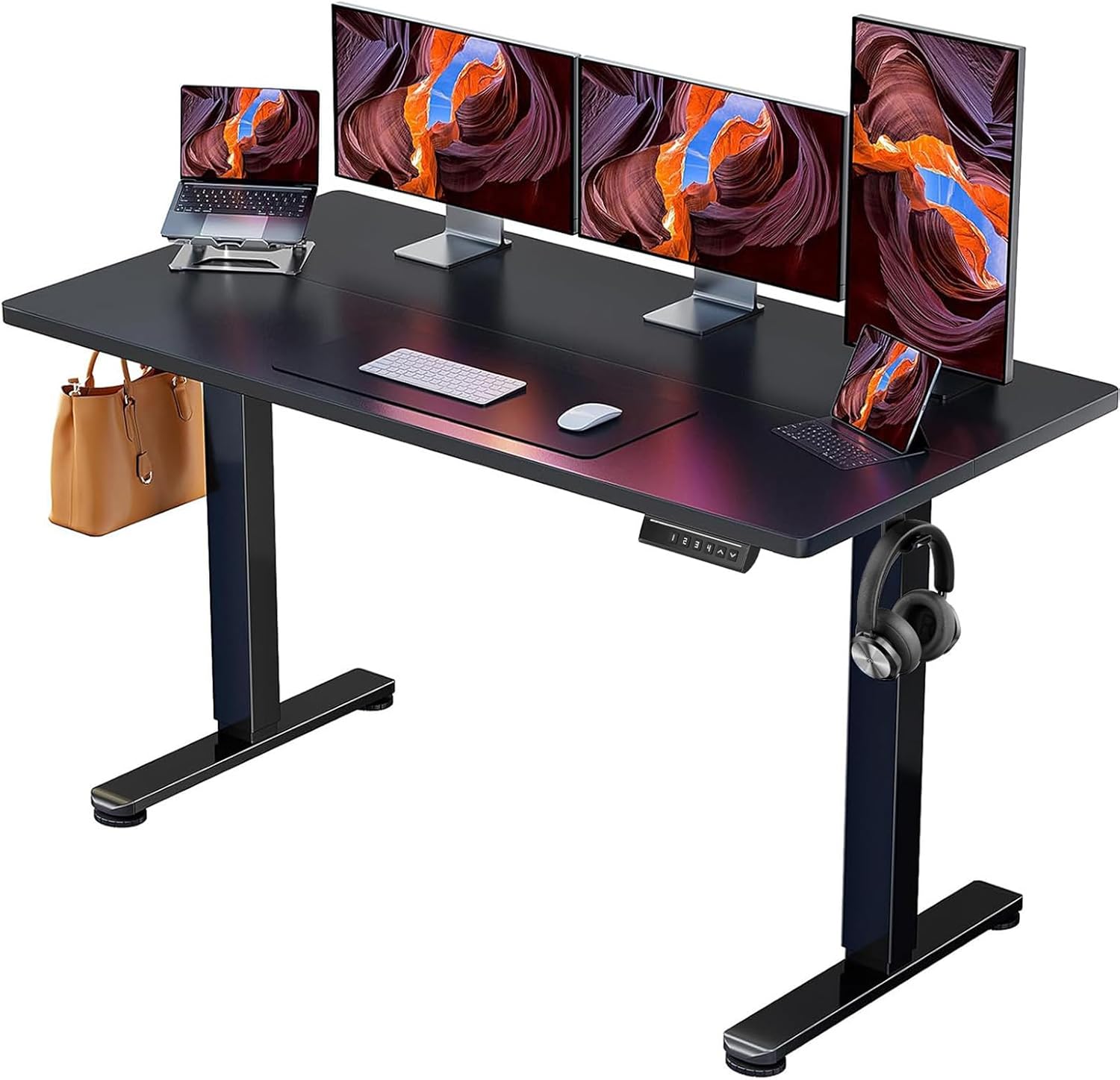
Most standing desks stop around 45–47 inches, which might work for average heights but leaves taller users hunching. If you’re 6’2″ or above, you need a standing desk for tall people that reaches 48–52 inches or more without wobbling at full extension.
I’ve looked closely at height range, stability at maximum setting, and desktop depth because those are the specs that actually matter for tall frames. A desk that stops at 45 inches can force your shoulders up, strain your neck, and make proper monitor placement impossible.
Let’s break down what to look for and which models get it right.
📌 Why Height Range Matters for Tall Users
Most standard fixed-height desks sit at 28–30 inches. If you’re over 6’2″, that’s simply too low for typing or mousing while standing. The result is a forward hunch, rolled shoulders, and extra strain through your neck and upper back.
Your ideal standing elbow height is the number that actually matters. For tall users, that usually means a desktop surface between 44 and 52+ inches, depending on your height, shoes, and whether you use a keyboard tray. A 6’4″ person in flat shoes often needs around 47–50 inches; add boots or an anti-fatigue mat and you may need more.
Working at a too-low desk doesn’t just feel awkward. Over time, it can contribute to:
- Neck pain from constantly looking down
- Lower back discomfort as you lean forward
- Shoulder tightness from elevated elbows or shrugged posture
That’s why maximum height—not minimum height—is the critical spec for tall buyers. Minimum height is easy to hit; maximum height is where many desks fall short. A desk that tops out at 45 inches might work for someone 6’0″, but not for you at 6’5″.
Look for extended-height frames that reach 48–52 inches without casters. Two-stage or three-stage legs usually get you there, even if you add a thick desktop. Avoid relying on casters or risers to make up the gap; they can reduce stability at full height.
📌 Key Features to Look for in a Tall-Friendly Standing Desk
For tall users, the difference between a desk that works and one that causes shoulder strain is usually maximum height range. Here’s exactly what I check before recommending a desk.
- Maximum height: 48 inches minimum, 50–52 inches ideal. If you’re 6’4” or taller, a desk that tops out at 46 inches will force you to hunch while standing. Look for at least 48 inches of travel. Better yet, choose one that reaches 50–52 inches so you can wear shoes or use an anti-fatigue mat.
- Electric with programmable presets. Manual cranks work, but switching between sitting and standing multiple times a day gets old quickly. An electric dual-motor desk with 2–4 memory presets lets you save your exact sitting and standing heights.
- Steel frame with crossbar or four-leg design. At maximum height, cheap two-leg desks wobble side-to-side. A steel crossbar or four-leg frame adds rigidity and keeps monitors from shaking while you type.
- Desktop depth of at least 30 inches. Tall users often have longer arms and need extra monitor distance. A 30-inch depth keeps your screen at a comfortable focal point without crowding your keyboard.
- Weight capacity of 200–250 lbs or more. Multiple monitors, a heavy monitor arm, and accessories add up. A higher capacity prevents motor strain and sagging over time.
- Anti-collision and child lock. When a desk rises to tall heights, it can hit shelves or pinch a hand. Anti-collision stops movement on resistance, and a child lock prevents accidental adjustments.
You don’t need every premium extra, but those six features cover the bases for tall users.
📌 Top 5 Standing Desks for Tall People in 2026
I narrowed this list using three criteria: a max height of at least 48 inches, proven stability at full extension, and consistent praise from tall users over 6’2″. All five desks below clear the bar, but they serve different budgets and setups.
1. Uplift V2 4-Leg Standing Desk – Best Premium Stability
The four-leg frame makes this one of the most stable desks at its 50.9-inch max height. The 535 lb lift capacity comfortably handles heavy multi-monitor arms and tall users without wobble.
- Rock-solid at max height
- Huge 535 lb capacity
- 15-year warranty
- Expensive
- Heavy, assembly takes time
2. Deskhaus Apex Pro – Heavy-Duty Tall Build
Built like a commercial workbench, the Apex Pro hits around 52 inches max height with a four-leg frame and 600 lb capacity. It’s ideal for tall users with heavy equipment or standing desk converters.
- Exceptional stability at tall heights
- 600 lb capacity
- USA-made frame
- High price
- Longer lead time
3. Flexispot E7 Pro – Best Value Tall Desk
The E7 Pro’s three-stage frame reaches 50.6 inches and includes a crossbar for extra side-to-side stability. It’s the most affordable way to get a tall max height without feeling flimsy.
- Great price-to-height ratio
- Crossbar reduces wobble
- Dual motor lift
- Basic desktop options
- Crossbar reduces leg room
4. Vari Electric Standing Desk 60×30 – Reliable Brand
Vari desks have a max height just under 50 inches and feel sturdy thanks to a thick steel frame and quiet dual motors. Tall users consistently report minimal wobble at standing height.
- Dependable build quality
- Stable at 50 inches
- Fast shipping
- Basic keypad controller
- Fewer size options
5. ApexDesk Elite Series – Affordable Dual Motor
The Elite Series reaches 49 inches and lifts 225 lb with dual motors. It’s a solid pick for tall users under 6’4″ who want a full-size desk without spending $800+.
- Affordable
- 49-inch max height
- Good lift capacity
- Slight wobble for very tall users
- Limited frame finishes
⚡ Standing Desk Comparison: Tall-Friendly Height Ranges and Specs
⚡ Standing Desk Comparison: Tall-Friendly Height Ranges and Specs
| Model | Max Height (incl. 1″ desktop) | Min Height | Lift Capacity | Desktop Size | Stability | Price Range | Check Price |
|---|---|---|---|---|---|---|---|
| Uplift V2 4-Leg | 50.9″ | 24.3″ | 535 lb | 42″x24″–80″x30″ | Excellent | $1,200–$2,000+ | Check Price → |
| Uplift V2 2-Leg | 50.9″ | 25.3″ | 355 lb | 42″x24″–80″x30″ | Very good | $599–$1,100 | Check Price → |
| Fully Jarvis | 50.5″ | 24.5″ | 350 lb | 30″x24″–72″x30″ | Very good | $550–$1,000 | Check Price → |
| Vari Electric Standing Desk | 50.5″ | 25″ | 200 lb | 48″x30″ / 60″x30″ | Very good | $695–$995 | Check Price → |
| Flexispot E7 Pro | 48.4″ | 22.8″ | 355 lb | 48″x24″–80″x30″ | Good | $499–$900 | Check Price → |
Always confirm whether the listed max height includes the desktop. Some brands quote only the frame columns, so adding a 1″ thick top changes your actual standing height. For tall users, that inch can make or break comfort.
Two-stage columns often top out around 46–48″, which can feel short for anyone over 6’2″. Three-stage columns extend higher and offer better seated-to-standing range, making them the safer pick for tall builds.
Weight capacity matters too. A tall user’s setup with dual monitors, monitor arms, and accessories can easily pass 150 lb. I’d look for at least 300 lb lift capacity if you run a heavy rig.
Quick picks: go four-leg Uplift V2 if you want zero wobble. Choose Uplift V2 2-leg or Fully Jarvis for the tall-friendly value sweet spot. The Flexispot E7 Pro is my budget two-leg recommendation when you pair it with a crossbar.
📌 Stability and Build Quality at Maximum Height
When a desk rises past 48 inches, even small flex in the columns gets exaggerated. Tall users feel this more because they’re forced to work at the top of the frame’s range, where leverage is worst. Side-to-side wobble and monitor shake become obvious during fast typing.
Stability depends on a few specific design choices:
- Four legs vs. two: four-leg frames resist both lateral and front-to-back rocking much better.
- Column diameter and crossbar: thicker columns plus a fixed crossbar reduce twist.
- Foot width and desk weight: wider, heavier bases lower the center of gravity.
At full height, I grip the front edge and push side-to-side, then front-to-back. Many two-leg desks show 1–2 inches of monitor movement while typing at 50 inches. That’s livable for email but distracting for coding or video calls.
If you need maximum stiffness, step up to a four-leg desk like the Uplift V2 4-Leg or Deskhaus Apex Pro. Both use four columns and a heavy crossbar assembly. Expect to pay more and spend extra time on assembly, but the tall-height difference is clear. Check price on Amazon → Check price on Amazon →
On a budget two-leg frame, add a stabilizer crossbar or a sturdier monitor mount before replacing the whole desk. It won’t match four-leg rigidity, but it can cut visible wobble enough to make full-height work comfortable.
📌 Ergonomic Setup Tips for Tall Users
Getting your desk height right matters even more when you’re 6’2″ or taller. A desk set too low forces you to hunch, and one set too high makes you shrug. I aim for elbows at roughly 90–100 degrees while standing, with wrists neutral over the keyboard.
- Monitor height: Raise the display so the top third of the screen sits at eye level. Tall users often outgrow the stock monitor stand, so a monitor arm with 15–20 inches of vertical lift is worth it.
- Keyboard and mouse: Keep both at the same height and close to your body. Reaching forward pulls on the shoulders, which gets worse if your desk is already near its top setting.
- Floor support: Use an anti-fatigue mat and supportive footwear. A quality mat reduces leg fatigue, and firm shoes beat going barefoot on hardwood for all-day standing.
- Sit-stand switching: Program sitting and standing presets so you actually alternate. A tall-friendly chair with a high seat height and a footrest helps when you sit, so your knees don’t dangle.
- Cable management: Bundle cables with enough slack so the desk can move through its full range without snagging or creating a trip hazard.
❓ FAQ: Standing Desks for Tall People
What minimum desk height do I need if I’m 6’5”?
For most 6’5” users, you’ll want a desk that reaches at least 48 inches, ideally 50–52 inches from floor to desktop. Your standing elbow height shifts with footwear, arm position, and whether you use an anti-fatigue mat. I’d look for a frame with a max height of 51 inches or higher.
Are standing desks stable at maximum height?
Quality steel frames, especially four-leg or crossbar models, stay stable at full extension. Budget two-leg desks can develop side-to-side wobble when fully raised. Check owner reviews from tall buyers to see how the frame behaves at 48 inches or higher.
Can I use a standing desk converter instead of a full desk?
You can, but most converters have limited lift range and often won’t reach a tall user’s standing elbow height. If you’re over 6’2”, a full extended-height desk is usually the better choice.
What is the best budget standing desk for tall people?
The Flexispot E7 Pro or similar three-stage desks with a max height near 50 inches and a crossbar offer solid value. They balance height range, stability, and price better than most two-stage budget frames.
Do casters add height or cause instability?
Locking casters can add 1–2 inches of height, which helps very tall users. Choose a stable frame and always lock the casters while working. Unlocked casters can make wobble worse at full height.
How much weight capacity do I need?
Aim for at least 200–250 lbs if you run multiple monitors, arms, and accessories. Four-leg desks often hold 300 lbs or more, which gives you extra headroom for heavier setups.
1 thought on “Best Standing Desks for Tall People (2026 Buying Guide)”