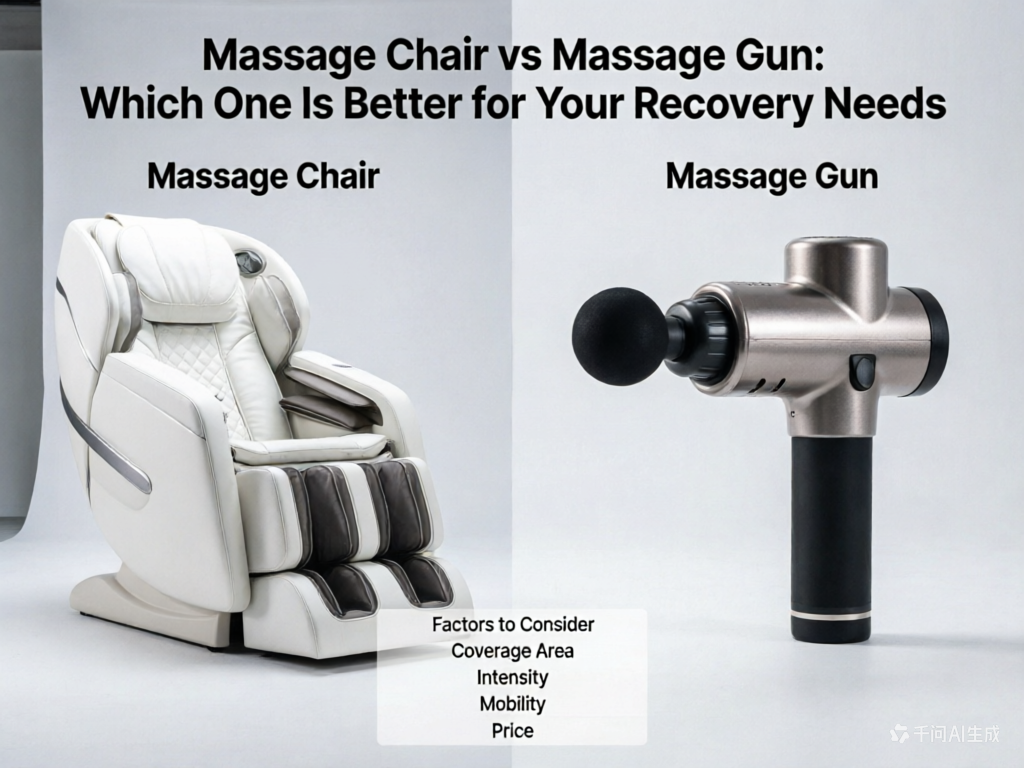
Massage chairs and massage guns are both designed to provide at-home muscle relief, but they are built for very different experiences. A massage chair is a large, hands-free device designed to massage multiple areas while you sit or recline. A massage gun is a handheld percussion device designed for targeted work on individual muscle groups.
If you’re deciding between a massage chair vs massage gun, the better fit depends less on which device is universally “better” and more on where you want to use it, how much space you have, how much you want to spend, and whether you prefer targeted or whole-body massage.
Massage Chair vs Massage Gun at a Glance
| Feature | Massage Chair | Massage Gun |
|---|---|---|
| Coverage | Multiple body areas, depending on the chair design | One targeted area at a time |
| Operation | Mostly hands-free | You hold and guide the device |
| Portability | Low | High |
| Targeting | Broad coverage along the chair’s roller and airbag zones | Precise targeting of individual muscles |
| Heat | Available on many models | Usually not a core feature |
| Space required | Dedicated floor space | Very little storage space |
| Upfront cost | Generally much higher | Generally much lower |
| Typical use case | Whole-body relaxation and regular home use | Targeted muscle work and portability |
How a Massage Chair Works
A massage chair combines a powered recliner with mechanical massage components. Depending on the model, these can include rollers, airbags, heat, foot rollers, recline functions, and body-scanning systems.
Roller Massage
The roller mechanism is one of the biggest differences between massage-chair models. Rollers travel along a predefined track and may provide movements such as kneading, tapping, rolling, or other programmed patterns.
Some chairs use an S-Track, while others extend farther under the body using an L-Track or SL-Track. The exact coverage varies by model, so track terminology should be treated as a design feature rather than a guarantee that every part of the body will receive the same amount of massage.
Airbag Compression
Many full-size massage chairs include airbags around areas such as the shoulders, arms, hips, calves, and feet. These airbags inflate and deflate to create a compression sensation.
Airbags are different from rollers: they are primarily about compression and surrounding-body coverage, rather than the focused mechanical movement of a roller.
Heat
Heat is another common feature, particularly around the lower back. Heat can make a massage session feel more comfortable for some users, but the exact heating area, temperature, and controls vary significantly between models.
Reclining and Zero-Gravity Positions
Some massage chairs offer zero-gravity-inspired reclining positions. These positions place the body in a more reclined posture and can change how your weight is distributed against the chair.
It is better to think of zero gravity as a reclining and positioning feature rather than assuming a specific percentage of spinal pressure reduction. The actual sensation depends on the chair, the user, and the position selected.
How a Massage Gun Works
A massage gun, also called a percussion massager, is a handheld device that repeatedly moves a massage head against soft tissue.
Percussion
The motor rapidly moves the attachment head back and forth. You then guide the device over the muscle you want to target.
Massage guns are particularly useful when you want to focus on a specific area instead of receiving a general massage across the body.
Amplitude and Speed
Massage guns are often marketed using specifications such as speed levels, amplitude, and stall force. These numbers can be useful when comparing models, but they should not automatically be interpreted as measurements of therapeutic effectiveness.
A longer amplitude can create a different physical sensation, while speed controls affect how rapidly the attachment moves. The most useful setting is usually the one that feels comfortable and controllable for the particular muscle being treated.
Massage Attachments
Many massage guns include several attachment heads. Common shapes include ball, flat, bullet, and fork-style attachments.
Rather than assuming one attachment is universally better, consider the muscle area, pressure preference, and manufacturer’s instructions for each attachment.
Massage Chair vs Massage Gun: The Biggest Differences
1. Whole-Body Coverage vs Targeted Massage
This is probably the most important difference.
A massage chair is designed to provide massage across multiple areas during the same session. Depending on the model, that may include the back, shoulders, hips, arms, calves, and feet.
A massage gun is much more targeted. You choose the muscle and manually move the device over it.
2. Hands-Free Use
A massage chair requires relatively little active effort. Once you select a program and adjust the settings, you can sit back while the chair operates.
A massage gun requires you to hold, position, and move the device yourself. This is an advantage when precise targeting matters, but it also makes the experience more active.
3. Portability
Massage guns are much easier to move between locations. They can generally be stored in a drawer, backpack, gym bag, or travel case.
Massage chairs are large pieces of furniture. Weight, dimensions, delivery requirements, and the chair’s required clearance all need to be considered before purchase.
4. Space Requirements
A massage gun needs very little storage space.
A massage chair needs enough room for the chair itself as well as sufficient clearance for its reclining mechanism. Some models are designed to move forward as they recline, while others require more rear clearance.
If you live in an apartment, have a small bedroom, or are setting up a compact home office, check the manufacturer’s chair dimensions and required wall clearance before buying.
5. Control and Targeting
Massage guns provide direct control over the exact area being treated. You can move from one muscle to another and adjust pressure immediately.
Massage chairs provide a more programmed experience. You select a mode, intensity, or body area, and the chair follows its programmed massage pattern.
This makes the two devices fundamentally different rather than simply different versions of the same product.
Which Is Better for Back Massage?
For back massage, the answer depends on what you mean by “better.”
A massage chair can reach large portions of the back without requiring you to hold a device. A suitable roller track may cover the neck, upper back, lower back, and potentially extend toward the glutes or thighs depending on the design.
A massage gun provides more precise control but is difficult to use on your own mid-back and lower back. You may not be able to comfortably reach every area without assistance.
For someone who wants hands-free back coverage, a massage chair is generally the more practical format. For someone who wants to target an accessible muscle area precisely, a massage gun can be more convenient.
Which Is Better for Neck and Shoulder Tension?
Both devices can be relevant, but they are used differently.
A massage gun can be useful for accessible muscles around the shoulders and upper back when used carefully. It should not simply be pressed against the neck or other bony areas.
Massage chairs can provide programmed shoulder and upper-back massage without requiring the user to hold a device.
There is also some direct research involving massage chairs and neck/shoulder pain. A 2023 randomized controlled trial studied 60 office workers, with 58 completing the six-week follow-up. The experimental group received the same basic physical treatments as the control group plus 20 minutes of a specific massage-chair neck mode twice per week. The researchers reported significant improvements in the study’s pain and neck-disability measures, along with an increase in pressure pain threshold. The study was specifically about office workers with neck and shoulder pain, so its findings should not be generalized to every type of chronic pain or every massage chair.
For more information about this particular use case, see our guide to massage chairs for office workers with neck pain.
Which Is Better for Exercise and Recovery?
Massage guns are particularly convenient around exercise because they can be carried to the gym and used on selected muscle groups.
They may help with perceived muscle tightness and short-term range-of-motion changes, but it is important not to treat a massage gun as a guaranteed performance enhancer. Evidence on performance effects is mixed, and a recent small crossover study in trained athletes found that massage-gun use during a warm-up did not consistently improve performance compared with a dynamic warm-up alone.
A massage chair can be more convenient after exercise when the goal is simply to sit down and relax multiple areas of the body. However, the appropriate choice depends on the user’s comfort, the chair’s settings, and the type of exercise-related soreness involved.
Massage Chair vs Massage Gun for Chronic Pain
This is where you should be particularly careful with product comparisons.
Chronic pain is not one condition. It can have many different causes, and a massage device that feels helpful for muscle tension may not be appropriate for every underlying problem.
A massage chair or massage gun should therefore be considered a comfort and recovery tool, rather than a replacement for diagnosis or treatment of an underlying medical condition.
The available massage-chair research is also narrower than some product pages suggest. For example, the randomized trial discussed above involved office workers with neck and shoulder pain rather than people with every form of chronic back pain, arthritis, fibromyalgia, or sciatica.
If you have persistent, severe, unexplained, or worsening pain, the more important question is identifying the cause rather than choosing the stronger massage device.
Massage Chair vs Massage Gun: Cost and Value
A massage gun generally has a much lower upfront cost than a full-size massage chair.
That difference matters because the two products also serve different roles. A massage gun is a relatively small personal device. A massage chair is a substantial piece of furniture with a mechanical system, motorized recline, rollers, airbags, and other components depending on the model.
| Cost Consideration | Massage Chair | Massage Gun |
|---|---|---|
| Initial purchase | Higher | Lower |
| Space cost | Requires dedicated space | Minimal |
| Portability | Low | High |
| Maintenance | More components to maintain | Generally simpler |
| Best value when… | You will regularly use whole-body massage features | You mainly need targeted and portable massage |
Instead of calculating a universal “cost per session,” it is more useful to compare the type of use you expect over several years. A more expensive chair may make sense for someone who uses whole-body programs frequently, while a massage gun may provide better practical value for someone who only needs occasional targeted muscle work.
Which One Takes More Effort to Use?
Massage Chair
- Select a massage program.
- Adjust intensity or body areas if available.
- Recline and let the chair operate.
- Remain aware of how the massage feels and stop if it causes discomfort.
Massage Gun
- Select an appropriate attachment.
- Start at a comfortable intensity.
- Keep the attachment on muscle rather than directly over bone.
- Guide the device over the selected area.
- Avoid applying excessive pressure.
Cleveland Clinic’s guidance for massage guns emphasizes starting at a low intensity, moving slowly, avoiding bony areas, and limiting time on individual muscle groups rather than continuously applying strong pressure.
Massage Gun Safety: What to Avoid
A massage gun should be used on appropriate soft-tissue areas rather than treated as a general-purpose device that can be applied anywhere on the body.
- Avoid direct contact with bones and joints.
- Do not aggressively press the device into a painful area.
- Start with a lower intensity when trying a new muscle or attachment.
- Stop if you experience sharp pain, numbness, unusual tingling, or significant discomfort.
- Follow the manufacturer’s instructions for the specific device.
If you have an underlying medical condition, are recovering from an injury, or have concerns about whether percussion massage is appropriate, consult your healthcare professional before use.
Massage Chair Safety: What to Consider
Massage chairs are consumer wellness devices, but their mechanical pressure and reclining functions mean that they are not appropriate for everyone.
Extra caution is appropriate for people with conditions involving blood clots, osteoporosis, certain implanted medical devices, recent surgery, acute injuries, or other medical concerns. Cleveland Clinic similarly recommends discussing massage therapy with a healthcare provider in several of these situations.
- Read the manufacturer’s contraindications before your first use.
- Start with a lower intensity if you are unfamiliar with the chair.
- Use the chair’s recommended session settings.
- Stop if the massage causes pain rather than comfortable pressure.
- Do not assume that a stronger massage is automatically more effective.
Who Should Choose a Massage Gun?
A massage gun may fit your needs if you:
- Want to target specific muscle groups.
- Exercise regularly and want a portable recovery tool.
- Travel frequently.
- Have limited living space.
- Want direct control over pressure and location.
- Prefer a lower-cost entry point.
- Want something that can easily be stored in a drawer or gym bag.
Who Should Choose a Massage Chair?
A massage chair may fit your needs if you:
- Want massage across multiple body areas.
- Prefer a hands-free experience.
- Regularly experience general muscle tension after sitting or working.
- Have enough room for a dedicated chair.
- Want features such as rollers, airbags, heat, and reclining positions.
- Plan to make massage part of a regular home relaxation routine.
- Prefer sitting back rather than manually controlling a handheld device.
Can You Own Both?
Yes. In fact, the biggest advantage of owning both is that they solve different practical problems.
| Situation | More Practical Tool | Reason |
|---|---|---|
| Target one tight muscle | Massage gun | Precise manual targeting |
| Massage several body areas | Massage chair | Broader programmed coverage |
| Travel | Massage gun | Portable and easy to store |
| Hands-free evening routine | Massage chair | Requires little active effort |
| Small apartment | Massage gun | Minimal space requirements |
| Whole-body home massage | Massage chair | Designed for multi-area massage |
Massage Chair vs Massage Gun: How to Decide
Use these questions before buying either device:
- Where do you want to use it? Home only, office, gym, or while traveling?
- Do you need targeted or broad coverage? A massage gun is more precise, while a chair covers more areas automatically.
- How much space do you have? A chair needs dedicated floor space; a gun does not.
- How much active effort do you want? A chair is mostly hands-free, while a gun requires active positioning.
- What is your budget? Massage guns generally have a much lower entry cost.
- What features matter? For chairs, consider roller type, track design, airbags, heat, foot massage, body scanning, recline, and fit.
- How often will you realistically use it? The most useful device is the one that fits naturally into your routine.
Massage Chair vs Massage Gun FAQs
Is a massage chair better than a massage gun?
Neither device is universally better. A massage chair is designed for broad, hands-free massage across multiple body areas, while a massage gun is designed for targeted percussion massage. Your space, budget, target areas, and preferred experience should determine the better fit.
Is a massage gun better for deep tissue massage?
A massage gun provides more direct control over a specific muscle and can create a strong percussion sensation. However, specifications such as amplitude should not automatically be interpreted as proof that one device provides better therapeutic results.
Can a massage gun replace a massage chair?
It can replace some functions, but not the entire experience. A massage gun can provide targeted massage, while a massage chair can provide broader coverage, reclining, airbags, and other integrated features that a handheld device does not provide.
Can a massage chair replace a massage gun?
Not completely. A massage chair is convenient for broad coverage, but it cannot provide the same level of manual targeting that a handheld percussion device offers.
Which is better for back pain?
It depends on the cause and location of the pain. A massage chair can provide broader back coverage without requiring you to reach the area yourself. A massage gun is more suitable for accessible muscle areas where targeted percussion is appropriate. Neither should be treated as a substitute for medical evaluation when pain is persistent, severe, unexplained, or worsening.
Can I use a massage gun every day?
Usage depends on the device, the body area, and how your body responds. Follow the manufacturer’s instructions and avoid repeatedly applying aggressive pressure to the same area. Starting with lower intensity is a sensible approach when trying a new device or muscle group.
Are massage chairs good for relaxation?
Relaxation is one of the main reasons people choose massage chairs. Reclining, rollers, airbags, heat, and hands-free operation can create a more spa-like experience than a handheld massage gun. The experience varies substantially between models, however.
Which one is better for travel?
A massage gun is considerably more practical for travel because it is compact and portable. A full-size massage chair is designed for a fixed location.
Should I buy a massage chair or a massage gun first?
If portability, low cost, and targeted massage are your main priorities, a massage gun may be the more practical starting point. If you have enough space and specifically want hands-free, multi-area massage at home, a massage chair may better match your intended use.
Final Thoughts: Massage Chair vs Massage Gun
Massage chairs and massage guns are better viewed as different tools rather than direct substitutes.
- Choose a massage gun when portability, targeted muscle work, and lower upfront cost matter most.
- Choose a massage chair when hands-free operation and broader multi-area massage are your priorities.
- Consider both if you want a portable targeted tool as well as a dedicated home massage setup.
The right choice ultimately comes down to your primary use case, available space, budget, target body areas, and preferred level of control. Rather than choosing based on claims about which device is universally more effective, compare the features that actually match how you plan to use it.
Related Massage Chair Guides
- Massage Chairs Hub — Explore our massage-chair buying guides, comparisons, and reviews.
- Massage Chair Features Checklist — Understand rollers, tracks, airbags, heat, body scanning, and other features.
- Best Massage Chair for Chronic Pain — Compare features to consider when shopping for a massage chair for chronic pain.
- Best Massage Chair for Heavy Person — What to check for weight capacity, fit, and chair dimensions.
- Best Massage Chair for Small Spaces — Compare space-saving designs and clearance considerations.
- Are Massage Chairs Worth It? — Evaluate the cost, features, and practical value of owning a massage chair.
- How Much Should You Spend on a Massage Chair? — Understand massage-chair pricing and which features typically affect cost.