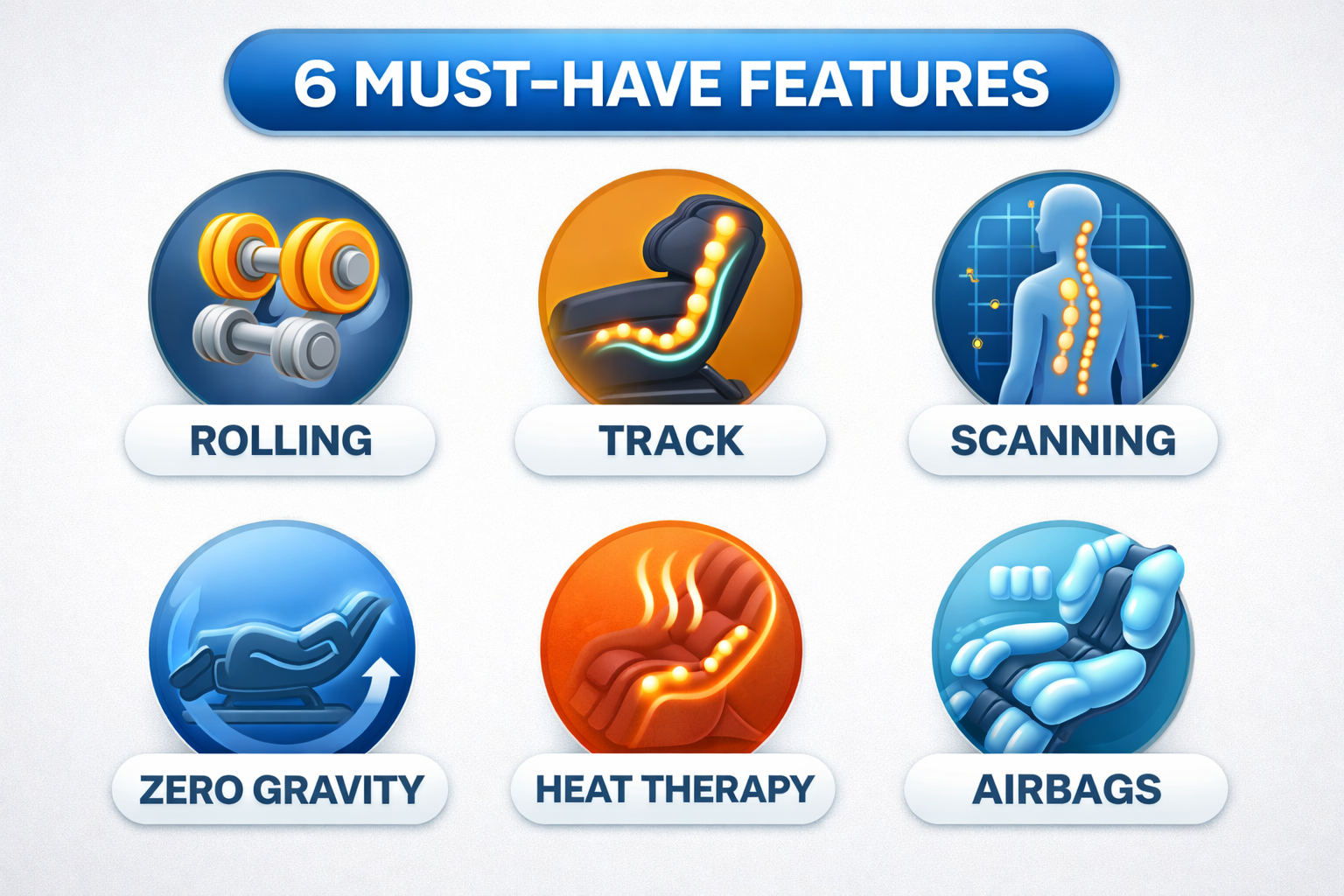
Massage chairs can come with dozens of features, from 3D and 4D rollers to body scanning, zero-gravity recline, heat, airbags, foot rollers, Bluetooth, and voice control. This guide explains what each feature actually does, which specifications deserve attention, and which extras may not be worth paying more for.
Shopping for a massage chair can be confusing because manufacturers often use different names for similar technologies. Terms such as 3D rollers, 4D rollers, S-Track, L-Track, SL-Track, body scan, zero gravity, air compression, and heat therapy can sound technical without telling you whether a feature will actually matter to you.
The goal of this guide is to make those specifications easier to compare. Instead of judging a chair by the number of features on the box, focus on the features that change how the chair fits and how the massage feels.
Massage Chair Features at a Glance
| Feature | What It Affects | Who Should Prioritize It | What to Check |
|---|---|---|---|
| Roller System | Massage movement and depth | Most buyers | 2D, 3D or 4D; intensity adjustment |
| Track Type | Massage coverage | People wanting lower-body coverage | S-Track, L-Track or SL-Track |
| Body Scanning | Roller positioning | Multiple users or unusual body proportions | What the system actually detects |
| Zero-Gravity Recline | Positioning and comfort | People who enjoy reclined massage | Recline angles and wall clearance |
| Heat | Warmth and comfort | People who prefer warmth during massage | Location, temperature control and coverage |
| Air Compression | Compression of arms, shoulders and legs | People who enjoy compression massage | Coverage and intensity adjustment |
| Foot Rollers | Foot massage | People who frequently want foot massage | Roller design, foot-size range and intensity |
| Stretch Programs | Movement and assisted stretching | People who enjoy stretching programs | Program type and intensity control |
| Space-Saving Design | Room placement | Apartments and smaller rooms | Required wall clearance |
| Bluetooth / Voice Control | Convenience and entertainment | Users who specifically want these functions | Whether the feature works reliably |
1. Roller Technology: 2D vs 3D vs 4D
The roller system is one of the most important specifications to understand because it affects how the massage mechanism moves against your back.
2D Massage Rollers
A traditional 2D system generally moves the rollers along the programmed track while maintaining a relatively fixed distance from the body. These systems can still provide a useful massage, particularly for buyers who prefer simpler operation or a lower price.
3D Massage Rollers
A 3D system adds another dimension of movement, allowing the rollers to move farther toward or away from the body. This can provide more control over massage intensity and pressure.
- Useful for people who want adjustable massage depth
- Look for multiple intensity settings
- Check whether depth can be adjusted during manual programs
4D Massage Rollers
4D is generally used to describe systems that add changes in roller speed, rhythm, or movement patterns in addition to three-dimensional positioning. The exact implementation varies by manufacturer, so the label alone does not tell you how the massage will feel.
Read our detailed comparison:
3D vs 4D Massage Chairs: What’s the Difference?
2. Massage Track Type: S-Track, L-Track and SL-Track
The track determines the path followed by the massage rollers. Understanding the track is particularly important if you want massage coverage beyond the upper and middle back.
S-Track
An S-Track follows the natural curves of the spine and generally focuses on the back. It is a common design and can be appropriate for buyers who mainly want back and shoulder massage.
L-Track
An L-Track extends the roller path farther below the lower back, typically toward the glute or upper-thigh area. The exact coverage varies by chair.
SL-Track
An SL-Track combines the curved path of an S-Track with the extended coverage associated with an L-Track. This can be useful if you want a longer massage path rather than concentrating primarily on the back.
| Track | Typical Coverage | Best Consideration |
|---|---|---|
| S-Track | Primarily back | Back and shoulder massage |
| L-Track | Back plus lower-body extension | Buyers wanting extended coverage |
| SL-Track | Curved back path plus extended coverage | Whole-body massage coverage |
For a deeper explanation, see:
L-Track vs S-Track Massage Chairs.
3. Body Scanning: What Does It Actually Do?
Body scanning is designed to help position the massage rollers according to the user’s body. Depending on the chair, sensors may identify areas such as shoulder position or body dimensions before a massage program begins.
This can be particularly useful when several people share the chair or when your height and proportions differ significantly from the chair’s typical target range.
What to Check
- Does the chair detect shoulder position?
- Can the user adjust roller position manually?
- Does the chair support different user profiles?
- What height range does the manufacturer recommend?
- Can the massage position be fine-tuned after scanning?
4. Zero-Gravity Recline
Zero-gravity is a reclined seating position designed to distribute the body differently across the chair. Massage chairs may offer one or more zero-gravity positions, but the exact angle and mechanism vary between models.
For many users, the main advantage is simply comfort and positioning during a reclined massage. Reclining can also change the way the body contacts the rollers.
What to Check
- How many recline positions are available?
- Can you use the massage programs while reclined?
- How much wall clearance is required?
- Does the chair use a wall-hugging mechanism?
- Can you easily return to an upright position?
Don’t buy a chair solely because it uses the phrase “zero gravity.” Compare the actual recline range and the space required in your room.
5. Heat Therapy
Heat is a common massage-chair feature and is generally intended to provide warmth during the massage. Many models concentrate heat around the lumbar area, while some offer additional heated areas.
If you enjoy warm massage sessions, heat can be a worthwhile comfort feature. However, the presence of “heat” does not tell you how warm the chair gets or how much of the body is heated.
What to Check
- Where is the heat located?
- Can the heat be turned on and off independently?
- Is the temperature adjustable?
- Does the chair offer multiple heat zones?
- Are there manufacturer warnings or usage limitations?
6. Air Compression and Airbags
Airbags use inflation and deflation to provide compression around areas such as the shoulders, arms, hips, calves, or feet. They provide a different sensation from mechanical rollers.
Instead of counting the total number of airbags, look at where the airbags are located and whether their intensity can be adjusted.
Useful Airbag Areas
- Shoulders: useful for users who enjoy shoulder compression
- Arms: adds upper-body compression
- Hips: may provide additional lower-body compression
- Calves: useful for people who enjoy leg compression
- Feet: commonly combined with foot massage functions
7. Foot and Calf Massage
Foot and calf massage can make a noticeable difference for buyers who specifically enjoy lower-leg and foot massage. Depending on the model, the footwell may use airbags, mechanical rollers, or a combination of both.
What to Look For
- Rotating or mechanical foot rollers
- Calf air compression
- Adjustable compression intensity
- Foot-length compatibility
- Easy-to-clean foot liners
If you frequently want foot massage, this feature may be more important to you than extras such as Bluetooth speakers or decorative lighting.
8. Auto Massage Programs
Auto programs are preset combinations of roller movements, air compression, recline positions, heat, and other settings. They can make a massage chair easier to use because you don’t have to configure every setting manually.
However, a large number of programs is not necessarily a sign of a better chair.
Instead of asking whether a chair has 10, 20, or 30 programs, check whether it offers programs that match how you actually plan to use the chair.
- Relaxation
- Full-body massage
- Back-focused massage
- Stretching programs
- Gentle programs
- Programs with adjustable intensity
9. Stretch Programs
Some massage chairs combine reclining, leg movement, airbags, and roller positioning to create assisted stretching programs.
These programs can be enjoyable for people who like a more active massage experience, but they should not be treated as a substitute for physical therapy or medical treatment.
If you have a known injury, spinal condition, recent surgery, or persistent pain, follow the relevant medical advice before using aggressive stretching functions.
10. Space-Saving and Wall-Hugging Design
A massage chair can take up more room than its footprint suggests because many models move backward when reclining.
This makes required wall clearance an important specification for apartments, bedrooms, offices, and other smaller spaces.
Before Buying, Measure:
- The available floor area
- Distance from the wall
- Doorway width
- Hallway clearance
- Ceiling height if the chair has a large reclining movement
- Power outlet location
A wall-hugging design can reduce the space needed behind the chair, but always use the manufacturer’s published clearance requirement rather than assuming that every “space-saving” model needs only a few inches.
If space is your main concern, see our guide:
Best Massage Chairs for Small Spaces.
11. Bluetooth Speakers and Audio
Bluetooth audio can make a massage session more enjoyable if you like listening to music, podcasts, or guided relaxation programs.
But it should usually be treated as a convenience feature rather than a reason to choose one chair over another.
If two chairs have similar massage systems, don’t automatically choose one simply because it has better-looking speakers. Prioritize the features that affect the massage itself.
12. Voice Control
Some premium massage chairs offer voice commands for starting programs, changing settings, or controlling the chair.
Voice control can be convenient, but it is not essential. The usefulness depends on how accurately the system recognizes commands and how many functions it actually supports.
If you are considering a voice-controlled model, test the feature before buying whenever possible.
13. LED Lighting and “Chromotherapy”
Some massage chairs include colored LED lighting as part of the relaxation experience. If you enjoy the appearance, there is nothing wrong with treating it as an entertainment or ambience feature.
However, buyers should not assume that decorative colored lights provide medical benefits simply because a manufacturer uses terms such as “chromotherapy” or “healing.”
Which Massage Chair Features Matter Most?
There is no single feature list that is right for every buyer. A better approach is to prioritize features according to your actual use case.
| Your Priority | Features to Investigate | Also Check |
|---|---|---|
| Deep or adjustable massage | 3D or 4D rollers | Intensity settings and roller adjustment |
| Longer massage coverage | L-Track or SL-Track | Actual roller travel |
| Better fit | Body scanning | Height range and manual adjustment |
| Warm massage | Heat | Heat location and controls |
| Leg and foot massage | Foot rollers and calf airbags | Foot-size range |
| Small room | Wall-hugging design | Actual clearance measurements |
| Simple operation | Auto programs and clear remote | Screen readability and controls |
Massage Chair Features by Budget
Price ranges can vary significantly by brand, retailer, promotions, and model generation, so there is no reliable feature cutoff at a specific dollar amount. Instead of assuming that every chair under or over a particular price has the same specifications, compare the actual feature list of each model.
Entry-Level Massage Chairs
Lower-priced chairs may use simpler roller systems, shorter massage tracks, fewer adjustment options, and fewer automatic programs. Some still offer heat, air compression, or reclining functions.
For a lower-budget purchase, focus on the features that cannot easily be added later: body fit, roller coverage, track length, basic comfort, and overall build quality.
Mid-Range Massage Chairs
Mid-range models often provide a broader combination of roller adjustment, longer tracks, body scanning, heat, air compression, foot massage, and automatic programs.
This category can be attractive for buyers who want a wider feature set without paying primarily for premium finishes or additional convenience functions.
Premium Massage Chairs
Premium models may add more advanced roller systems, additional adjustment options, multiple massage programs, improved materials, more sophisticated control systems, and additional comfort features.
Higher price does not automatically mean a better fit. A premium chair that does not suit your height, body size, massage preferences, or available room may be less useful than a simpler model that fits those requirements.
Massage Chair Features for Different Users
For Tall Users
Tall users should pay particular attention to the manufacturer’s recommended height range, roller travel, shoulder position, footrest length, and calf compartment dimensions.
A longer track alone does not guarantee a good fit. Check the actual user-size specifications before buying.
For Short Users
Shorter users may have the opposite problem: the rollers or shoulder airbags may not line up correctly if the chair is designed around a taller user.
Look for adjustable shoulder detection, manual roller positioning, and a published minimum user height.
For People Who Want Foot Massage
Prioritize foot rollers, calf compression, foot-size compatibility, and adjustable intensity. If foot massage is one of your main reasons for buying a chair, don’t treat the footwell as a secondary specification.
For Office Workers
If you spend long periods sitting at a desk, comfort, easy controls, adjustable massage intensity, and a suitable back massage area may matter more than advanced entertainment features.
See:
Best Massage Office Chairs.
For Athletes and Active Users
Active users may prefer stronger massage settings, leg and foot coverage, adjustable intensity, and stretching programs. However, a massage chair should not be treated as a replacement for appropriate recovery, rehabilitation, or medical care.
Massage Chair Features for Back or Neck Discomfort
Many shoppers search for massage chairs because they experience occasional back, neck, or shoulder discomfort. Feature selection can help determine whether a chair provides the type of massage you prefer, but a massage chair should not be presented as a treatment for an underlying medical condition.
For Lower Back Comfort
- Consider an L-Track or SL-Track if you want extended lower-body coverage
- Look for adjustable roller intensity
- Consider lumbar heat if you enjoy warmth
- Check whether the chair can target the lower back
For Neck and Shoulder Massage
- Check shoulder detection and roller positioning
- Look for adjustable intensity
- Consider shoulder airbags if you enjoy compression
- Check the manufacturer’s recommended height range
For Persistent or Severe Pain
If pain is persistent, severe, worsening, or associated with other symptoms, a massage chair should not be used as a substitute for professional evaluation. People with known medical conditions should also review manufacturer warnings and seek appropriate medical advice before using strong massage or stretching programs.
For a broader discussion of the evidence and limitations, see:
Do Massage Chairs Help With Back Pain?
Massage Chair Features You Should Not Overpay For
Optional features are not necessarily “bad.” The important question is whether you personally value them enough to justify the additional cost.
Bluetooth Audio
Useful if you enjoy listening to music during massage, but not a substitute for a better massage mechanism.
Voice Control
Convenient for some users, but generally less important than a clear and responsive physical or touchscreen controller.
Decorative LED Lighting
Primarily an ambience feature. Don’t assume that colored lighting provides a medical benefit simply because it is marketed using wellness terminology.
Large Numbers of Auto Programs
Twenty programs are not necessarily better than eight well-designed programs. Look at what the programs actually change and whether intensity can be adjusted.
Massage Chair Buying Checklist
Core Features
- □ Check the roller type: 2D, 3D, or 4D
- □ Check the track type and actual massage coverage
- □ Check the recommended user height and weight
- □ Check whether body scanning is included
- □ Check roller intensity and positioning controls
- □ Check whether heat is included and where it is located
- □ Check airbag locations and intensity controls
- □ Check foot and calf massage features
Fit and Room
- □ Measure the room before ordering
- □ Check required wall clearance
- □ Measure doorways and delivery access
- □ Confirm the chair’s recommended user-size range
- □ Check whether the footrest fits your foot length
Ownership
- □ Read the manufacturer’s warranty
- □ Check what parts and labor are covered
- □ Review the return policy
- □ Check delivery and assembly requirements
- □ Confirm where service is available
Optional Features
- □ Bluetooth audio
- □ Voice control
- □ LED lighting
- □ Additional auto programs
- □ App control
Frequently Asked Questions
What features should I look for in a massage chair?
Start with the features that affect the massage itself: roller system, track type, body fit, intensity adjustment, massage coverage, and comfort. Then consider heat, air compression, foot rollers, stretching programs, and other extras according to your preferences.
Is 3D or 4D better for a massage chair?
4D systems generally add more variation in roller speed or movement compared with 3D systems, but the exact implementation varies between manufacturers. A well-designed 3D chair can be a better fit for one buyer than a 4D model. Compare the actual controls and massage programs rather than relying on the label alone.
Is an SL-Track better than an S-Track?
Not automatically. An SL-Track generally provides a longer massage path that can extend below the lower back, while an S-Track focuses more on the back. If you want extended lower-body coverage, an SL-Track may be worth considering.
Do I need body scanning?
Not necessarily. Body scanning can help position the massage mechanism, especially for multiple users or people whose proportions differ from the chair’s target range. However, manual adjustment and a suitable user-size range are also important.
Is zero gravity necessary?
No. Zero gravity is primarily a positioning and comfort feature. It can be useful if you enjoy reclined massage, but it should not be treated as a requirement for every massage chair.
Is heat necessary in a massage chair?
No. Heat is an optional comfort feature. If you enjoy warm massage sessions, lumbar or multi-zone heat may be worth prioritizing. Check the manufacturer’s instructions before using heat, especially if you have a condition that affects heat sensitivity.
How many airbags should a massage chair have?
There is no universal number that defines a good massage chair. Instead of counting airbags, compare their location, coverage, pressure adjustment, and how they work with the rest of the massage system.
Are Bluetooth speakers and voice control worth paying extra for?
They can be useful convenience features, but they generally should not take priority over roller quality, track coverage, body fit, intensity control, warranty, and room requirements.
What should I check before buying a massage chair online?
Check the manufacturer’s specifications for user height and weight, roller system, track type, recline clearance, footrest size, heat, airbag coverage, warranty, return policy, delivery requirements, and service availability.
Related Massage Chair Guides
- 3D vs 4D Massage Chairs: What’s the Difference?
- L-Track vs S-Track Massage Chairs
- How Much Should You Spend on a Massage Chair?
- Best Massage Chairs Under $1,500
- Best Massage Chairs Under $2,000
- Best Massage Chairs for Small Spaces
- Best Massage Office Chairs
- Do Massage Chairs Help With Back Pain?
- How Long Should You Use a Massage Chair Each Day?
Final Takeaway
The best massage chair is not necessarily the model with the longest feature list. The better approach is to identify the features that affect massage movement, coverage, body fit, comfort, and everyday usability, then compare models based on those specifications.
For most shoppers, start by checking the roller system, track design, user-size range, massage intensity controls, recline system, heat, air compression, and foot massage. After those basics are covered, consider optional features such as stretching programs, Bluetooth audio, voice control, app integration, and decorative lighting.
Most importantly, don’t judge a massage chair by marketing terminology alone. Check the manufacturer’s actual specifications, measure your available space, confirm the chair fits your body, and review the warranty and return policy before making a purchase.
Quick checklist:
Roller system → Track → Body fit → Intensity control → Recline → Heat → Air compression → Foot massage → Room clearance → Warranty → Return policy.
That’s a much better starting point than simply choosing the chair with the largest number of advertised features.
2 thoughts on “Massage Chair Features: What to Look For Before Buying”